



For decades, the far side of the Moon was an unreachable mystery for astronomy. This half of the satellite, always invisible from Earth, has just revealed a surprising fact: its interior is up to 100 °C cooler than the side we see.
The discovery, published in Nature Geoscience, was made possible by the analysis of samples collected in 2023 by a Chinese mission in a crater on the hidden hemisphere. It is the first direct record demonstrating a deep thermal asymmetry between both sides of the natural satellite.
The fragments, about 2.8 billion years old, were studied using advanced chemical and thermal techniques. The results show that the lava on the far side solidified at about 1,100 °C, while that of the visible hemisphere did so at higher temperatures, revealing that the thermal differences are not limited to the surface but extend to the lunar core.
This asymmetry confirms that the Moon is a body of two contrasting halves: one warmer, smooth, and covered with basaltic seas, and the other colder, mountainous, and ancient.
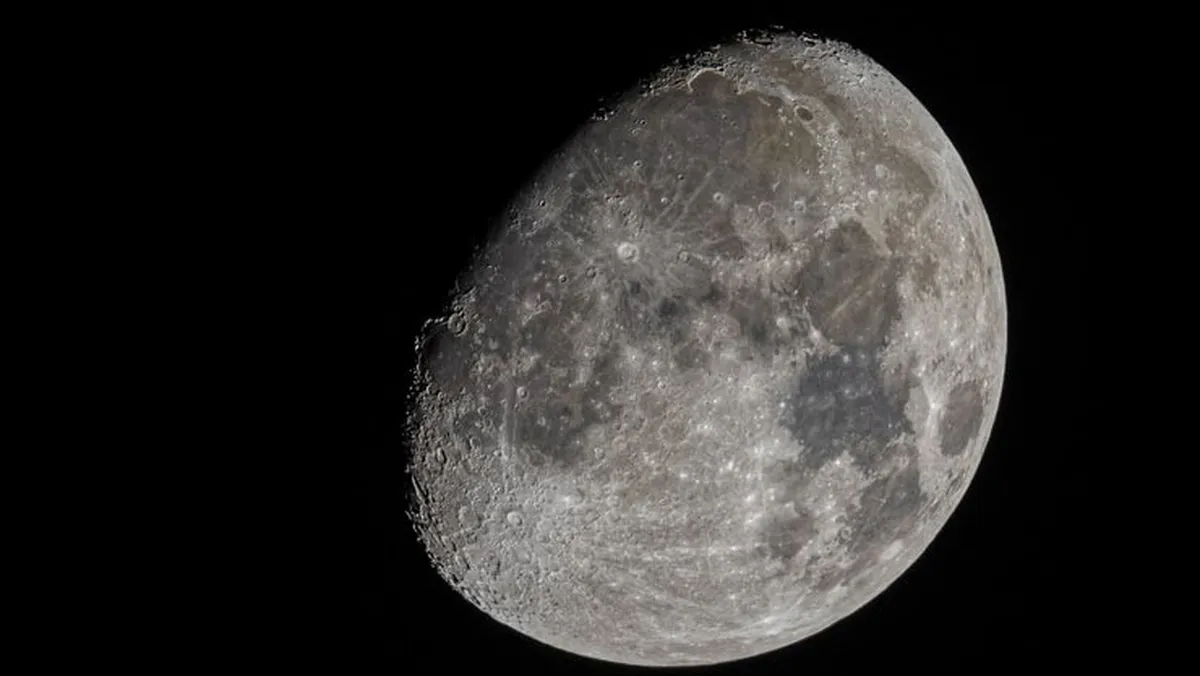
Why the far side is cooler
The origin of this difference could lie in the uneven distribution of radioactive elements such as uranium, thorium, and potassium, which generate heat as they decay. Analyses indicate that these elements are less abundant on the far side, which would explain the lower temperatures and the lack of recent volcanic activity.
In turn, the thicker and more mountainous crust of the hidden hemisphere may have acted as a thermal barrier, limiting the release of internal heat. This geological imbalance would have influenced the evolution of both sides, creating completely different landscapes and affecting the formation of the lunar seas visible from Earth.
Some models suggest that this contrast originated after a colossal impact in the satellite’s first millions of years, which redistributed radioactive materials towards the visible side. Others suggest that Earth’s gravitation also contributed to keeping the side facing the planet warmer.
The purpose of these investigations
Studies like this not only expand knowledge about the origin and evolution of the Moon but also offer essential clues to understanding the thermal history of other planetary bodies. Analyzing their internal differences allows for the reconstruction of cooling processes, impacts, and volcanic activity that marked the beginning of the Solar System.
Moreover, these findings are vital for future space exploration. Understanding the thermal and chemical variations of the lunar subsurface can facilitate the selection of safe areas to establish bases, obtain resources, and plan long-duration manned missions.
They also provide valuable data for studying Earth’s geodynamics, as the Moon retains in its structure traces of the impact that gave rise to the Earth-Moon system. Each new sample analyzed helps decipher how planets evolved and what factors determine their habitability.
Overall, the research reaffirms that, even after half a century of lunar exploration, the satellite still holds secrets that can change the view of the cosmos and the planet itself.



