



Researchers from the Federal University of Roraima (UFRR) confirmed the discovery of fossil footprints of dinosaurs in the Brazilian Amazon. It is the first recorded evidence in this region, a fact that expands the paleontological map of South America, representing an unprecedented discovery.
The marks, preserved in rock formations in the municipality of Bonfim, show a wide variety of sizes and shapes. This detail suggests the coexistence of different dinosaur species, both large herbivores and small carnivores.
The discovery began in 2011 when a sandstone outcrop caught the attention of a local geologist. Fourteen years later, multidisciplinary studies confirmed that the footprints belong to animals that inhabited the area about 110 million years ago, during the Cretaceous period.
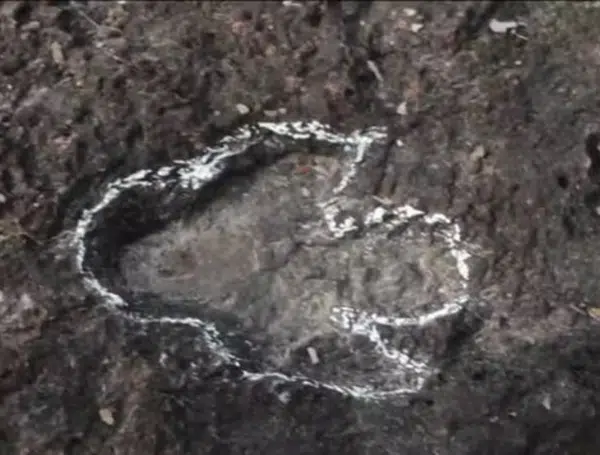
A journey to the past of prehistoric Amazonia with an unprecedented discovery
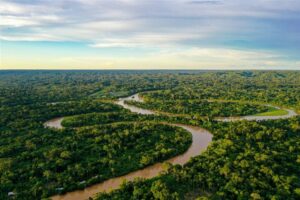
The fossils were found in an area now occupied by rural and indigenous communities, near the border with Guyana. Back then, the landscape was very different: a humid plain, crossed by rivers and surrounded by primitive vegetation.
The investigations revealed at least six different genera of dinosaurs, although specialists estimate that the diversity could have been much greater. This makes northern Roraima a new key point for understanding how these species were distributed in the ancient supercontinent Gondwana.
In addition to the footprints, fossilized plant remains were found. These plant fragments demonstrate the coexistence of conifers, ferns, and flowering plants, species that shaped the origins of the current lavrado biome, characteristic of the northern Amazon.
Characteristics and origin of the Amazonian giants
The footprints belong to different types of dinosaurs, including possible sauropods and theropods. The former were enormous long-necked herbivores, while the latter were agile predators of smaller size.
The set of fossil tracks indicates that these animals moved through floodplains, where the wet mud preserved their footprints with remarkable precision. The warm and humid climate of the time favored the formation of sediment layers that protect them today.
This finding confirms that the Amazon was not only a refuge of modern biodiversity but also a territory where ecosystems dominated by prehistoric giants thrived, adapted to an environment of transition between primitive forests and savannas.
Scientific and ecological contributions of the discovery
The study provides key information to understand how tropical ecosystems in South America evolved. By linking the footprints with plant remains, scientists can reconstruct the environmental dynamics that existed millions of years before the emergence of the current rainforest.
This type of evidence allows tracing a line of ecological continuity: the ancient Cretaceous landscapes gave rise to systems that, transformed, still sustain a high biodiversity. The research also provides data on the movement of tectonic plates and the climatic changes that shaped the Amazon region.
At an institutional level, the project promotes the creation of a geological park in Roraima. Its objective is to preserve the site, encourage scientific tourism, and promote environmental education. Thus, the discovery becomes not only a paleontological achievement but also an opportunity to strengthen ecological awareness and the link between science and community.



