



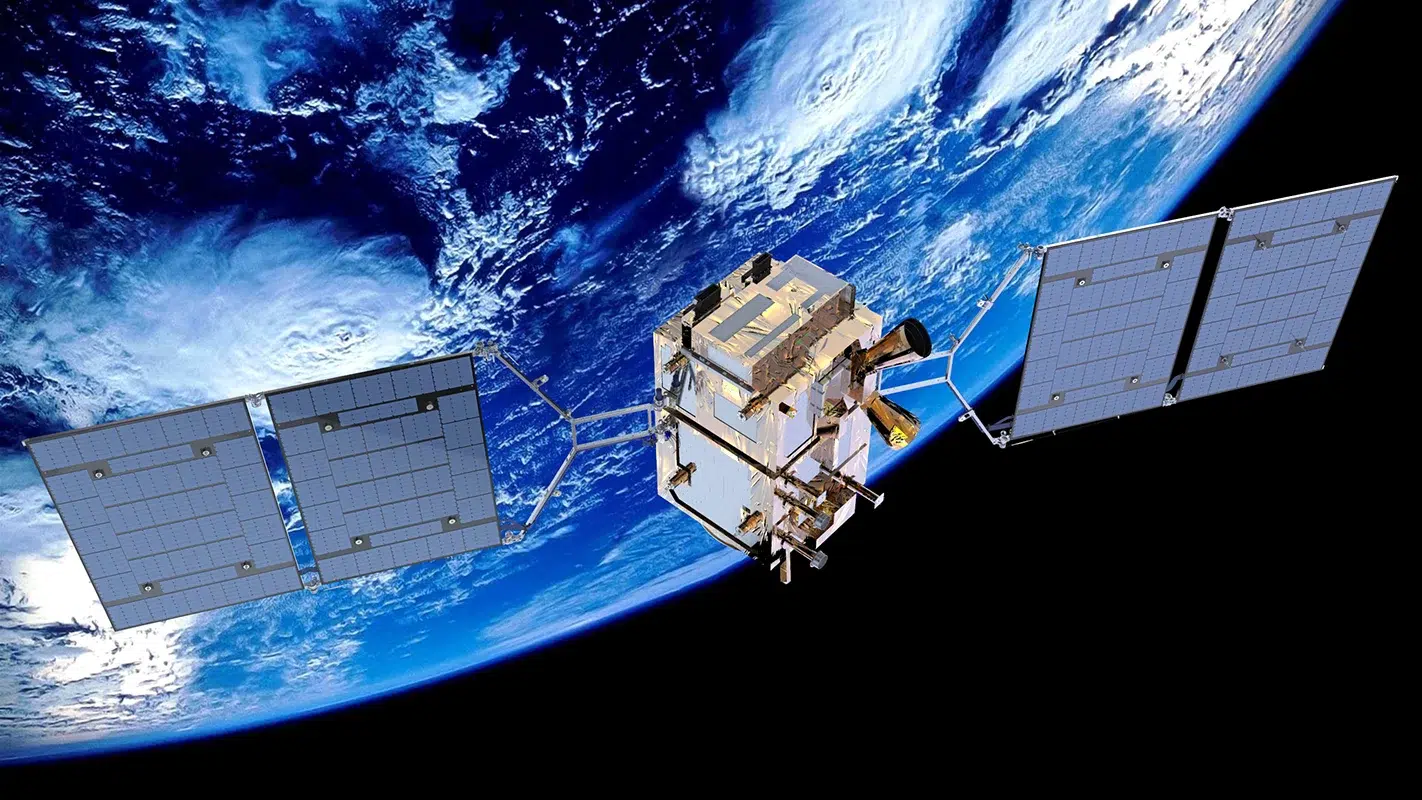
The CONAE announced that the SABIA-Mar satellite is in the final phase of integration and testing at the INVAP facilities in Bariloche. Its launch into orbit is scheduled for April or May 2027 and it will provide unprecedented tools to monitor the sea, study natural resources, and strengthen the country’s environmental management.
Conceived as an Earth observation mission focused on the sea and coastal areas, SABIA-Mar will allow obtaining proprietary information on ocean productivity, fishing resources, water quality, and the presence of vessels.
Technology and objectives of the SABIA-Mar satellite
The satellite will measure the color of the sea using high-precision optical cameras, which will allow calculating the concentration of chlorophyll-a, a key indicator of the ocean’s primary productivity and the presence of phytoplankton. This data will serve to:
- Monitor fishing resources.
- Support aquaculture and navigation.
- Detect harmful algal blooms (red tide).
- Analyze water quality in coasts, estuaries, lakes, and rivers.
- Study vegetation, land use, and water resources.
Additionally, it will feature a high-sensitivity camera to detect lights over the sea at night, allowing the location of vessels and analysis of fishing activity patterns.
Maritime surveillance and control of illegal fishing
SABIA-Mar will be able to identify vessels transmitting their position via the Automatic Identification System (AIS) and those operating with the signal turned off.
This capability will be essential to support the control of illegal fishing and the surveillance of the Argentine Exclusive Economic Zone.
National technological developments
The project faced unprecedented challenges in the country:
- Construction and calibration of VIS-NIR and NIR-SWIR optical cameras.
- Environmental testing with extreme temperatures and vibrations similar to those of the launch.
- Incorporation of a flight computer and a power module designed by INVAP.
- Inclusion of the AGR-T receiver, developed by the National University of La Plata, to determine the satellite’s position and velocity.
These advances strengthen national capabilities in satellite engineering, optics, electronics, navigation, and software, expanding the horizon for future Argentine space missions.
Operation and observation frequency
Once in orbit, SABIA-Mar will complete about 14 daily orbits around the Earth and will pass approximately six times a day over the Argentine Sea, increasing the amount of information available to researchers, public agencies, and productive sectors.
The launch of SABIA-Mar will mark a milestone in Argentine technological sovereignty. With proprietary and high-resolution data, the country will be able to better manage its maritime resources, strengthen science, and protect the Argentine Sea ecosystem.
The mission will not only provide strategic information but will also leave technical capabilities that can be incorporated into future national satellites.


