



The company **Centro de Ensayos de Alta Tecnología SA (Ceatsa)**, a partnership formed by **Invap** and **Arsat and responsible for satellite testing in Argentina**, announced its **liquidation phase** and the **cessation of activities**, as reported on its official website.
Although no further details were provided, the closure marks a critical point in the national infrastructure for **development and validation of space technology**.
## An strategic investment for satellite sovereignty
Ceatsa was born as a response to the need to carry out satellite tests in Argentine territory.
With an investment of **USD 40 million**, Ceatsa was conceived as a **key facility** to conduct **environmental and electromechanical tests** on satellites built by Invap, within the framework of the plan promoted during the government of **Cristina Fernández de Kirchner**.
Before its creation, satellites had to be sent to **Brazil**, which involved **high costs, complex logistics, and operational risks**.
## Satellites and radars: projects that went through Ceatsa
Among the equipment that underwent testing at Ceatsa are:
– **Arsat-2**
– **Saocom 1A and 1B**
– **Sabiamar**
– **Prototypes of radars developed by Invap**
The tests simulate the **extreme conditions of launch** and **operation in orbit**, including vibrations, thermal vacuum, acoustic noise, and electromagnetic compatibility.
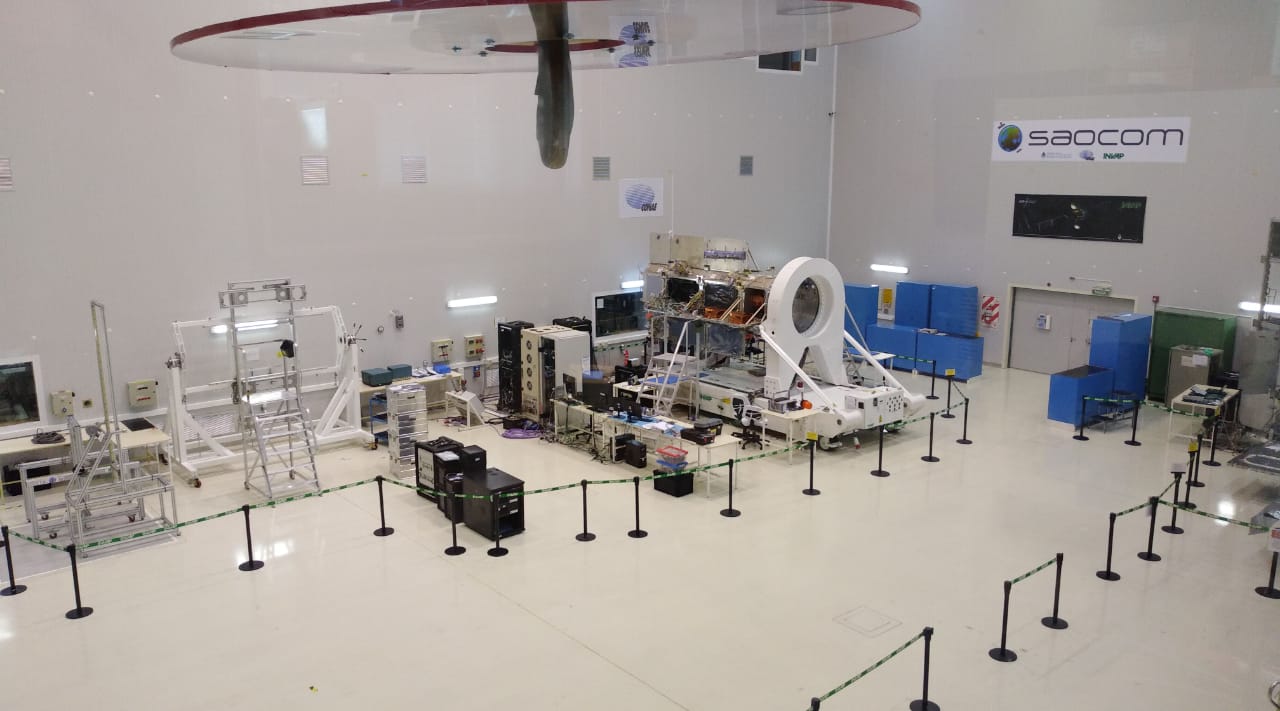
## Cutting-edge equipment to simulate space
Unique technology in the country to validate **aerospace components**.
Ceatsa’s facilities include:
– A **thermal vacuum chamber**, capable of reaching pressures **10,000 million times lower** than atmospheric and temperatures of **±150 °C**
– An **extreme acoustic system**, subjecting equipment to **141 decibels**, three times the volume of a rock concert
– A **three-dimensional shaker**, replicating launch vibrations
– An **anechoic chamber**, allowing the analysis of **electromagnetic self-compatibility** of systems
## Conversion and shared use: the future of the facilities
According to Invap spokespeople, Ceatsa’s closure responds to an **administrative optimization**, and there is currently a **shared use agreement** to carry out specific tests. In the future, it is planned to **rent the facilities to third parties**, under an agreement managed by **Arsat**.
Both state-owned companies were incorporated into the **Agency for the Transformation of Public Enterprises**, under the **Ministry of Economy**, with the aim of **evaluating privatization processes**.
## Industrial applications and sustainability challenges
Although originally intended for **the space sector**, Ceatsa was also designed to offer services to industries such as:
– Mobile telephony
– Automotive
– High-precision electronics
However, **significant commercial advances were not materialized**, and the future of the **Invap satellite factory** also faces uncertainty, following the failure of the prototype developed with a Turkish company for the third Arsat satellite.
## A strategic asset at risk of becoming idle
The **lack of new space projects** raises doubts about the operational continuity of the center.
The existence of a testing center of this magnitude depends on the **continuity in the construction of satellites** and other complex systems.
If no new projects are developed, the facilities could be **underutilized**, despite their capacity to simulate conditions of **deep space**.



