



Deep-sea sharks and rays face a silent threat in the South Atlantic. Their biology—slow growth, low fecundity, and few offspring—cannot withstand the current fishing pressure.
This week, in Rawson and Puerto Madryn, unprecedented data is being presented to fill the “black hole” of information that prevents the protection of what cannot be seen.
A complex balance: legislation, science, and fisheries management
Protecting the great predators of the deep sea is neither a simple nor one-dimensional task. It requires a delicate balance between legislation, science, and fisheries management.
Dr. Nelson Bovcon, a researcher at CONICET and an expert in marine fauna, summarizes it clearly:
“There is no exact recipe to determine the best action to minimize impact, but we know that protected areas work and are crucial. So are closed areas and the correct identification of catches to know how much of each species is being fished.”
The debate on fishing gear
One of the most sensitive points is the modification of fishing gear, especially in trawling, the most widespread method on the platform. Bovcon warns that it is difficult to drastically reduce bycatch, but suggests evaluating technical details:
- In shrimp fisheries, study whether reducing the vertical opening of the net helps decrease the entry of accompanying fish.
Science for conservation
The debate takes on new relevance this week with the GEMPA 2025 Meeting, organized by the Government of Chubut and the Argentine Deep Sea Study Group.
The trigger was the Talud IV expedition, when the vessel Falkor (too) and its underwater robots broadcast live from the Argentine seabed, captivating thousands. For biologists, these images are more than a spectacle: they are the necessary evidence to justify protection measures.
A vulnerable biology in an industrialized sea
Deep-sea sharks have a slow reproductive strategy:
- Low fecundity.
- Few offspring per year.
- Extreme longevity.
- Late sexual maturity.
Some species do not even reproduce every year. This natural slowness clashes with the speed of the fishing industry.
Researcher Alejo Irigoyen (CESIMAR-CONICET) explains:
“Being naturally in low density, they can only withstand very low extraction rates. Any fishing pressure, or even bycatch, significantly reduces their populations.”
The data problem: a “black hole”
To protect, it is necessary to know what is there and how much there is. However, Patagonia presents a historical information deficit compared to other regions.
Irigoyen admits:
“In Patagonia, we do not have data series, monitoring, or robust population estimates.”
What exists is the memory of fishermen, who perceive a reduction in catches of species like the gato pardo, cazón, or bacota.
Technology to see the invisible
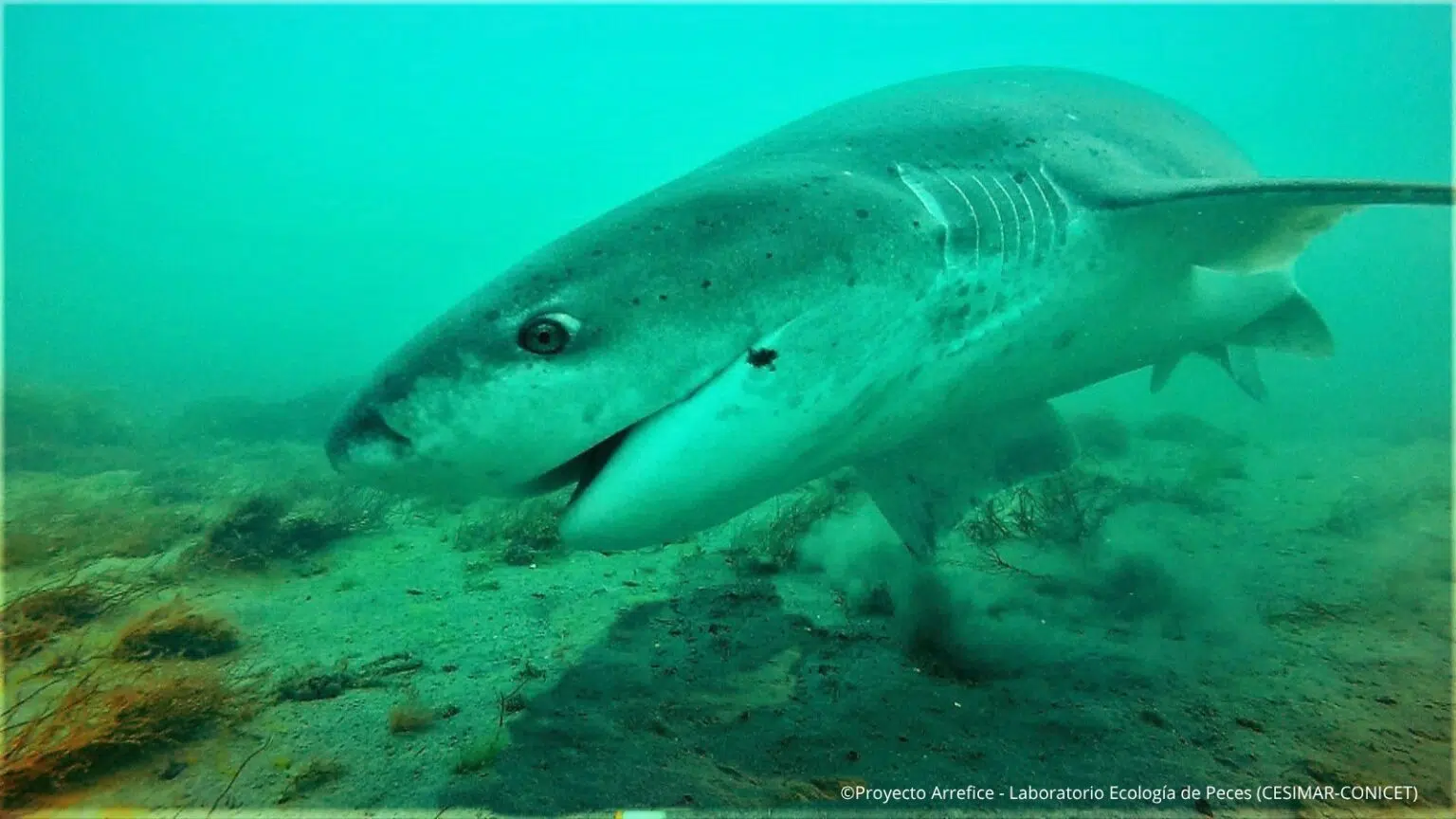
The use of ROV (Remotely Operated Vehicles) allowed the identification of cold-water species such as the Somniosus antarcticus shark or the gray shark (Hexanchus) in their natural refuges.
These observations provide unprecedented information about their behavior and habitat, far from the nets that capture them without context.
Agenda: knowing to legislate
The GEMPA 2025 Meeting aims to socialize these findings and generate social pressure to promote efficient Marine Protected Areas. The combination of scientific evidence, fishermen’s memory, and public dissemination is key to advancing towards sustainable fisheries management.
Deep-sea sharks and rays face a perfect storm: fragile biology, overfishing, and lack of data. Science and technology offer tools to make the invisible visible, but effective protection will depend on the ability to legislate and manage urgently.



