



Dust storms on Mars, long considered minor weather phenomena, have proven to be drivers of much more complex processes.
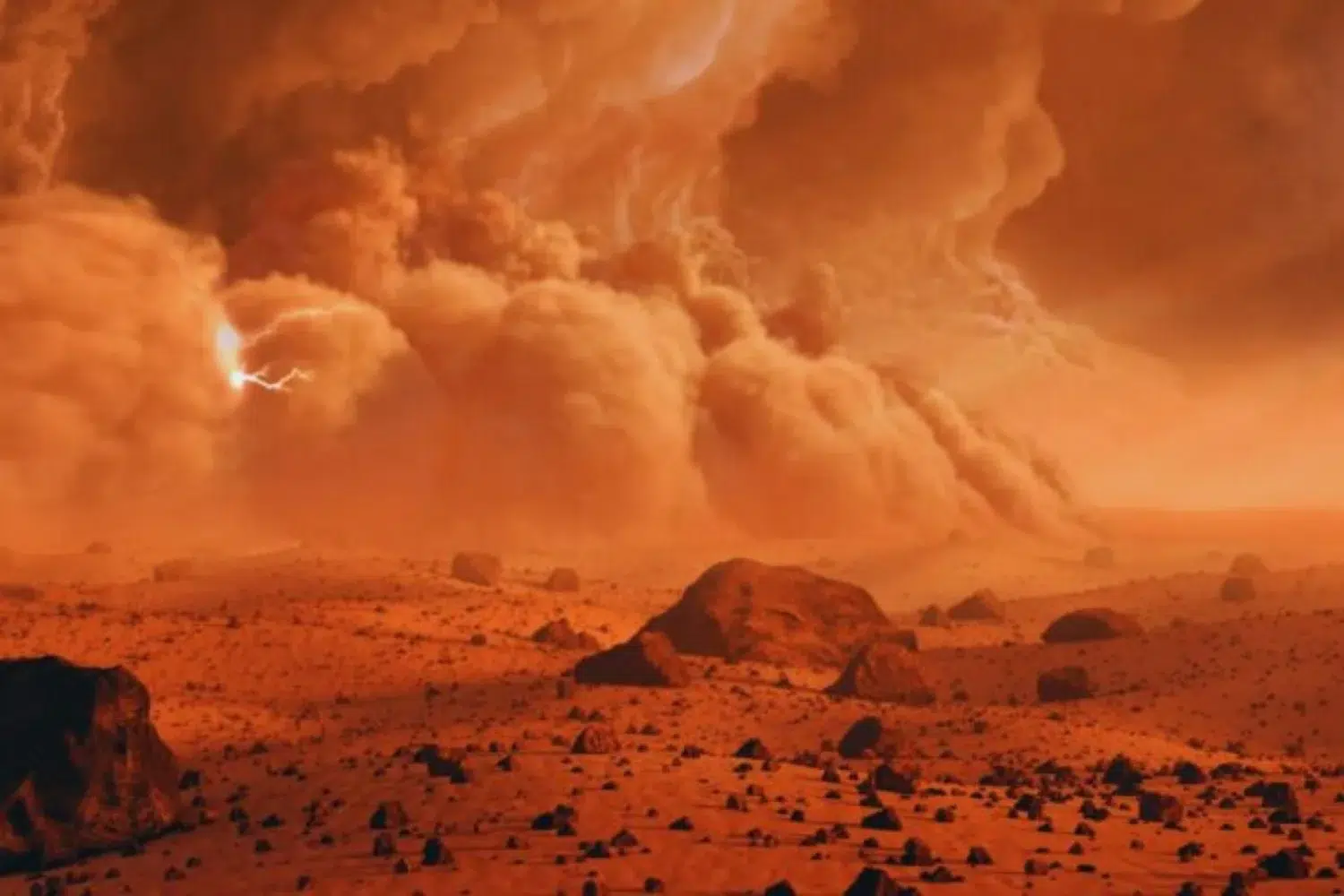
Recent research reveals that these events generate static electricity, capable of triggering chemical reactions that modify both the surface and the atmosphere of the red planet.
In a low atmospheric pressure environment, electrostatic discharges are more frequent than on Earth and manifest as flashes of light that initiate electrochemical reactions.
Laboratory Experiments
Planetary scientist Alian Wang from Washington University in St. Louis led experiments in simulation chambers that replicate Martian conditions.
The results showed the formation of compounds such as chlorates, suspended carbonates, and volatile chlorine species, all key elements in Mars’ current chemistry.
These findings confirm that the electrical activity of dust plays a fundamental role in the chlorine cycle and in shaping the Martian atmosphere.
Isotopic Evidence
The isotopic analysis conducted by the international team revealed a decrease in heavy isotopes in chlorine, oxygen, and carbon.
This pattern acts as a “fingerprint” of dust-induced electrochemistry, demonstrating that dust storms not only redistribute materials but also transform the planet’s chemical composition.
Recent Observations
The rover Perseverance supported these conclusions by recording more than 50 electrical discharges during whirlwinds and storms.
These data, published in Nature, align with models on the modern chlorine cycle and the formation of suspended carbonates, reinforcing the idea that Mars is a dynamic and constantly evolving planet.
Implications Beyond Mars
Researchers suggest that similar processes could occur on other celestial bodies like Venus or the Moon, where particle friction and low atmospheric pressure could also generate unexpected chemical reactions. This opens the door to new hypotheses about how dust-induced electrochemistry could be a common factor in the evolution of different worlds.
Dust storms on Mars are not simple meteorological events: they are engines of chemical change that reveal an active and complex planet.
Wang and her team’s research offers a renewed vision of Mars, showing how the interaction between dust, electricity, and chemistry can redefine our understanding of the red planet and serve as a reference for studying similar phenomena on other worlds.



