



For 135 years, Passiflora clypeophylla remained hidden on the steep cliffs of the Rubel Cruz community, in the department of Alta Verapaz, Guatemala. The plant had been described in 1891 from a single specimen collected in April 1889.
The botanist John Donnell Smith then recorded the locality as Barranca Rubel Cruz, Alta Verapaz, at 2,500 feet altitude. However, no other specimen was ever found. With the deterioration of the original material, the taxon was considered a dubious name.
Over time and after several failed attempts at rediscovery, the species was cataloged as extinct. Thus, for more than a century, no living or preserved specimen was known in suitable conditions.

The expedition that brought back hope
In 2024, the British researcher Jay Kuethe, from the University of Auckland, organized a new expedition while working on a monograph of the genus Passiflora. He had support from the IUCN in Guatemala and coordination with the Center for Conservation Studies (CECON) of USAC.
Due to the rugged topography and the isolation of the canyon, it was essential to request authorization from the Indigenous Maya Q’eqchi’ People. The Rubel Cruz community granted exceptional permits after meetings with their authorities. This agreement ensured respect for territorial and cultural rights.
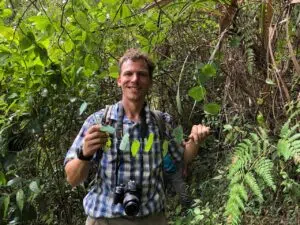
The team, consisting of Saban Sequen, Markus Vargas, and Dennis Imanol Medina Chub, descended into the canyon on February 21, 2024. After a complex journey, they located living specimens about two-thirds of the way down. The discovery marked one of the first non-Q’eqchi’ scientific entries in 135 years.
Characteristics and habitat of Passiflora clypeophylla
The Passiflora clypeophylla belongs to a lineage known for its adaptability and rapid reproduction. It inhabits humid forests in canyons with limestone rocks, between 1,250 and 1,300 meters above sea level. Its environment is dominated by well-preserved primary vegetation.
The species features leathery leaves, shiny on their upper surface, in addition to tendrils and glands characteristic of the genus. These adaptations allow it to climb among rocks and trees in high humidity environments. Its location on steep walls may have favored its survival.
The geographical isolation and the low agricultural suitability of the terrain helped preserve forest fragments. Thus, the species managed to survive in remnant patches despite regional environmental pressure.
Conservation and future of the species
After the rediscovery, new herbarium material was collected, and photographs, measurements, and updated descriptions were documented. This record will clarify its taxonomic identity.
Part of the living material was transferred to the CECON Botanical Garden in Guatemala City for cultivation and ex situ conservation. In this way, the aim is to multiply specimens and ensure their survival. Future reintroduction will depend on the continuous protection of the habitat.
The case demonstrates the importance of local knowledge and intercultural cooperation in conservation. It also underscores that even species declared extinct can persist in natural refuges. Protecting these ecosystems is key to safeguarding the still unknown biodiversity.



