



Antarctica is not just a desert of ice; it is, above all, a laboratory of light. In the context of the commemoration of February 22, the date marking Argentina’s first sovereign occupation of the white continent, a team of scientists from the CONICET is unraveling the mysteries of solar radiation in southern latitudes.
The goal is ambitious: to improve the quality of life of those inhabiting these polar territories and to strengthen the Argentine scientific vanguard in the South Atlantic.
The project, led by researchers Juan Manuel Monteoliva, Roberto Germán Rodríguez, and Emanuel Ricardo Schumacher, under the coordination of Dr. Andrea Pattini, focuses on the study of Sustainable Natural Lighting. This line of research, belonging to the INAHE, seeks to take advantage of Antarctica’s unique conditions, where cycles of extreme light and darkness challenge any conventional architectural and biological design parameters.
Research on three scales: city, building, and body
What makes this study disruptive is its comprehensive approach. As Juan Manuel Monteoliva explains, the research is not limited to measuring how much light falls on the ground but is divided into three critical dimensions: urban, building, and human.
On the urban scale, the team took Fortín Sargento Cabral as a case study. There, they analyzed how the materiality of the constructions and the terrain interact with the Antarctic skies.
On the building scale, the focus was on Base Esperanza, specifically in learning spaces such as the Provincial School No. 38 “President Raúl Ricardo Alfonsín” —the southernmost in the world— and the Multidisciplinary Antarctic Laboratory (LAMBE). The goal here is to determine how natural light impacts the occupants during the intense polar summer.
Finally, the human scale addresses health. The researchers evaluated sleep habits and light exposure (both natural and artificial from screens) to understand how the “midnight sun” phenomenon affects the circadian rhythms of the civilian and scientific population.
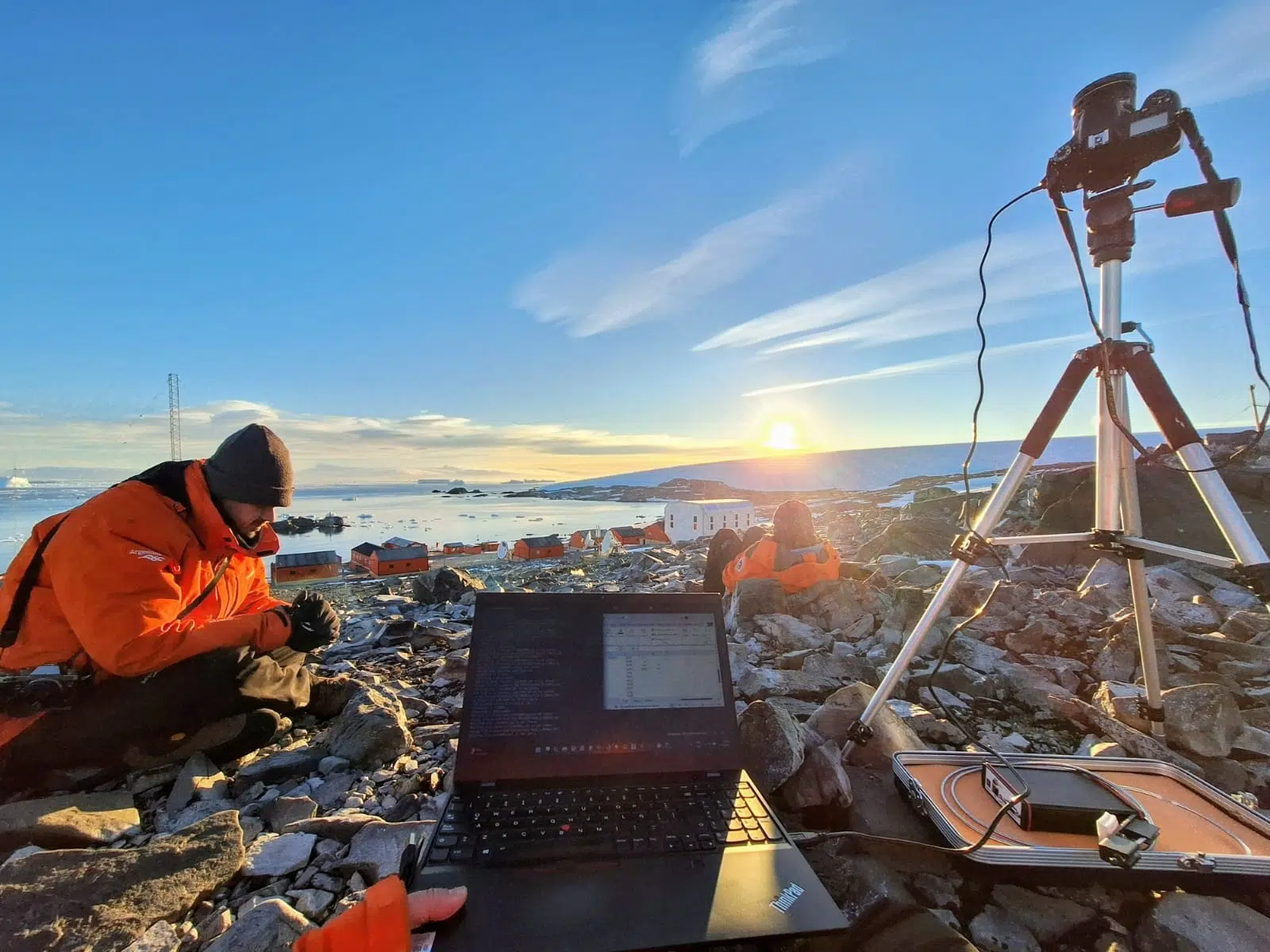
Science below zero: the challenge of measuring at the limit
Bringing precision scientific instruments to Antarctica is no easy task. Roberto Germán Rodríguez highlights that this is the first time a study of this magnitude has been conducted, integrating photometric characterizations and three-dimensional modeling.
“We are measuring ambient light from the visible and circadian spectrum. We seek to obtain information to create virtual models that allow us to predict light conditions throughout the year, even when we are not there,” says Rodríguez.
Working conditions have been, by definition, extreme. Operating equipment with winds exceeding 40 km/h and wind chills of -19º C required new methodological developments. In the Antarctic summer, although the sun sets, absolute darkness never arrives, forcing researchers to work at unusual hours to capture the light transition in all its complexity.
Sustainability and sovereignty: the long-term impact
Beyond technical data, the project has a profound social and geopolitical root. For Emanuel Ricardo Schumacher, the results will be critical inputs for the design of future sustainable habitats. The conclusions could be applied not only in Antarctic bases but also in high mountain shelters, mountaineering expeditions, and any extreme climate environment.
“We seek to generate empirical databases that position Argentine science in international collaboration networks,” says Schumacher. The project aligns with the strict environmental protocols of the Madrid Protocol, ensuring that human presence is as harmonious as possible with the ecosystem.
For her part, Andrea Pattini emphasizes the symbolic and strategic value of this work. “We have little awareness of the bicontinental nature of our territory,” she reflects. For the researcher, disseminating these results is a way to sustain national sovereignty, reminding that science is the pillar that has kept Argentina’s presence alive on the white continent for over a century.
As the team processes the data collected in the 2025-2026 campaign, it becomes clear that this study will not only bring light to the Argentine bases in Antarctica but will set a global precedent on how humans can inhabit, healthily and efficiently, the most remote corners of the Earth.



