



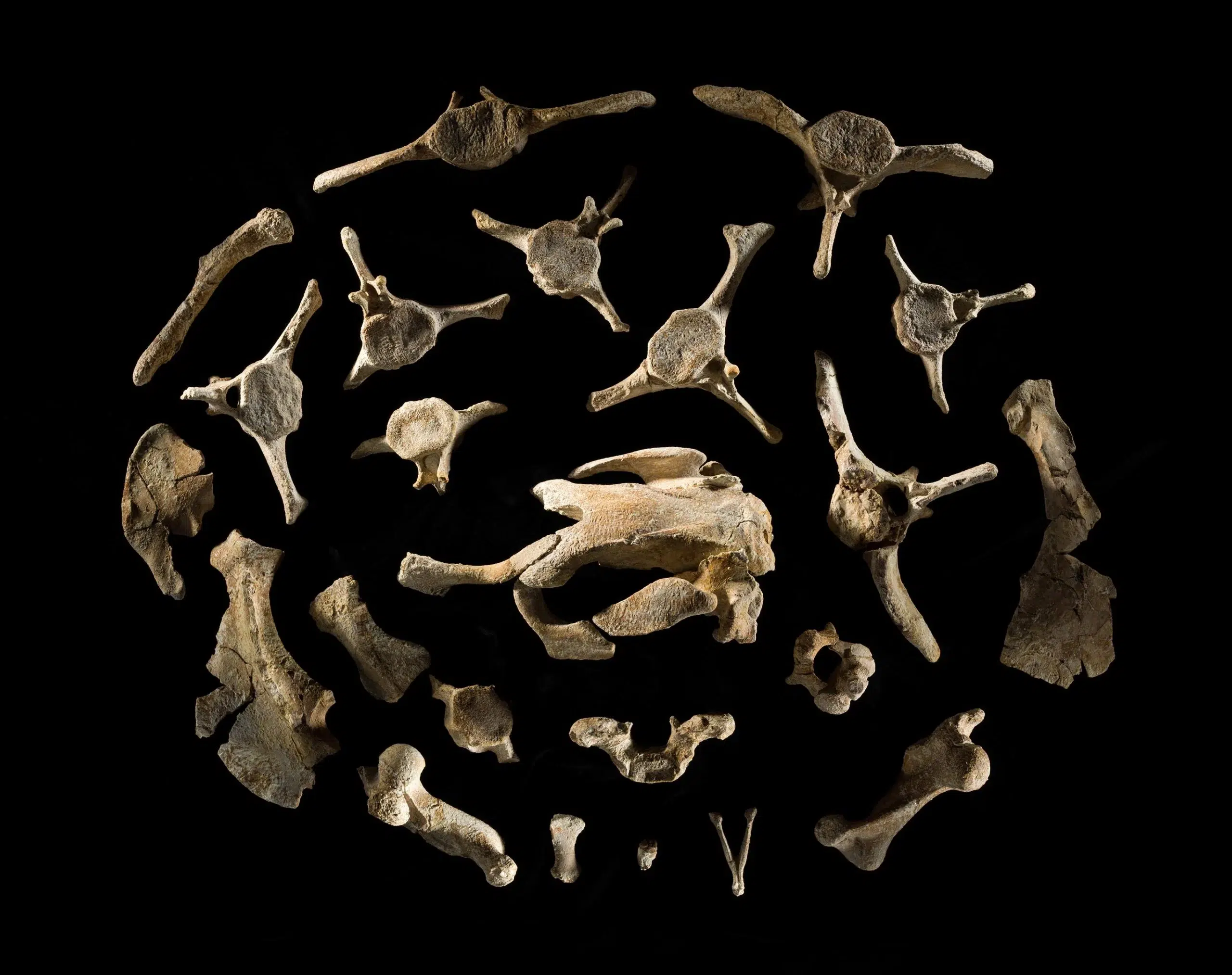
After an investigation led by the Smithsonian National Museum of Natural History and Qatar Museums, more than 300 fossil remains found in 172 different points of an area of just 0.76 km² have revealed a new species of sea cow that lived 21 million years ago.
For decades, the fossils remained scattered in the sediments of southwestern Qatar, as if waiting for someone to decipher their story.
A new species for science
The species was named Salwasiren qatarensis, in honor of the nearby Salwa Bay, where their distant descendants still live: the dugongs. These animals, known as sea cows, are large herbivores that feed on seagrass beds and play an essential role in coastal ecosystems.
The discovery confirms that already in the early Miocene there were ecosystems similar to the current ones, sustained by large marine herbivores that acted as ecosystem engineers.
The Al Maszhabiya site: a paleontological treasure
The fossils come from the Al Maszhabiya site, considered the largest sea cow deposit in the world. The record includes isolated bones and relatively complete skeletons, with an extraordinary density for this type of find.
The concentration of remains in the same geological level suggests that these animals lived in large aggregations, stirring up the seabed while feeding and facilitating the growth of underwater plants and nutrient recycling.
An independent lineage
Most striking is that Salwasiren qatarensis is not directly related to other fossil species of dugongids from the eastern Tethys region, nor to the current dugongs of the Gulf. It is a distinct lineage that evolved independently to occupy the same ecological role.
This detail suggests that the Gulf has been, for at least 20 million years, a stage of repeated evolution of marine communities with sea cows as a key species, albeit with different protagonists.
Ecological continuity and current conservation
The finding not only has paleontological value. Today, dugongs are considered vulnerable to extinction, due to their longevity, low reproduction rate, and human threats such as bycatch, coastal urbanization, and climate change.
Knowing that their role as ecosystem engineers dates back millions of years adds additional weight to efforts to protect them. The geographical coincidence is revealing: the site is less than 10 km from current seagrass beds where dugongs continue to feed, highlighting the ecological continuity of the Persian Gulf.
International research and advanced techniques
Although the site had been identified in the 1970s, its true importance went unnoticed. Only in recent years, thanks to an international collaboration, a systematic excavation campaign began, interrupted by the COVID-19 pandemic and the preparations for the 2022 World Cup in Qatar.
The study incorporated phylogenetic analysis, 3D scanning, and digital models, confirming that it is a completely new species. Among its particular features are a straighter snout, smaller tusks, and a more compact body structure than that of current dugongs.
World Heritage and ecological legacy
Given the importance of the discovery, Qatar Museums initiated the procedures to propose Al Maszhabiya as a UNESCO World Heritage Site.
If achieved, it would protect a scientific treasure and a testament to the long relationship between humans and marine ecosystems.
The Salwasiren qatarensis in Qatar reveals that sea cows have shaped coastal ecosystems for millions of years, playing a key role in the ecological continuity of the Gulf. This discovery reinforces the need to protect current dugongs and conserve seagrass beds in the face of 21st-century challenges.



