



Specialists from INGV discover a new crater and monitor the progress of the lava heading south, without reporting any significant seismic activity.
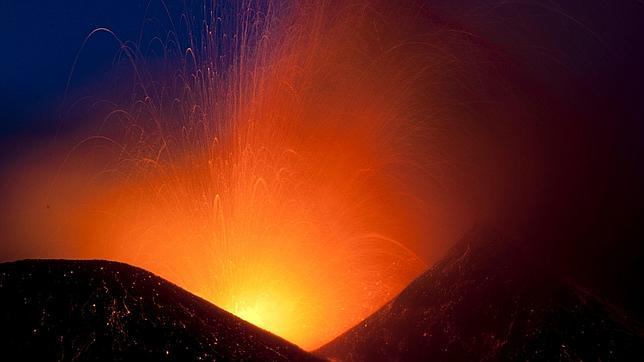
The Etna volcano in Italy, whose eruption began on June 2, has formed a new eruptive vent on its southern flank.
From this new opening with the new crater, located at an altitude of approximately 3,000 meters, a lava flow is moving southward, as reported by experts from the National Institute of Geophysics and Volcanology (INGV).
Despite the presence of magma, no significant seismic tremors or the expulsion of ashes that could interfere with air traffic have been detected.
However, as a precaution, authorities have set an orange alert for the airports in the region, such as Catania, which is currently operating normally.
INGV technicians maintain constant surveillance of the volcano and the new crater, conducting on-site analyses to assess how the phenomenon is evolving and ensure protection in the area. Both the local population and tourists remain vigilant for any possible changes, although for now the situation is considered stable within the eruptive phase that began in early June.

Etna Volcano Continues Erupting: Potential Consequences
The Etna volcano, located on the Italian island of Sicily, continues to erupt. It is spewing lava through a fissure on the southern slope of the crater called Bocca Nuova, which contrasts with the snow around the formation.
Volcanologists seek to reassure Sicilians by ensuring that the current eruption is subterminal in nature. What this means and what needs to be considered.
Etna Volcano, Erupting: What You Need to Know
The National Institute of Geophysics and Volcanology in Catania located the lava emission at an estimated altitude of nearly 3000 meters above sea level, between the base of the Bocca Nuova crater and the southeast crater.
According to the observatory of the National Institute of Geophysics and Volcanology in Italy, there were no significant changes in the volcano’s parameters.
In this regard, they sought to reassure Sicilians. As reported, the current eruption is of the subterminal type, meaning it originates from a fracture and not from one of the main craters.
About Etna
It is the tallest volcano in Europe and is believed to have the longest documented history of eruptions among all volcanoes, with records dating back to 425 BC.
According to data from the European Space Agency (ESA), it has a volume of at least 350 cubic kilometers and is one of the most active volcanoes on Earth in terms of eruptions.
Etna has an altitude of approximately 3330 meters, which varies by a few tens of meters depending on its activity, and is surrounded by populated areas. The city of Catania is located to the south.
The continental base of the volcano has a size of approximately 60 by 40 kilometers and a height of about 2900 meters.
Ancient Etna Activity
Volcanism began 300,000 years ago towards the southwest of the current summit, before the activity shifted to the current center about 170,000 years ago.
Compartí esta nota

Latest news
Te pueden interesarTe pueden interesar
Climate change threatens to reduce small fish populations in the Amazon by 50% by 2050-2070

Snapshot Argentina: Wildlife Monitoring with Camera Traps to Conserve Ecosystems in Argentina
Super Niño 2026: maximum alert in Argentina for a possible unprecedented rise in the Paraná River

Primate conservation in Argentina: only 7.2% of their habitat protected, Chaco and Formosa at risk due to deforestation
