



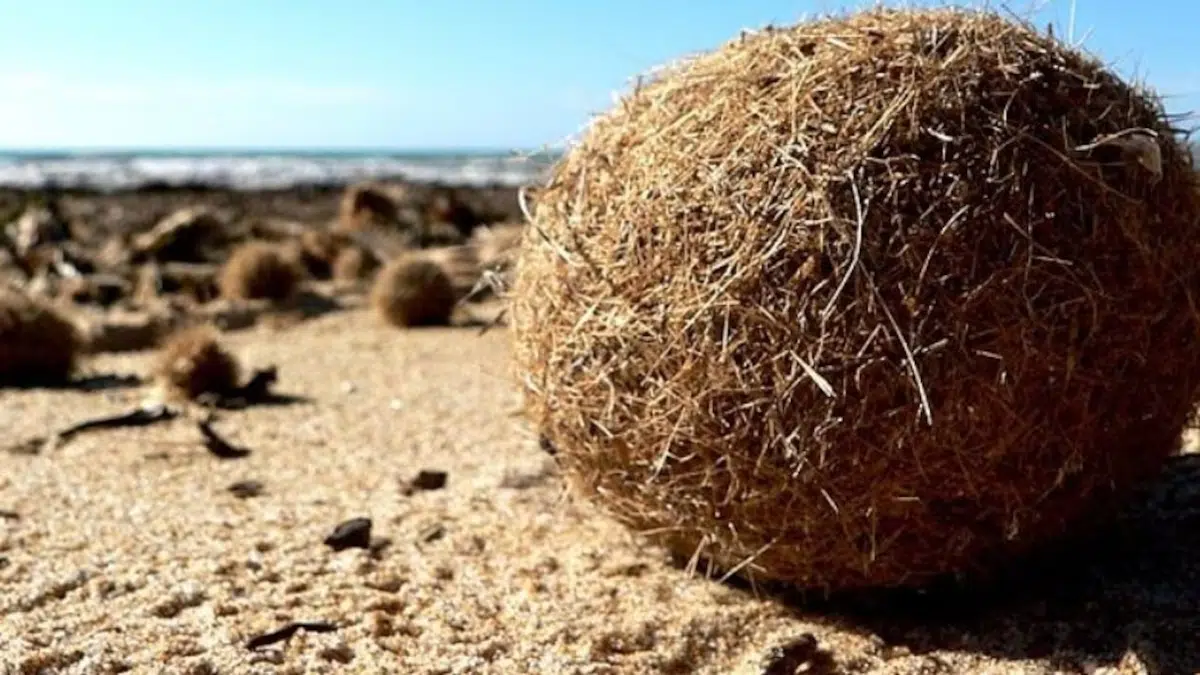
The so-called “Neptune balls” are natural spherical structures formed by remains of Posidonia oceanica, a marine plant that grows in the meadows of the Mediterranean Sea. These plant formations have the ability to accumulate marine plastics and concentrate them into visible particles on beaches and coasts.
A study published in Nature under the title “Seagrasses provide a novel ecosystem service by trapping marine plastics” revealed that these spheres can capture up to 900 million plastic fragments per year in the Mediterranean, becoming an unexpected ally against pollution.
How Neptune balls are formed
The physical dynamics of Posidonia meadows explain their origin:
- Every autumn, Posidonia leaves detach.
- These leaves are rich in lignin, a robust organic polymer.
- As they move with waves and tides, they tangle together forming dense clusters.
- Over time, they compact into spheres that trap particles present in the water.
Researchers observed that microplastics (fragments smaller than 5 mm) tend to associate with these plant fibers, becoming trapped and concentrated in the balls.
Scientific evidence in Mallorca
The team of researcher Anna Sánchez-Vidal documented on beaches in Mallorca, such as Sa Marina and Son Serra de Marina, that these balls can accumulate both microplastics and larger plastics (wipes, synthetic fibers).
Sampling revealed up to 1,500 plastic fragments per kilogram of Neptune ball, demonstrating a very high concentration of waste in these natural structures.
Ecological functions and warnings
Although Neptune balls help to highlight plastic pollution, experts clarify that they are not a cleaning solution. Sánchez-Vidal explained in an interview:
“These spheres provide essential moisture and nutrients to the beach. If we remove them, we would be destroying this delicate emerging ecosystem.”
Marine meadows fulfill vital functions:
- They improve water quality.
- They absorb carbon dioxide, helping to mitigate climate change.
- They offer a crucial habitat for numerous marine species.
- They preserve biodiversity and stabilize coastal ecosystems.
A declining ecosystem
Numerous studies warn that marine meadows face an alarming global decline. Since the late 19th century, their coverage has decreased by 29%, affected by:
- Pollution.
- Global warming of the oceans.
- Poor water quality.
- Coastal development.
This deterioration compromises both biodiversity and the ecosystem services they provide.
The key is prevention
The scientific community agrees that prevention at the source is essential:
- Reduce the production and consumption of plastics.
- Improve terrestrial waste management.
- Prevent fragments from reaching the sea.
Neptune balls show how nature can concentrate and highlight pollution, but the real solution lies in changing production and consumption models to protect the oceans in the long term.
Neptune balls are a natural phenomenon that reflects the ability of marine ecosystems to interact with plastic pollution. Although they do not represent a definitive solution, they are a powerful indicator of the magnitude of the problem and a reminder that prevention and reduction of plastic are the only sustainable strategies to protect the oceans and their marine meadows.



