



A California start-up, Marathon Fusion, claims to have devised a revolutionary method: manufacturing gold from common metals such as mercury. According to their simulations, the process would be scalable, profitable, and applicable in future nuclear fusion reactors.
The method is based on the transformation of the isotope mercury-198 into mercury-197 using high-energy neutrons. In a few days, the latter would turn into gold-197, the only stable isotope of the valuable metal.
The idea has sparked both enthusiasm and skepticism. The possibility of producing up to 5,000 kilograms of gold per gigawatt of energy generated seems promising, but it is still far from being a practical reality.
The main obstacle is that this system has only been tested in digital simulations. Furthermore, there are still no operational fusion plants on a commercial scale that can test the experiment under real conditions.
 A Start-up promises to turn mercury into gold. Photo: Pixabay.
Gold that Doesn’t Shine Yet
Despite the innovation, the process has a major limitation: the produced gold would be radioactive in its initial stage. This requires treating it as nuclear waste and storing it until it loses its radioactivity.
This critical point implies that it cannot be used immediately in jewelry or technology without a costly decontamination process. Although the waste could stabilize over time, safe storage requires strict protocols.
Additionally, the development of viable fusion reactors remains a technical challenge. Currently, no country has been able to sustain a controlled fusion reaction that produces more energy than it consumes.
The promise of unlimited gold could serve as an incentive to accelerate the development of this clean energy, but it could also divert attention from the environmental and technological challenges that still need to be overcome.
What is Gold and How is it Obtained?
Gold is a chemical element with symbol Au and atomic number 79. It is a noble metal, dense, soft, malleable, and has high electrical conductivity, highly valued for its rarity and durability.
Traditionally, it is obtained through open-pit or underground mining. This process requires large amounts of energy and water, and generates toxic waste such as cyanide and mercury, which contaminate soils and rivers.
Therefore, the possibility of producing gold in a laboratory, without destructive extraction, arouses ecological interest. However, turning this alternative into something sustainable and safe still presents numerous technological and environmental challenges.
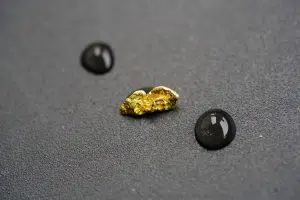 Gold. Photo: Pixabay.
Modern Alchemy and Its Limits
Alchemy, the ancient dream of turning common metals into gold, has always been a symbol of power and mystery. Nowadays, nuclear science could approach that ideal, but not without consequences.
The method by Marathon Fusion represents an interesting advancement, but it is still a hypothesis without solid experimental backing. Meanwhile, nuclear security risks and radioactive waste management remain key barriers.
If successful, this process could radically change the economy of nuclear fusion, making plants not only generate clean electricity but also precious metals. For now, the gold rush remains theoretical.



