



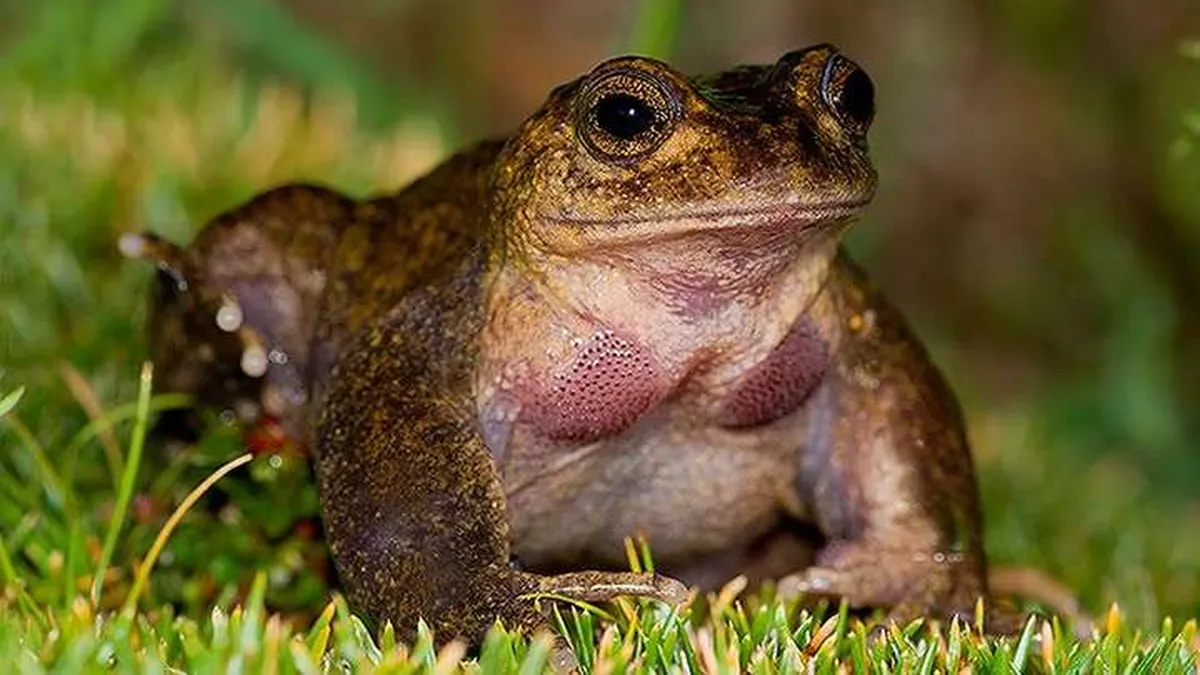
In the cold streams of high mountains, fed by the melting of the mountain range, lives the Pehuenche frog (Alsodes pehuenche), popularly known as the “bra frog.” Its distribution is extremely limited: it is only found in the Pehuenche Pass, between Mendoza and Chile, in wetlands that depend directly on meltwater.
The recent enactment of Law 9704 (April 8, 2026) declared it a Provincial Natural Monument, recognizing its critical conservation status and the urgent need to protect it.
Characteristics and behavior
- Size: adults between 45 and 75 mm; females are usually larger.
- Common name: it is due to the males, who during reproduction use spiny patches on the chest and limbs to hold onto the female.
- Appearance: robust, with brown and grayish tones, dark spots, and great camouflage ability on rocky backgrounds.
- Larval development: its tadpoles take up to four years to complete their metamorphosis, an extreme adaptation to mountain environments.
- Ecological function: consumes insects, acting as a natural pest control.
Ecological importance
The Pehuenche frog is considered an environmental bioindicator: its presence reflects good water quality and ecosystem balance. Furthermore, its phenotypic plasticity —the ability to express different morphotypes according to environmental conditions— gives it significant scientific value.
Main threats
The head of Fauna of the Subsecretariat of Environment, Adrián Gorrindo, defined it as “a biological jewel of the Andes” but also “one of the most threatened amphibians in Argentina and Chile.” Among the most serious risks:
- Climate change: reduction of snow and alterations in the microclimate.
- Road works: paving of National Route 145 and modifications in watercourses.
- Exotic species: the introduction of trout for sport fishing, which prey on tadpoles and adults and compete for food.
Conservation and challenges
The Pehuenche frog poses no risk to humans; on the contrary, it is a symbol of the environmental health of the Andes. Its conservation requires:
- Protecting the high mountain wetlands.
- Coordinating actions between the State, science, and local communities.
- Controlling invasive species and mitigating infrastructure impacts.
The declaration as a Provincial Natural Monument means that the species receives the highest protection category in Mendoza, which requires the implementation of monitoring plans, environmental education, and habitat restoration measures. Additionally, it opens the door to binational cooperation projects with Chile, given that the frog’s distribution is shared on both sides of the mountain range.
The “bra frog” is more than a unique amphibian: it is an indicator of the fragility of mountain ecosystems and a reminder of the urgency to conserve meltwater environments. Its survival depends on collective decisions that integrate scientific knowledge, public policies, and social commitment. Protecting it also means preserving water, biodiversity, and the ecological balance of the Andes.



