



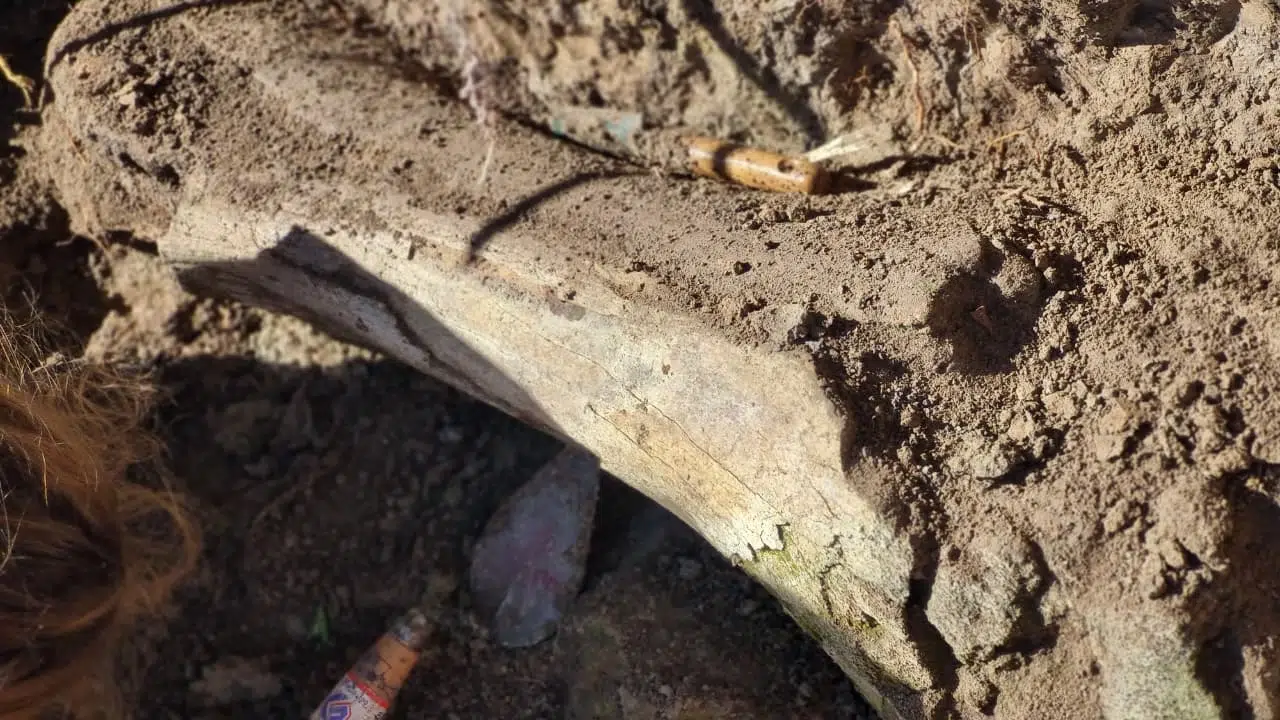
In the Buenos Aires city of Rojas, a fishing day turned into a discovery of great scientific and patrimonial value. Local resident Matías Gauna, while fishing in the Rojas River, found a large bone piece that caught his attention. Realizing it was an unusual element, he alerted specialists.
The Rojas anthropologist Franco Abatangelo was involved in the evaluation and rescue of the material. Due to its characteristics and robustness, one of the initial hypotheses is that it could belong to a megatherium, one of the “giant sloths” that inhabited South America over 10,000 years ago during the Pleistocene.
The giant sloths
These prehistoric animals could reach up to six meters in length and nearly two meters in width, being part of the megafauna that populated the Pampas region. Their presence in the area reinforces the paleontological importance of northern Buenos Aires.
The piece found was plastered on-site and transported for study. In the coming weeks, cleaning, restoration, and analysis tasks will be carried out to determine its species and age more precisely.
Educational participation
The operation involved students from the educational space Amanecer and School No. 3, who came as part of a pedagogical archaeology project declared of municipal interest.
The initiative seeks to bring students closer to the historical and natural heritage of the region, turning the discovery into an educational experience.
Paleontological potential of northern Buenos Aires
The province of Buenos Aires is one of the richest regions in findings of Pleistocene megafauna. Among the most notable discoveries are:
- Glyptodonts (giant armadillos): frequent in excavations and riverbanks. In 2024, remains were found in the AMBA with human intervention marks from 20,000 years ago.
- Giant sloths (megatheriums and mylodons): in 2026, a femur was discovered in Santa Clara del Mar, evidencing their wide distribution.
- Toxodonts and macrauchenias: strange-looking animals described by Charles Darwin in his expeditions through Punta Alta and Bahía Blanca.
- Prehistoric deer: in 2025, remains were found that provide data on the evolution of these species in the Pampas region.
- Fossil marine fauna: in the Southern Coastal Park, extinct sharks, rays, and corals like Oculina patagonica were recorded.
Importance of the discovery
The discovery in Rojas not only provides scientific information about the Pleistocene megafauna but also strengthens the link between community, education, and heritage.
Each discovery reaffirms that the Buenos Aires territory is a key reservoir for understanding the natural history of South America and the interaction of the first humans with these prehistoric giants.



