



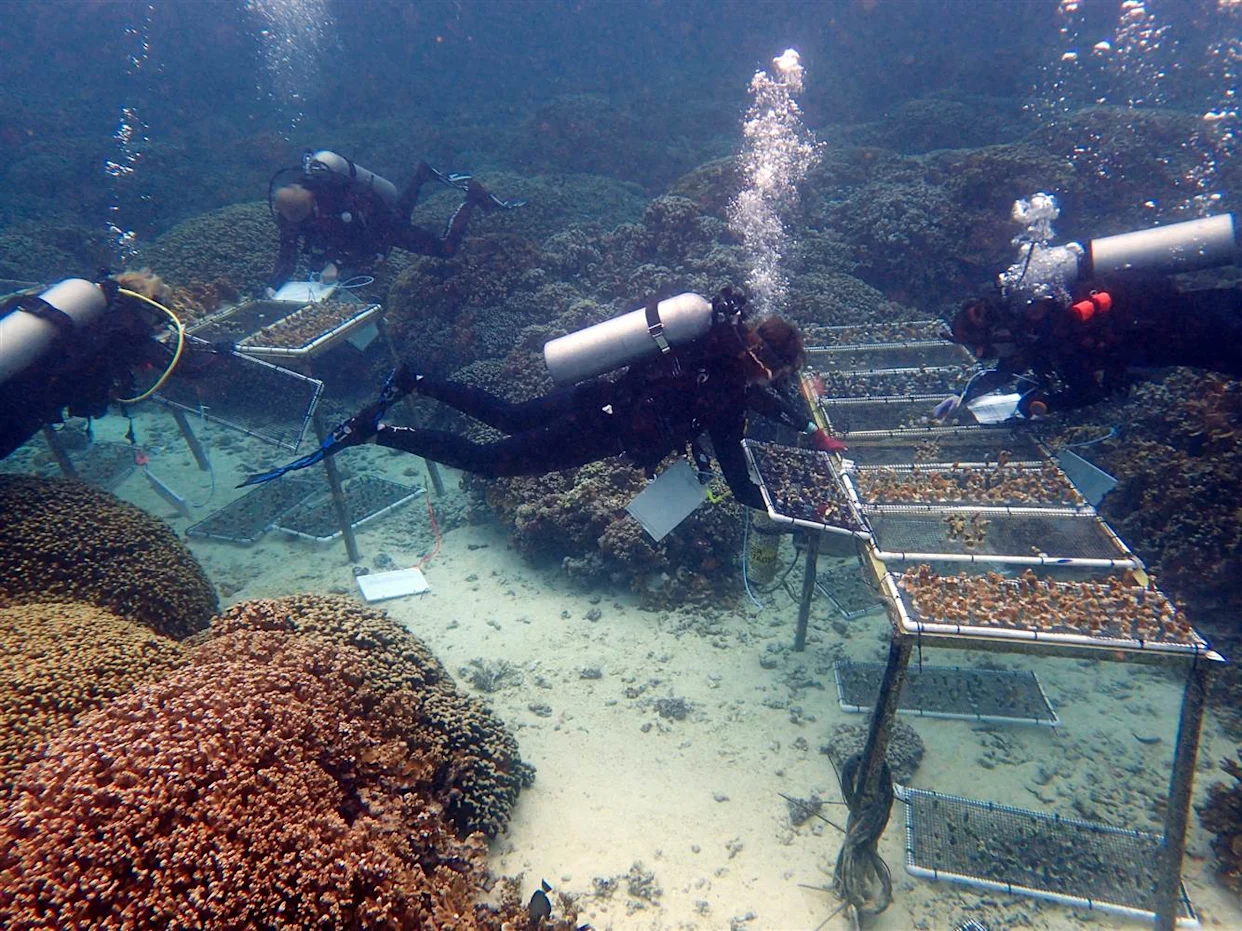
An international team from Newcastle University demonstrated that assisted evolution can prevent the extinction of coral reefs in the face of marine heatwaves.
The study, published on April 17 in Current Biology, concludes that to achieve effective results, biologists must be drastic: reproduce only the 1-5% of corals with the highest thermal tolerance over multiple generations.
Doctors Adriana Humanes and Liam Lachs tracked the pedigree of a coral population over eight years, mapping how traits like growth and survival are inherited. They discovered that genetic selection must focus directly on the coral host, ignoring its symbiotic algae.
Key Results
- Higher thermal tolerance: increasing heat resistance does not sacrifice growth or reproduction.
- Insufficient natural adaptation speed: since the 1980s, coral thermal tolerance has only increased by 0.1 °C per decade, while the ocean warms at twice that rate.
- Strong and sustained selection: is the only way to achieve significant advances in coral persistence.
Research Priorities
A parallel analysis published in Nature Reviews Biodiversity brought together 28 experts who warned that the current pace of research is insufficient. Among the nine highlighted priorities are:
- Establishing large-scale field research centers.
- Ensuring 3 to 7-year funding cycles, the biological time it takes for a coral to reproduce.
- Physically protecting lab corals by moving them to deeper waters during extreme heatwaves.
Assisted Evolution and Mitigation
Assisted evolution accelerates genetic adaptation through selective breeding. A previous 2024 study in Nature Communications found that selected corals withstand up to 1 °C additional per week of thermal stress. However, researchers emphasize that this technique does not replace the need to reduce greenhouse gas emissions, the main cause of ocean warming.
Ecological Importance of Reefs
Coral reefs are vital ecosystems:
- Biodiversity: they host 25% of marine life despite covering less than 1% of the ocean.
- Essential habitat: breeding and feeding grounds for countless species.
- Coastal protection: they reduce wave energy by up to 97%, acting as natural barriers against storms.
- Sand production: fish like the parrotfish generate the characteristic white sand of Caribbean beaches.
Socioeconomic Importance
- Food security and employment: more than 500 million people depend on reefs for their livelihood through fishing and tourism.
- Economic value: they are estimated to generate net annual benefits exceeding 29.8 billion dollars.
- Tourism and recreation: they are a key source of income from ecotourism.
- Medicine: they inspire biomedical research due to their natural compounds.
Assisted evolution offers a powerful tool to increase the thermal resistance of corals and prevent their collapse. However, its success depends on a rigorous genetic selection, sustained funding, and parallel actions to reduce global emissions.
Reefs, essential for biodiversity and humanity, require an urgent and coordinated response to survive in a rapidly warming world.



