



An international team led by paleontologist Paul Sereno (University of Chicago) identified a new species of spinosaurid in the central Sahara Desert: Spinosaurus mirabilis. The discovery, published in the journal Science, constitutes the first new species of Spinosaurus described in over a century, making it a paleontological event of great significance.
95 million years ago, the area of Niger where the fossil was found was a river ecosystem with forests and large freshwater fish, very different from the current arid landscape.
Distinctive Features
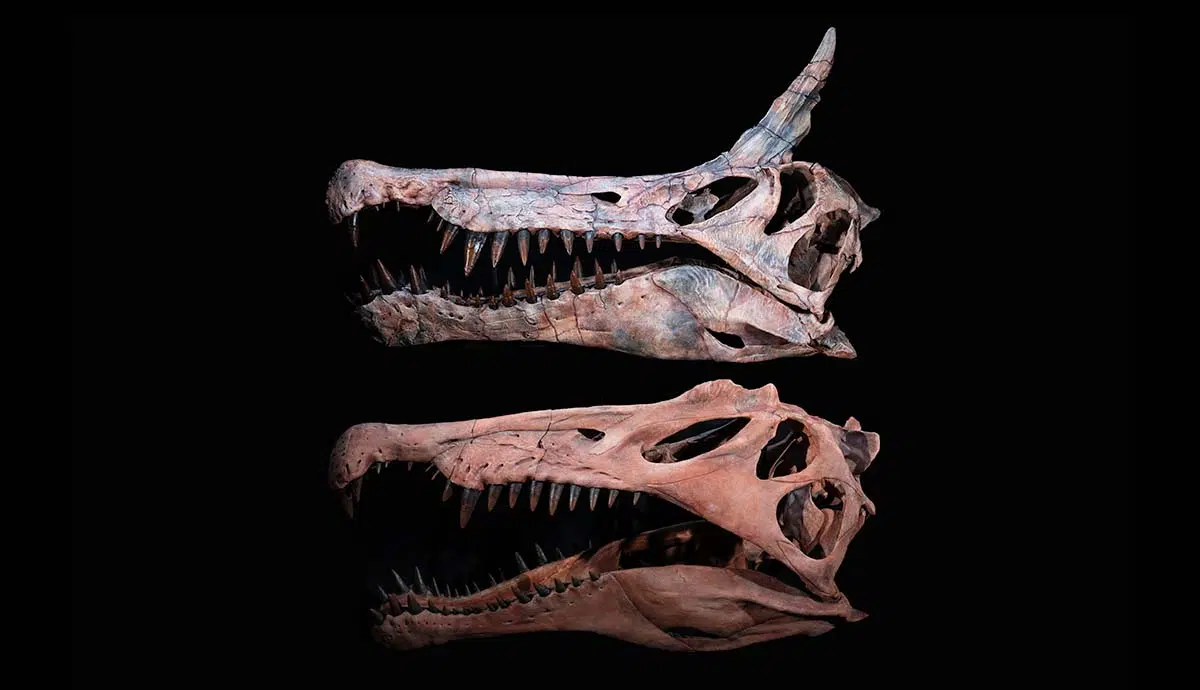
Spinosaurus mirabilis exhibits two unique characteristics:
- Scimitar-shaped cranial crest: curved, sharp, and about 50 cm high, with vascular channels suggesting it was covered in keratin. It likely served a display function to attract mates or intimidate rivals.
- Interdigitated dentition: the upper and lower teeth interlocked when the mouth was closed, forming a true “fish trap.” This adaptation, common in aquatic reptiles like crocodiles or ichthyosaurs, had never been so clearly documented in theropod dinosaurs.
Debate on Lifestyle
The discovery reignites the discussion on whether spinosaurids were active swimmers or shallow water predators.
- The fossils of S. mirabilis were found in inland fluvial sediments, far from ancient marine environments.
- This suggests it moved in rivers and riparian forests, hunting fish in shallow waters.
- The study compares it to modern wading birds, describing it as a sort of “hell heron” weighing several tons, capable of wading in waters up to two meters deep.
Although it is not ruled out that it could swim, its bone proportions fit better with animals adapted to river ecosystems than with marine predators.
Technology Applied to the Discovery
The first remains were found in 2019 at the Jenguebi (Niger) site. During the expedition, researchers assembled a digital model of the skull in the middle of the desert using solar energy. Later, in Chicago, the fossils were scanned with computed tomography, allowing 3D reconstructions of the crest and dentition.
This multidisciplinary approach reflects how contemporary paleontology combines extreme fieldwork with advanced digital technology.
Evolutionary Implications
Spinosaurus mirabilis could represent one of the last stages in the evolutionary radiation of spinosaurids, a lineage that spanned about 50 million years. Its combination of features—exaggerated crest, specialized dentition, and adaptation to inland fluvial environments—suggests a greater diversification than previously thought.
The discovery does not close the debate but intensifies it. Each new Spinosaurus fossil brings clarity and new questions. In this case, the Sahara Desert once again demonstrates that beneath its apparent emptiness lies a lost world that rewrites what we thought we knew about dinosaurs.



