



The Earth’s magnetic north pole is no longer where it was a few decades ago. The latest update of the World Magnetic Model 2025 (WMM2025), prepared by the NOAA and the British Geological Survey, confirms that the point to which compasses point is now closer to Siberia than to the Canadian Arctic, after traveling more than 2,200 kilometers since 1831.
Changes in Speed
For much of the 20th century, the pole moved slowly, just a few kilometers a year. Starting in the 1990s, it accelerated to 50–60 km annually, crossing the Arctic Ocean and the international date line. However, in the last five years, its speed has reduced to 35 km per year, the greatest deceleration recorded so far.
Geophysicist William Brown, from the British Geological Survey, describes this behavior as “never observed until now,” which is why the new model has received so much attention.
What is the Magnetic Pole
It is important to distinguish between the geographic North Pole, fixed on maps, and the magnetic north pole, which moves over time. The latter is the point where the Earth’s magnetic field points almost directly downward.
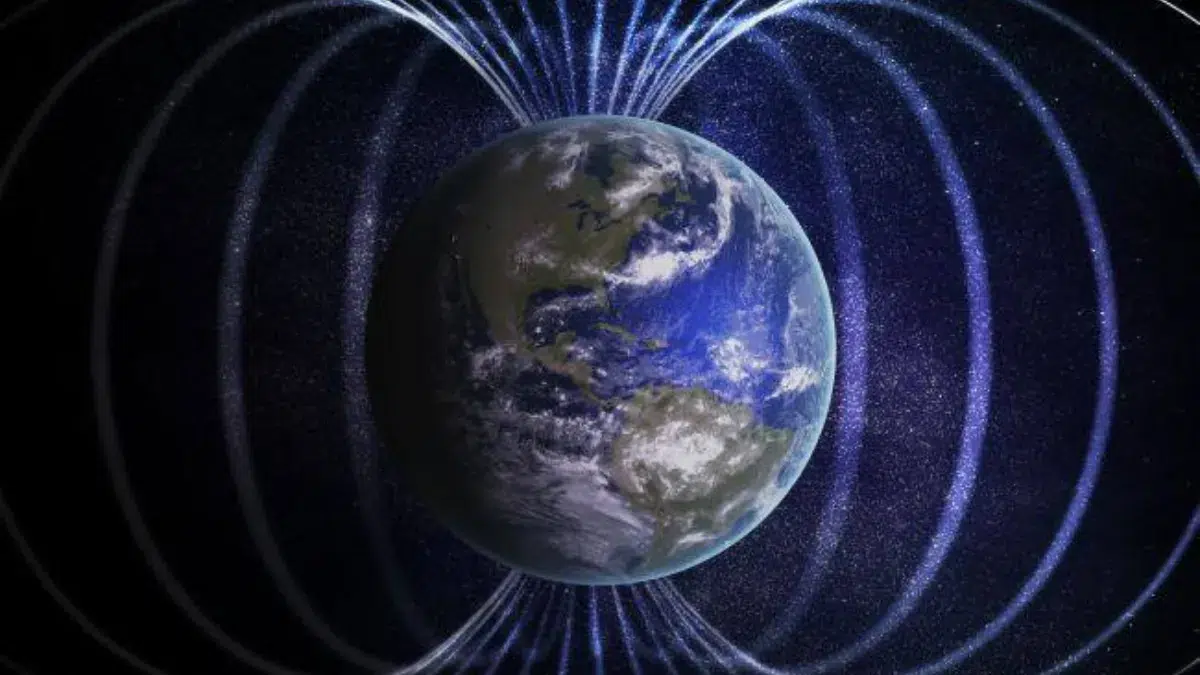
The field originates about 3,000 km deep, in the outer core of molten iron and nickel. Its movement generates electric currents that produce a large planetary magnet, extending into space in the form of a magnetosphere, the shield that protects the atmosphere from solar particles.
The World Magnetic Model 2025
The WMM is updated every five years and is the standard used by:
- Civil and military aviation.
- Commercial navies and international organizations such as NATO.
- Submarine navigation systems.
- Mobile and automobile manufacturers to calibrate digital compasses.
The 2025 version, published in December 2024, will be valid until the end of 2029. Its main novelty is the high-resolution version (WMMHR2025), which improves accuracy from 3,300 km to about 300 km at the equator, optimizing course calculations in complex areas like the Arctic.
Practical Impact
For short journeys, like a subway trip, the impact is minimal. But on flights of thousands of kilometers, using an outdated model can generate errors of tens of kilometers in the route.
Additionally, the model updates the areas of “magnetic blackout” near the poles, where compasses become unreliable, affecting polar routes and scientific expeditions.
Separating Noise from Reality
The movement of the magnetic pole is linked to internal processes of the Earth’s core, not to global warming or CO₂ emissions. It also does not imply an imminent reversal of the magnetic poles. Geological records show that the field has reversed many times, the last time being 780,000 years ago, and these processes occur on scales of thousands of years.
Although the field’s intensity has reduced by 9–10% in two centuries, experts consider these changes normal on a geological scale.
The episode reminds us that Earth is a dynamic planet, inside and out. Just as we measure CO₂ or ocean temperatures, closely monitoring the magnetic field is essential to protect critical infrastructure and understand the planet’s internal machinery. The geophysics clock does not stop, and the magnetic north pole continues to chart its own course.


