



A study published in the journal PNAS, led by the University of Leipzig and the German Centre for Integrative Biodiversity Research (iDiv), in collaboration with the University of Valencia and other institutions, confirmed that the planet’s green belt has been accelerating its migration towards the northeast for decades.
The research introduced an innovative method to track the “center of mass” of Earth’s greenery, that is, the balance point of the planet if each fragment of vegetation had a weight proportional to its leaf density. This approach offers a scientific compass to measure how the planet’s green belt changes.
Seasonal and Sustained Movement
Based on satellite observations and climate models, the team tracked the seasonal shift of the green center:
- Each year, vegetation oscillates between hemispheres, reaching its northernmost point in July near Iceland and the southernmost in March off the coast of Liberia.
- However, besides this pattern, a double constant shift towards the north and east was detected, linked to greening in India, China, Europe, and Russia.
Hypotheses on the Causes
Professor Miguel Mahecha, the lead author, noted that longer growing seasons and milder winters in the northern hemisphere could drive this phenomenon. The increase in atmospheric CO₂ also acts as a fertilizer, enhancing photosynthesis and extending growing seasons.
Contrary to expectations, no equivalent shift towards the south was observed during the austral summer, reinforcing the asymmetry between hemispheres in vegetation’s response to climate change.
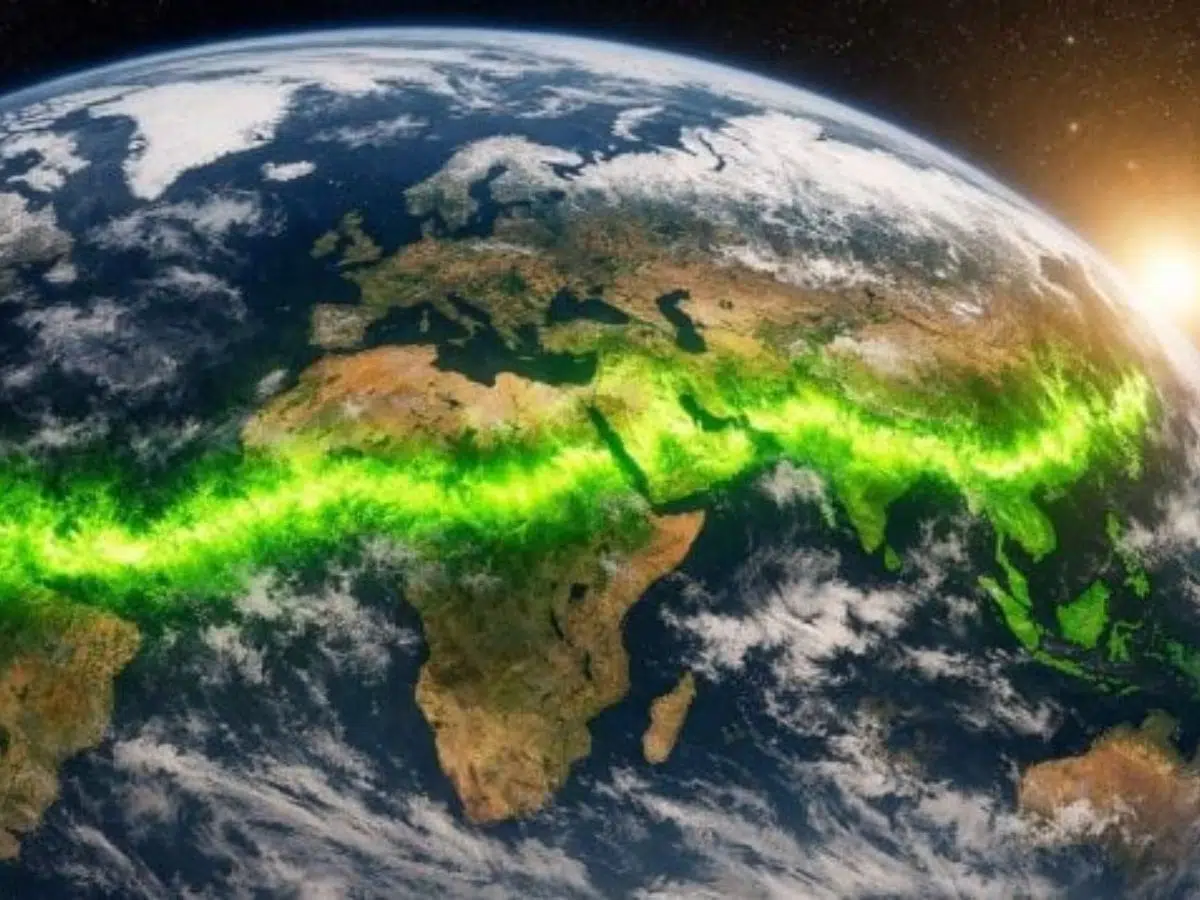
Global Greening
The study provides evidence of global greening, a lesser-known phenomenon of climate change that describes the overall increase in vegetation density.
This process is transforming previously arid regions into greener areas, although it also raises questions about the sustainability of ecosystems and water availability.
A Compass for the Biosphere
The theoretical framework is not limited to terrestrial greenery. It can be adapted to track:
- A “blue wave” in the oceans.
- A “red wave” of thermal anomalies.
This makes the methodology a multidimensional tool for monitoring the pulse of the Earth’s system, connecting climate, biosphere, land use, fires, droughts, and animal migrations.
For the first time, science has a compass capable of accurately measuring how the living surface of the planet is reorganized in a context of global warming.
The northeast shift of the green belt reflects the profound interaction between climate and vegetation, and opens new avenues for understanding and anticipating the impacts of climate change.


