



From the Los Lagos region to the Magallanes area in Chile, the red luga or Sarcopeltis skottsbergii, a marine algae fundamental to the southern ecosystems, inhabits. However, climate change is altering the conditions that sustain its development.
In this context, the increase in sea temperature pushes numerous species towards colder latitudes. As a result, marine biodiversity begins forced displacements that modify balances built over centuries.
Thus, the food chain begins to suffer, and the stability of fjords and channels becomes fragile. Understanding these movements becomes key to anticipating major impacts.

Science against the clock in the southernmost fjords
In this scenario, a scientific alliance between Brazil and Chile is promoting a project to identify priority conservation areas. The initiative brings together researchers from the Federal University of Paraíba and the University of Magallanes.
The work focuses on detecting areas that could remain climatically stable until the year 2100. In this way, it seeks to ensure natural refuges for the red luga in the face of global warming.
To achieve this, the team uses advanced mathematical models and databases with over 25 years of records. These inputs allow projecting which sectors of the southern fjords and channels will offer better future conditions.
Maps to decide and protect
The study results translate into maps of high ecological precision. These tools guide public policies and define areas where protection must be prioritized.
At the same time, the models provide key information to regulate extraction. In this way, it seeks to avoid overexploitation and ensure the natural regeneration of the resource.
Thus, science becomes a bridge between environmental conservation and the responsible management of the marine territory.
A vital support for coastal communities
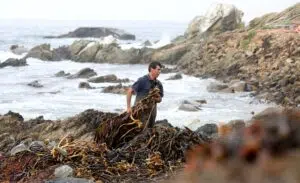
The red luga not only plays an ecological role, but also a social and economic one. Thousands of families depend on its biomass through artisanal fishing and shore gathering.
If the species decreases or migrates to inaccessible areas, the impact would be direct on coastal communities of Los Lagos and Magallanes. Therefore, the problem transcends the environmental and becomes social.
Moreover, the Chilean coast has a cultural and productive potential similar to countries where algae are a central part of identity. However, climate change and extractive pressure force a rethink of the current model.
Restore to secure the future
Beyond passive protection, scientists are advancing in active restoration strategies. Recent research has shown that it is possible to repopulate red luga meadows through cultivation techniques.
The use of artificial substrates allowed the growth of juvenile specimens in the cold waters of Magallanes. This experience opens new possibilities for recovering degraded areas.
Finally, the combination of repopulation, monitoring, and planning seeks to consolidate a sustainable blue economy. Thus, the red luga ceases to be a silent victim of the climate and becomes a symbol of adaptation and scientific cooperation.


