



The artificial solar eclipse is now a reality. In recent months, technology has shown that it can go further and recreate events that were previously exclusive to nature. This is because two satellites from the Proba 3 mission of the European Space Agency (ESA) created the first “artificial total solar eclipse” in orbit.
These satellites, capable of flying as a single ship with onboard positioning technologies, resulted in various images of the outer atmosphere of the sun, where the solar corona can be appreciated.
In this way, ESA demonstrated the potential behind formation flight technologies that also obtain invaluable scientific data that will help improve the enigmatic atmosphere of the Sun.
This mission saw its first advances in March, when the two spacecraft, the Coronagraph and the Occulter, flew 150 meters apart in perfect formation for several hours without Earth-based control. This was the result of the alignment of both satellites, maintaining their relative position with millimeter precision thanks to a set of innovative navigation and positioning technologies.
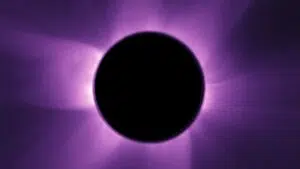 Artificial solar eclipse. Photo: Social media.
Artificial eclipses are now a reality
Thanks to the optical instrument, called ASPIICS for the abbreviation of Association of Spacecraft for Polarimetric Research and Imaging of the Solar Corona, developed by ESA, images of the solar corona were captured without the interruption of bright solar light.
But for this to happen, first the satellites had to be aligned with the sun, in such a way that the 1.4-meter disk carried by the spacecraft Occulter covers the bright disk of the Sun for the spacecraft Coronagraph, projecting a shadow of 8 cm in diameter onto the optical instrument.
According to researchers, ASPIICS images can be easily compared to those taken during a natural eclipse, as the only difference lies in the duration and frequency with which they occur.
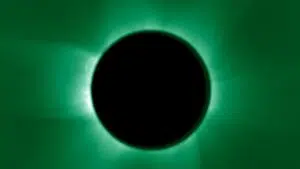 Europe achieved the first artificial total solar eclipse. Photo: Social media.
Astronomical events that will remain unique
Total solar eclipses occur when the Moon passes between the Earth and the Sun, completely covering the solar disk for a few minutes. This phenomenon is only visible from a specific strip of the planet called the “path of totality,” while in other regions a partial eclipse can be observed.
During a total eclipse, the sky darkens as if it were night, temperatures drop slightly, and the solar corona, an outer layer of the Sun normally hidden by its brightness, becomes visible. This astronomical spectacle has fascinated humanity for centuries, being the subject of scientific studies and numerous cultural legends.
For a total eclipse to occur, several precise astronomical factors must coincide, making them relatively rare in the same location. Safe observation requires the use of special filters, as looking directly at the Sun, even partially covered, can cause permanent eye damage.


