



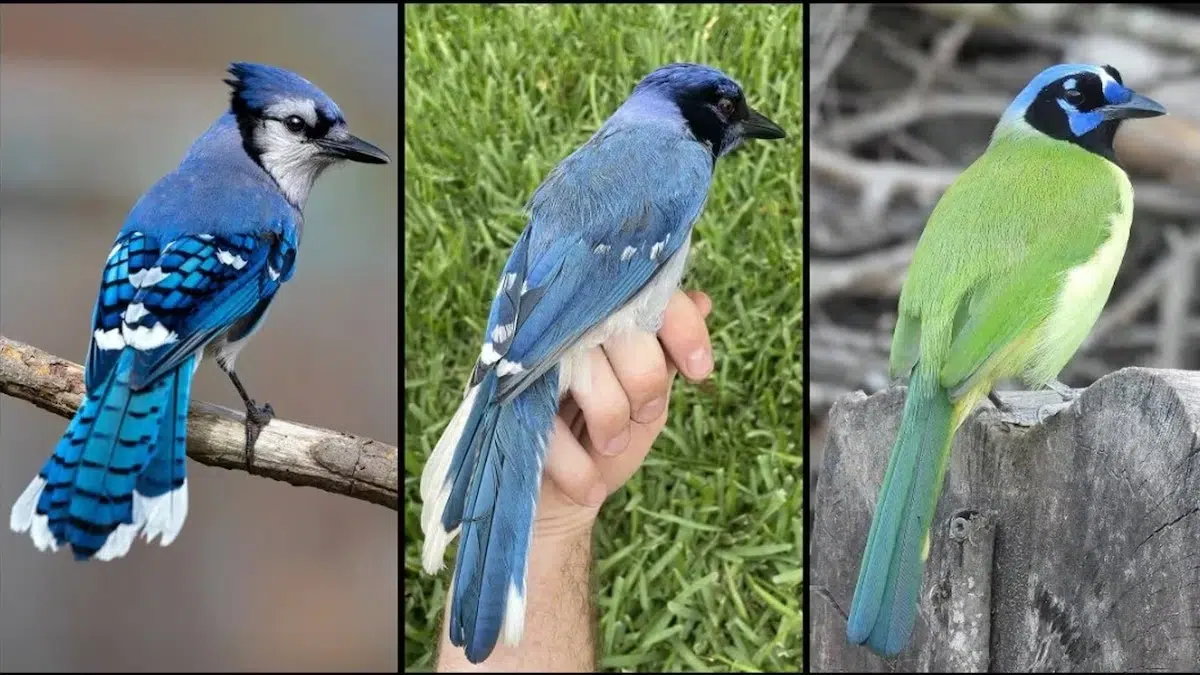
An unexpected discovery surprised the scientific community: a team from the University of Austin in Texas discovered a natural hybrid bird between a green jay and a blue jay, two species that had never shared habitat and whose evolutionary separation exceeds seven million years.
The case, published in Ecology and Evolution, marks a milestone in understanding the effects of climate change on biodiversity.
Climate change and biogeographic convergence
Traditionally, green jays inhabited tropical areas in southern Texas, while blue jays were distributed in the eastern United States. However, in recent decades, both have expanded their ranges —the former to the north, the latter to the west— until overlapping in the San Antonio region.
Researchers attribute this convergence to recent climate alterations that modified the ecological boundaries of both species.
“It is the first vertebrate whose hybridization appears to be directly caused by climate change,” says Brian Stokes, lead author of the study.
A fortuitous discovery and a unique story
Citizen observation and scientific monitoring allowed the phenomenon to be documented.
The discovery began when Stokes saw a photo of a bluish bird with black mask and white chest on social media, posted by a local observer. After several attempts, he managed to capture it in a mist net, take genetic samples, and place an identification ring on it.
The bird disappeared for years and returned to the same garden in June 2025, in what the researcher described as “pure chance”.
Genetic analysis confirmed that it was a hybrid male, the offspring of a green jay mother and a blue jay father. Although there is a precedent in captivity in the 1970s, this case is natural and spontaneous, without human intervention.
Natural hybridization: more common than believed
Hybridization in nature is not exclusive to birds. There are cases like the grolar bear (polar bear with grizzly), the coywolf (coyote with wolf), and the narluga (narwhal with beluga).
However, most arose from the expansion of a single species or from human action. The jay hybrid represents an unprecedented biogeographic convergence.
“Hybridization could be common but difficult to record,” Stokes points out.
Rethinking biodiversity in times of change
The discovery of this hybrid bird invites us to review how climate is rewriting evolutionary rules.
For the University of Austin, this discovery expands the biodiversity catalog and suggests that nature could harbor many more hybrids than science has managed to identify.
In a context of environmental acceleration, these events could become more common, challenging the classic models of species evolution and distribution.



