



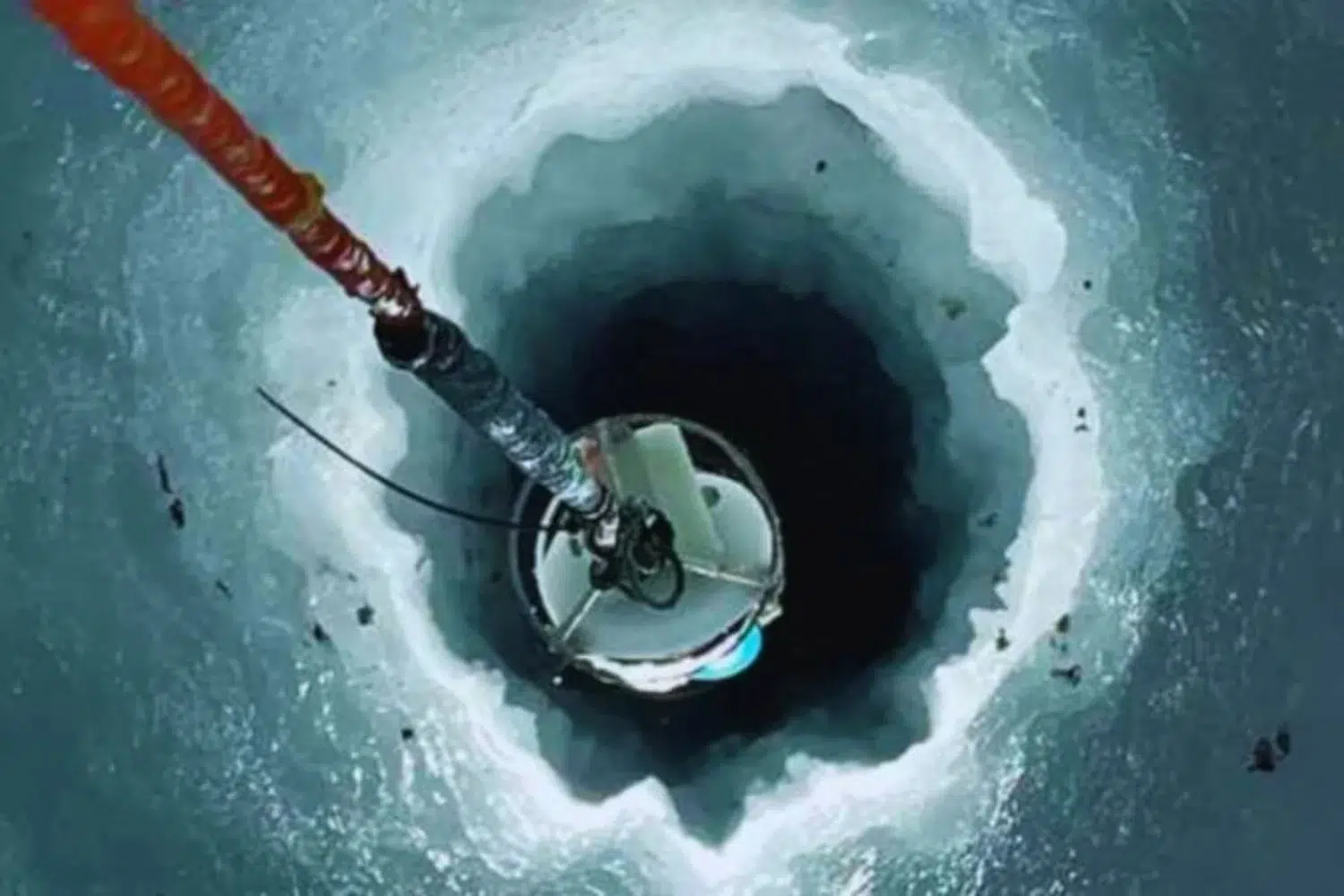
The British Antarctic Survey, in collaboration with European institutes, reached a scientific milestone by drilling down to 2.8 kilometers deep in East Antarctica. This is at the site known as Little Dome C, near the Concordia station. The extracted core contains atmospheric and chemical information dating back 1.2 million years, becoming the oldest continuous ice record ever recovered.
Extreme working conditions
For several years, a team of about 30 people operated in temperatures close to -35 °C, maintaining the precision necessary not to alter the material.
The analysis focused on the bottom 190 meters of the core, corresponding to the oldest ice, using continuous flow techniques that allow simultaneous measurement of isotopes, particles, and chemical compounds.
A historic moment for science
Liz Thomas, project leader, highlighted: “This is a historic moment, as we have a detailed blueprint of Earth’s climate dating back more than 1.2 million years”.
The discovery will allow the study of the change in glacial cycles, which shifted from 41,000-year intervals to 100,000-year intervals, a crucial point in the planet’s climate dynamics. Having direct data prior to that transition improves the reliability of current models on the climate’s response to natural variations and the impact of greenhouse gases.
Advantages over other records
Until now, much of the knowledge about ancient climates came from marine sediments, useful but indirect.
Ice cores offer a decisive advantage: they preserve intact air bubbles and chemical traces that directly reflect the atmospheric composition of past eras. This makes Antarctic ice an essential reference for evaluating current climate change.
Global implications
The Beyond EPICA – Oldest Ice project seeks to reconstruct Earth’s climatic evolution and better understand how natural cycles interact with human emissions. The results will help:
- Refine climate prediction models.
- Evaluate the stability of glaciers in the face of global warming.
- Understand the relationship between carbon dioxide concentrations and temperatures in pre-human periods.
The British drilling in Antarctica marks an unprecedented scientific milestone, offering a direct record of Earth’s atmosphere from over a million years ago. This advance not only illuminates the past but also strengthens the tools to face the planet’s climatic future.

