



Science discovered a new quasi-moon that orbits alongside the Earth on its journey around the Sun.
This mysterious space rock is only the size of a building and has been accompanying our planet for decades.
It is PN7, a quasi-moon that, although it has shared Earth’s orbit since the 1960s, was only discovered in August of this year.
It was the Pan-STARRS Observatory in Hawaii that identified PN7, now the seventh known quasi-moon of Earth.
In reality, these objects orbit around the Sun, but their looping trajectory makes it seem like they are orbiting the Earth.
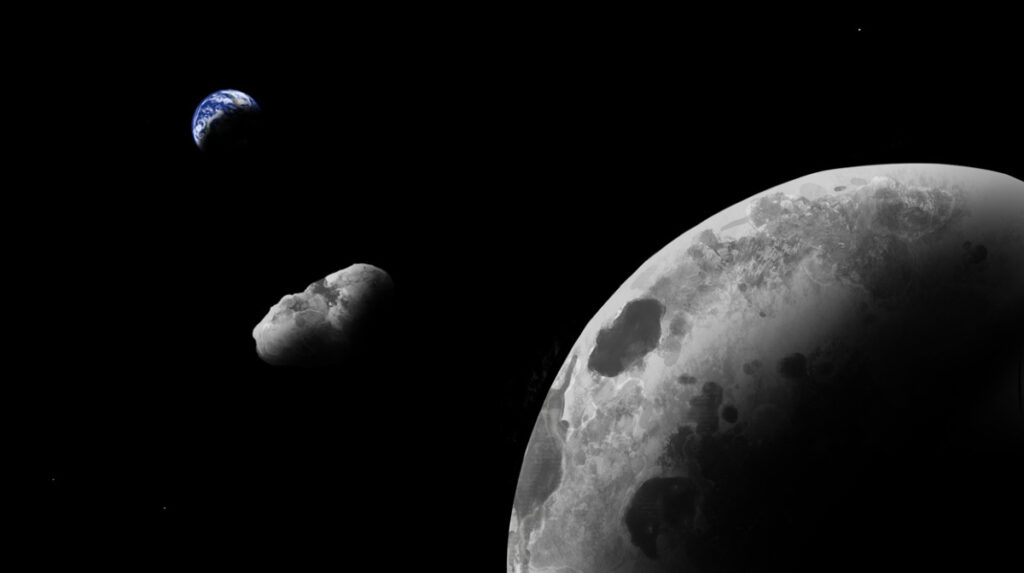
What are quasi-moons
Quasi-moons enter and exit a shared orbit with Earth due to gravitational coincidence.
These small bodies experience tiny forces of gravitational attraction from our planet, although they are not completely captured by it.
PN7 synchronized with the Earth in the mid-1960s, before the first humans set foot on the Moon.
Scientists predict that this object will enter a different orbit around the Sun in 2083.
The quasi-moons discovered so far have the following characteristics:
- Sizes ranging from 9 to 300 meters in diameter
- Variable durations in their orbital configuration with Earth
- Orbits that slide in front of or behind the planet
- Only visible with powerful specialized telescopes
The differences between quasi-moons and mini-moons
Unlike quasi-moons, mini-moons are truly captured by the gravity of the Earth.
These rocks orbit the planet temporarily, usually for less than a year, before breaking free.
So far, astronomers have only observed four mini-moons. The last one, approximately the size of a school bus, left Earth last year after a few months in orbit.
Grigori Fedorets, an astronomer at the University of Turku in Finland, notes that most mini-moons are “quite small, like rocks,” making them difficult to detect.
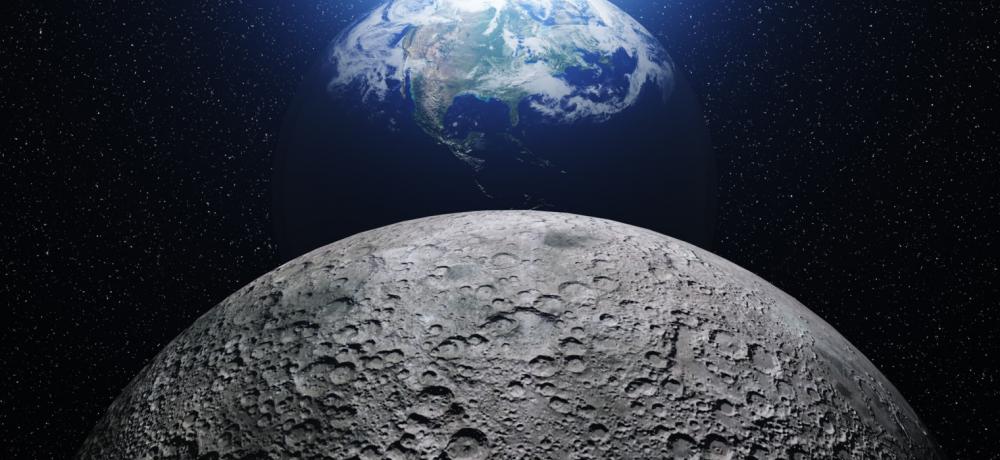
Origin and future research
Scientists are still investigating the origin of these occasional visitors.
They could be near-Earth asteroids that Jupiter pushed into the inner Solar System, or fragments of our Moon torn off by collisions.
When Sharkey and his colleagues studied the quasi-moon Kamo’oalewa, they found that its composition seemed “more like the Moon than any other asteroid we have observed before.”
China sent a mission that will reach Kamo’oalewa next summer.
The probe will collect rocky fragments from this quasi-moon for analysis, which could help determine its origins.
“They really make you reconsider a neat, orderly, and static view of the Solar System,” Sharkey says about these discoveries.
New telescopes, particularly the Vera C. Rubin Observatory, promise to detect more similar objects in the near future.



