



Starting this Friday 22 until September 20, Uruguay begins its exploration of the seabed. A team of scientists will lead the expedition “Uruguay Sub200: Journey into the Unknown”.
They will study the marine fauna and geological structures of the Uruguayan continental shelf.
The mission, taking place aboard a vessel from the Schmidt Ocean Institute of the United States, equipped with cutting-edge technology, promises to provide unprecedented knowledge about deep-sea biodiversity and ecosystems.
A pioneering research on the seabed
Similar to the CONICET mission in Argentina‘s Mar del Plata canyon, it promises to be impressive.
According to Leticia Burone, a Ph.D. in Marine Geology and lecturer at the Faculty of Sciences of the University of the Republic, the fieldwork will generate information for conducting research over “many years”.
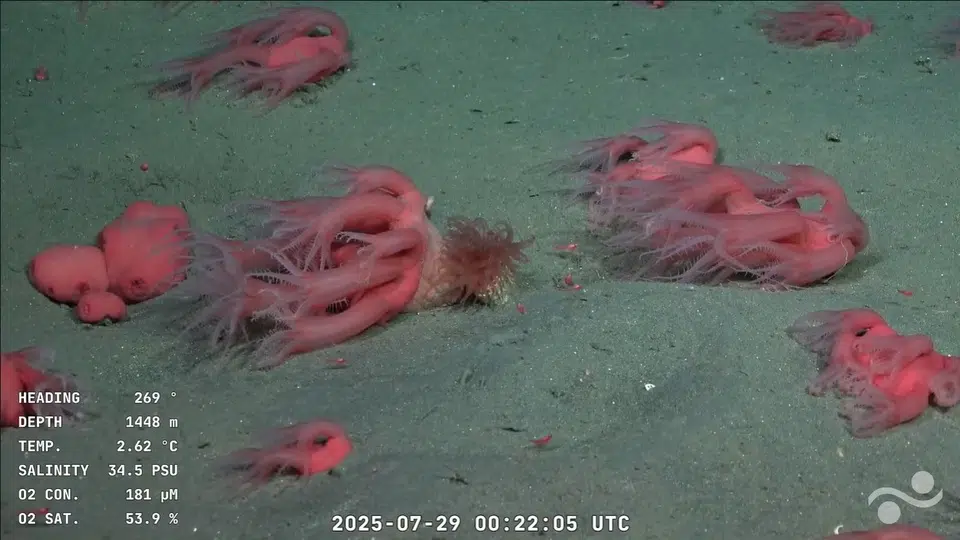
The study area includes a strip of the continental slope, located about 200 kilometers off the Uruguayan coast, with depths ranging from 200 to 3600 meters.
There, the team of 37 scientists plans to explore up to 50 potential sites, including the six submarine canyons of the country. Unique formations such as coral mounds could be found there.
Furthermore, they will search for submarine fluid emissions associated with chemosynthetic organisms, organisms capable of generating energy without sunlight, opening a window to studying life forms adapted to extreme conditions.
An international team for a strategic project
The expedition will involve specialists in marine ecology, underwater archaeology, geophysics, and deep-sea mapping. They come from Uruguay, Argentina, Brazil, Chile, Germany, and France.
Burone highlighted that, although this mission is carried out with the same vessel that recently explored the Mar del Plata Canyon in Argentina, the objectives and oceanographic conditions are different.
While in Argentine waters the influence of cold Antarctic currents prevails, on the Uruguayan continental shelf there is an interaction of these water masses with warm currents from Brazil. This creates ecosystems with unique physical and chemical characteristics.
Science, sovereignty, and oceanic culture
For Burone and researcher Fabrizio Scarabino, this expedition will be a turning point for both Uruguayan science and society in general.
In addition to its contributions to knowledge, they hope that the online broadcast will spark a similar interest to the one generated by the Argentine expedition.
“It is something wonderful for sovereignty and for our culture. Uruguay already has more marine territory than land, but it is still not part of our collective identity. We don’t see it in school or high school, and these types of initiatives help to change that,” highlighted Scarabino.
The Uruguay Sub200 expedition not only promises valuable scientific discoveries but also reinforces the need to view the sea as an essential part of the country’s present and future.



