



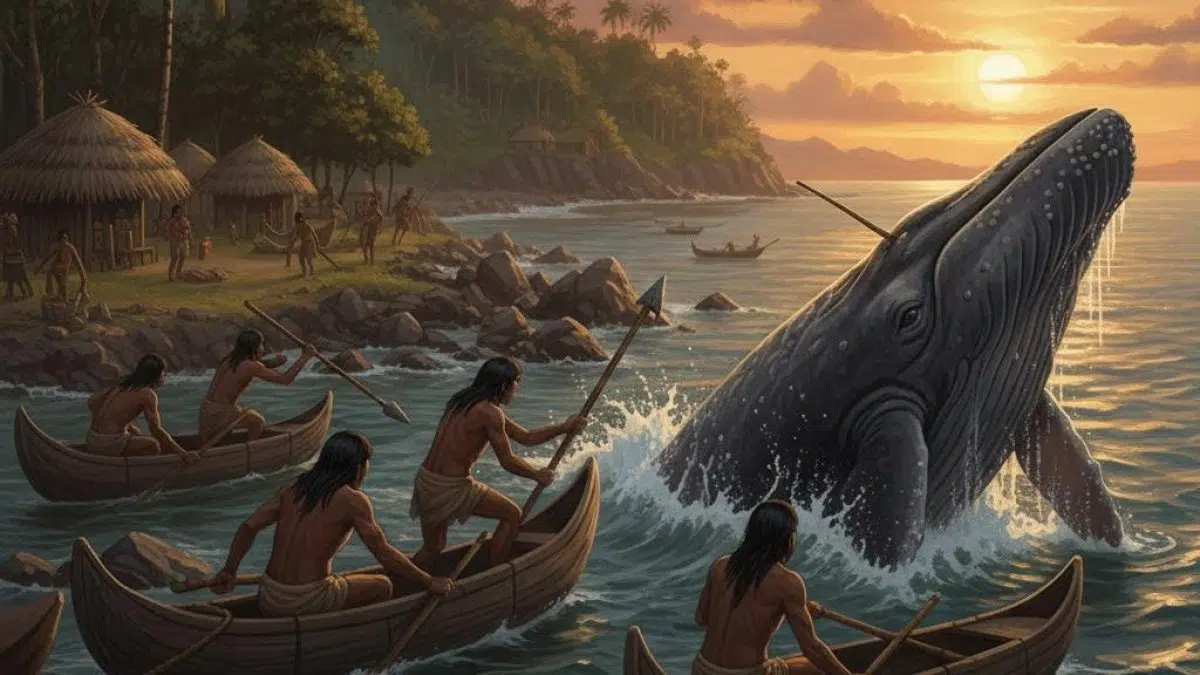
An international study published in Nature Communications revealed that whale hunting in South America began 5,000 years ago, a thousand years earlier than previously believed.
Findings in the sambaquis of southern Brazil — ancient shell mounds in the Babitonga Bay — show that indigenous communities developed advanced techniques to capture large cetaceans. This transforms the global understanding of the origins of complex maritime cultures.
Archaeological evidence in sambaquis
Researchers identified bone remains of various species:
- Humpback whale
- Southern right whale
- Blue and sei whale
- Sperm whale
- Dolphin
Many bones showed cut marks associated with butchering, confirming intentional and organized hunting activity, beyond the exploitation of stranded animals.
Additionally, large harpoons made from whale bones were found, some of the largest such artifacts known in South America. Their presence in funerary contexts suggests that cetaceans had a ritual and social role, besides being a food source.
A paradigm shift
The team led by Krista McGrath and André Colonese from the ICTA-UAB concluded that these sambaqui communities developed specialized knowledge and tools thousands of years before the Arctic and North Pacific cultures, where the oldest evidence of whale hunting dated between 3,500 and 2,500 years ago.
This finding redefines the place of South American societies in the origins of complex maritime cultures, until now attributed almost exclusively to the northern hemisphere.
Social and cultural dimension
The analysis of funerary contexts, where whale bones appear alongside human remains, evidences a structured relationship between the communities and the maritime environment.
Cetaceans were not only a food source but also part of ritual practices and the cultural identity of the sambaqui peoples.
Implications for conservation
Co-author Marta Cremer noted that the recent increase in humpback whale sightings in southern Brazil could be linked to a historical recolonization of the species. This provides new perspectives for cetacean conservation in the South Atlantic.
Interdisciplinary methodology
The study combined:
- Zooarchaeology
- Typological analysis
- Advanced molecular techniques
These methods allowed for documenting the diversity of species captured and the development of specific technologies for hunting large cetaceans. The materials analyzed are preserved in the Archaeological Museum of Sambaquis of Joinville, one of the main repositories of information on these cultures following the destruction of many original sites.
The finding in the Brazilian sambaquis advances the chronology of whale hunting by a thousand years and grants South American communities a central role in the history of maritime cultures.
Beyond archaeology, this discovery connects past and present, providing insights for cetacean conservation and understanding the relationship between human societies and the ocean.


