



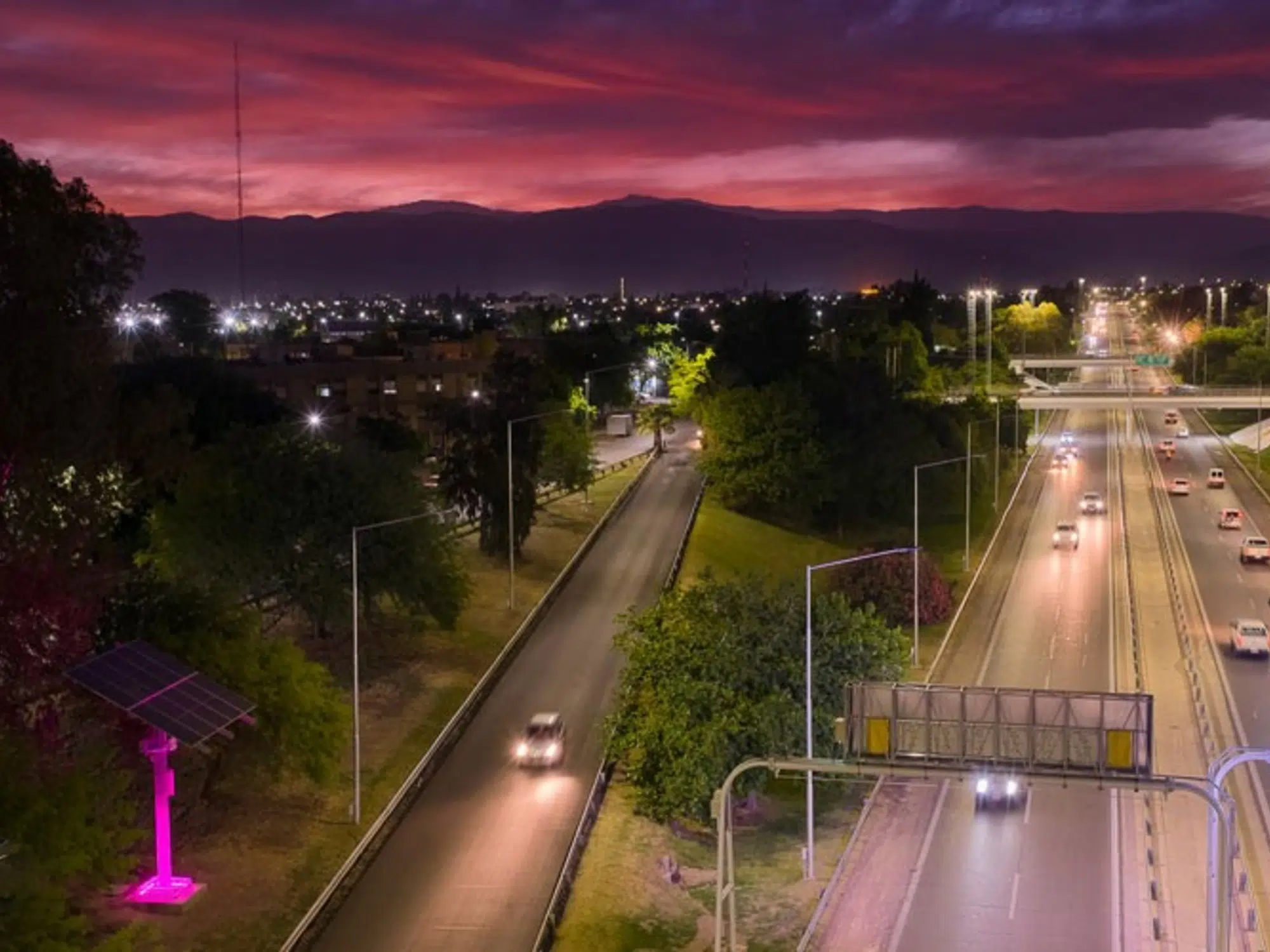
The province of San Juan inaugurated the country’s first road illuminated exclusively with solar energy.
The Avenida de Circunvalación (National Route A014) began operating with a public lighting system powered by photovoltaic panels, marking a milestone in the sustainable modernization of Argentine road infrastructure.
Technical details of the project
The system includes 36 individual photovoltaic generators of 5 kW each, installed on seven-meter-high metal monopoles and oriented to the north. These units operate autonomously, ensuring constant lighting at night without relying on the electrical grid.
The energy independence allows that, even in the event of outages or failures in the conventional supply, the lighting continues to operate, reinforcing road safety on a high-traffic avenue.
Benefits of solar energy on roads
Solar lighting offers multiple advantages:
- Environmental sustainability: reduces greenhouse gas emissions and dependence on fossil fuels.
- Enhanced road safety: ensures constant lighting, even in rural areas or during blackouts.
- Economic efficiency: eliminates costs of underground wiring and monthly electric bills.
- Minimal maintenance: thanks to the durability of materials and LED technology.
International context
Photovoltaic road infrastructure is already implemented in countries such as South Korea, the Netherlands, and the United States (California), where solar roads incorporate sensors and storage systems to improve energy efficiency.
The project in San Juan positions itself as a first step towards technological innovation in Argentina, with the potential to be replicated in other provinces.
Economic and social impact
The project, carried out by Sergio Chiconi S.R.L. together with EPSE, involved more than 80 specialized professionals and technicians, including engineers, welders, and metallurgists. Besides strengthening local technical expertise, it boosted regional suppliers and laid the groundwork for future energy projects.
Such initiatives contribute to the blue and green economy, generating employment, reducing public costs, and improving safety on high-traffic roads and dangerous crossings.
Innovation and future
The installation of solar lighting on roads opens the door to new applications: traffic monitoring systems, environmental sensors, and charging stations for electric vehicles. In a country with vast rural areas and extensive roads, solar energy can become a strategic solution to ensure safety and connectivity without relying on the traditional electrical grid.
Argentina’s first solar road in San Juan represents a strategic advance in sustainable infrastructure, combining technological innovation, economic savings, and environmental benefits. This project demonstrates that the energy transition can be practically integrated into daily life, illuminating paths with clean and reliable energy.



