



In Spain and other countries, the construction sector is undergoing a transformation. Traditional materials such as brick and concrete are starting to be replaced by lighter and more environmentally friendly alternatives. Among them, blocks made from coffee, wood, and even modular systems that are assembled like Lego pieces stand out.
To this trend, an innovative development in Brazil is added: the creation of ceramic bricks made from seaweed known as sargassum. This resource, abundant in the Atlantic Ocean, poses an environmental problem when it accumulates on the coasts, but it also represents an opportunity to transform waste into sustainable solutions.
Seaweeds, as they decompose, generate harmful gases such as hydrogen sulfide and methane, which affect health and biodiversity. Moreover, their proliferation causes serious economic and social consequences in coastal communities. Faced with this reality, a group of Brazilian researchers found a way to reuse sargassum in the construction industry.
The project, led by universities in São Paulo and São Carlos, involves incorporating these seaweeds into clay to obtain lighter and ecological bricks. The manufacturing process includes different proportions of biomass and the use of conventional or microwave ovens to ensure the material’s strength.
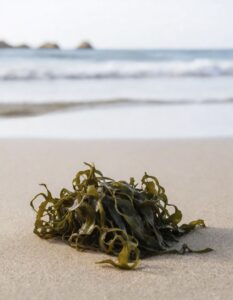 Seaweeds are used for the creation of ecological bricks, used for sustainable construction. Photo: Freepik.
Sustainable construction: a path towards greener cities
The proposal not only aims to solve the excess of sargassum on beaches but also opens the door to construction with less environmental impact. Trials have shown that mixtures with up to 40% seaweed reduce the density of blocks, improving their thermal performance and reducing the consumption of natural resources.
Furthermore, the life cycle analysis of these bricks revealed better environmental performance compared to conventional expanded clay. This means fewer pollutant emissions and a lower carbon footprint throughout the production process.
There was even experimentation with particle panels and fiber-cement tiles using sargassum ash as a substitute for limestone. The results were positive, showing that this resource can completely replace non-renewable materials without compromising quality or durability.
These advances drive a more sustainable vision of the sector, where each innovation becomes an opportunity to rethink how we build our cities.
A future with less waste and more efficiency
The use of sargassum in the construction industry is a clear example of circular economy: transforming an environmental problem into a valuable resource. Moreover, the lightness of bricks made with seaweed promotes energy efficiency in buildings by improving insulation and reducing the need for air conditioning.
Sustainable construction goes beyond material choices. It also involves processes that reduce water and energy consumption and pollutant emissions. In this sense, the use of microwave ovens in the production of clay with sargassum is presented as a more efficient option than conventional ovens.
The Brazilian experience demonstrates that ecological innovation can arise from environmental challenges themselves. With a global perspective, this type of research could be replicated in other countries affected by algae proliferation, offering local solutions to common problems.
 Seaweeds, the new tool for sustainable construction.
The positive impact on the sector and the planet
The introduction of materials such as sargassum bricks not only reduces pressure on landfills and coastal ecosystems but also sets a new standard for more responsible construction. The combination of technological innovation and environmental awareness sets a course towards buildings that, instead of creating negative impacts, provide benefits to the environment.
The challenge now is to scale up these initiatives and to ensure that construction companies and governments adopt them as part of their sustainability policies. The transition to green cities requires political will, investment in research, and increased public awareness of the role of construction in the climate crisis.
Turning seaweeds into bricks is undoubtedly an inspiring example of how waste can be turned into valuable resources. An opportunity for construction to no longer be seen as a highly polluting industry and to become a driver of change towards a more balanced future between progress and nature.



