



South America boasts more than 300 national parks, but many remain off the tourist and scientific radar. One of them, located in the northeast of the province of Córdoba (Argentina), holds an extraordinary secret: the Mar de Ansenuza, also known as Laguna de Mar Chiquita, the largest saltwater lagoon in South America and the fifth largest in the world.
An inland sea in the heart of Argentina
With more than 6,000 km² of surface area, the Mar de Ansenuza stretches out like a true inland sea, where the horizon blends with the sky. Its high concentration of mineral salts creates a unique and fragile environment, in which only certain species manage to adapt.
The landscape, with pink, gray, and turquoise tones, attracts photographers, tourists, scientists, and nature lovers every year. However, beyond its beauty, this wetland is considered one of the most important on the continent for its role in biodiversity conservation.
Sanctuary for migratory birds
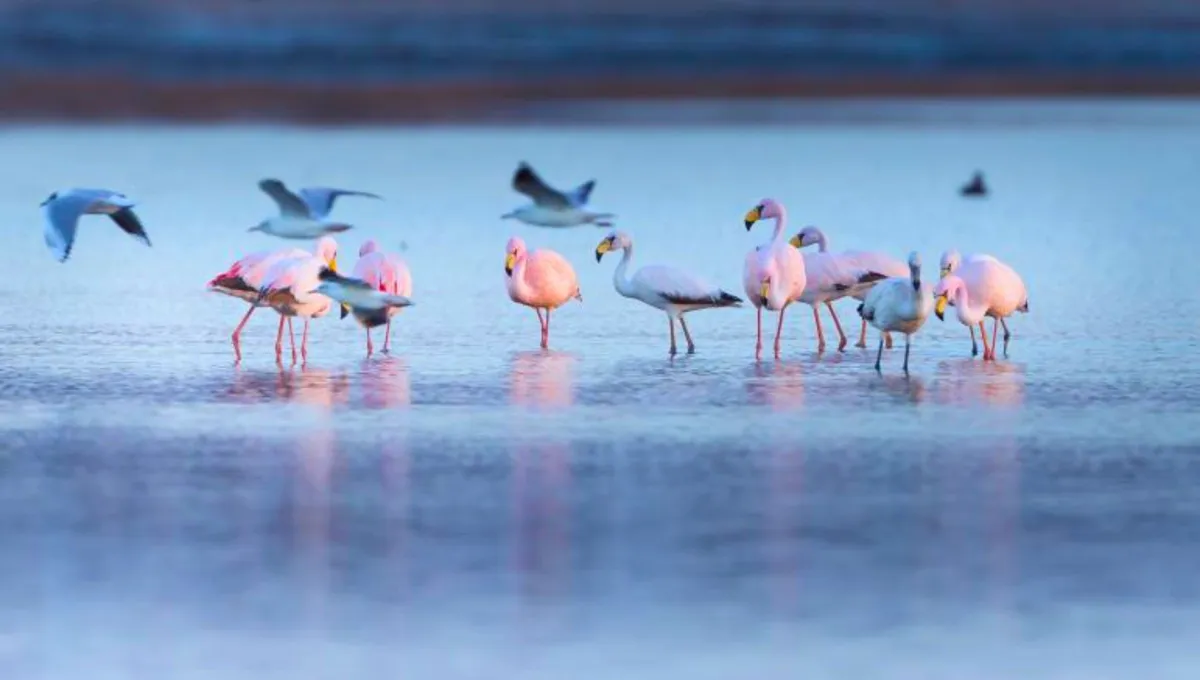
The Parque Nacional Ansenuza is home to more than 350 bird species, including three varieties of flamingos:
- Chilean flamingo.
- Andean flamingo.
- Puna flamingo.
Additionally, it serves as a biological corridor for migratory birds arriving from Canada, the United States, and other regions of the continent, consolidating its international significance.
Other birds present include herons, storks, roseate spoonbills, ibis, cormorants, and ducks, which find a safe haven in this wetland.
Flora and fauna adapted to salinity
The park’s flora consists of species adapted to the soil’s salinity:
- Trees: carob trees, quebracho trees, molle, and horco quebracho.
- Shrubs and plants: pennyroyal, piquillín, peperina, thyme, reed beds, and bulrushes.
- Halophytic vegetation: species resistant to salinity, typical of saline wetlands.
The fauna is equally diverse:
- Mammals: coypu, capybara, red opossum, brown brocket deer, collared peccary, pampas fox, ferret, and wildcat.
- Threatened species: neotropical otter and maned wolf.
- Reptiles and amphibians: iguanas, lizards, terrestrial turtles, toads, and frogs.
A protected area of continental scale
The creation of Parque Nacional Ansenuza was a fundamental step in protecting this ecosystem, threatened for decades by agricultural expansion, pollution, and alterations in the rivers that feed it.
The protected area covers about 600,000 hectares, comparable in size to Argentina’s great national parks like Nahuel Huapi, Iguazú, or Los Glaciares. Additionally, it is the endpoint of Argentina’s largest endorheic basin, meaning a basin with no river outlet to the ocean.
The name “Ansenuza” comes from the goddess of the waters of the indigenous peoples who inhabited the region, reinforcing the cultural and spiritual connection with this landscape.
Nature tourism and recreational activities
The park offers multiple activities for visitors:
- Bird watching.
- Nature photography.
- Kayaking in permitted areas.
- Hiking and panoramic viewpoint tours.
These experiences allow visitors to enjoy the vastness of the wetland while promoting environmental education and respect for biodiversity.
The Parque Nacional Ansenuza not only protects the largest saline lagoon in South America but also stands as a symbol of conservation and resilience. Its ecological, cultural, and scenic richness makes it a continental treasure, crucial for biodiversity and for the future of generations seeking a more balanced planet.


