



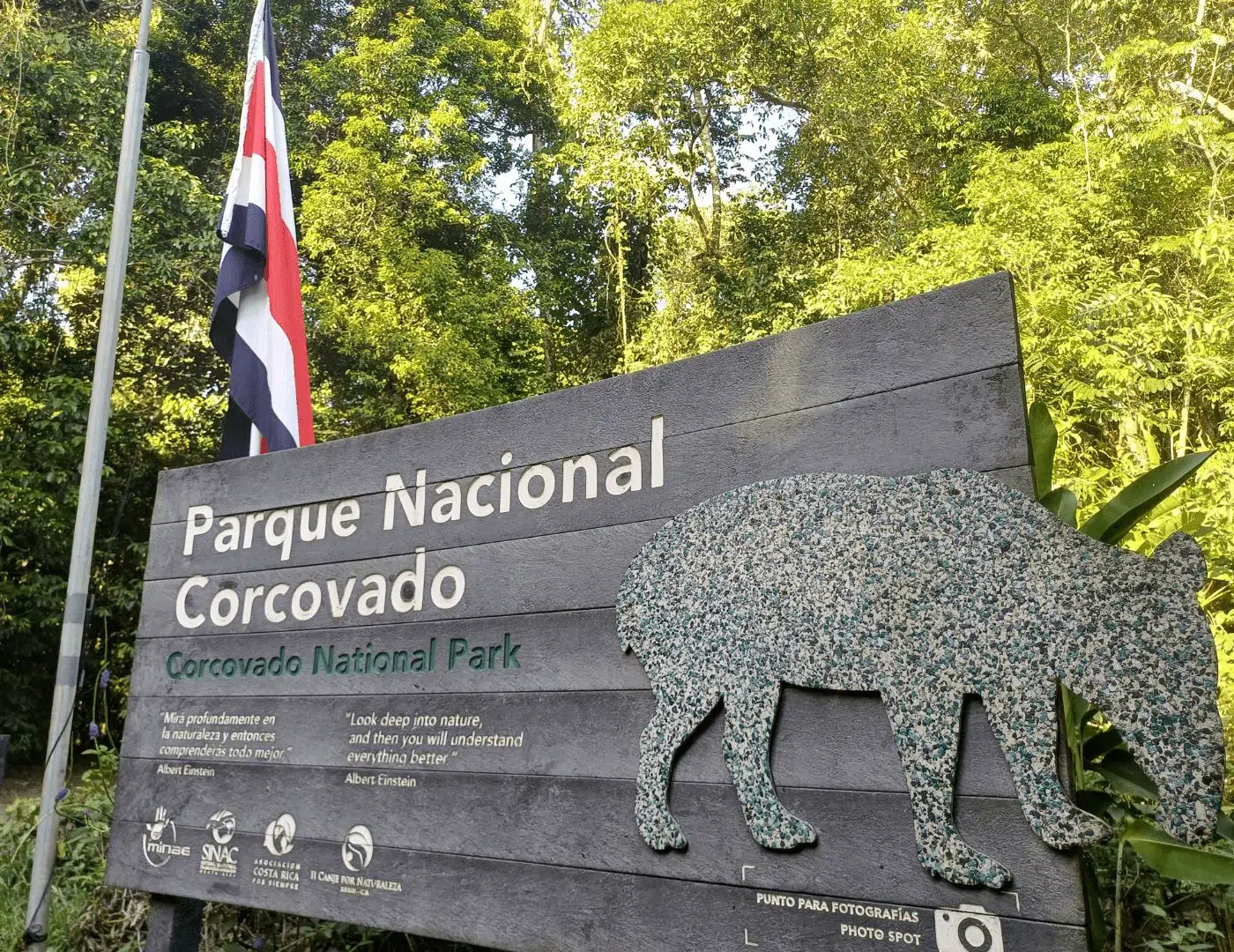
Located in the **Osa Peninsula**, in the southwest of **Costa Rica**, the **Corcovado National Park** covers an area of **424 km²** and protects approximately one third of the peninsula.
Recognized by **National Geographic** as “the most biologically intense place on Earth,” this park is home to **13 main ecosystems**, ranging from **rainforests and cloud forests** [to](https://noticiasambientales.com/medio-ambiente/las-amenazas-que-ponen-en-riesgo-a-los-manglares-de-ecuador/) **mangroves and coastal marine habitats**.
## A refuge for emblematic species and unique ecosystems
The biological diversity of Corcovado National Park includes:
– **500 tree species**
– **400 bird species**, with the largest population of **scarlet macaws** in Central America
– Dozens of species of reptiles and amphibians
– Mammals such as the **Baird’s tapir**, **jaguar**, **puma**, **harpy eagle**, **squirrel monkeys**, **white-lipped peccaries**, and **sloths**
Moreover, its **39 kilometers of golden beaches** lined with coconut trees are habitat for **hammerhead sharks**, **crocodiles**, and **bull sharks**, especially in the lagoons and estuaries of the Claro and Sirena rivers.
## From illegal extraction to regulated ecotourism
The creation of the park transformed the **Osa Peninsula** and allowed the forest to regenerate.
Before its protection, the region was a scene of:
– Uncontrolled logging
– Poaching
– Illegal gold mining
Since the park was established, the tree canopy has increased by **11% between 1987 and 2017**, contrasting with the widespread loss of [tropical forests in the region](https://noticiasambientales.com/medio-ambiente/rayos-en-los-bosques-tropicales-amenazas-ocultas-beneficios-inesperados-y-un-actor-clave-en-la-regeneracion/).
**Regulated ecotourism** replaced extractive activities, making Corcovado the **tenth most visited park in Costa Rica**, with **50,000 annual visitors**.
## Controlled access and effective conservation
Only three public trails allow entry, always accompanied by authorized guides. The enabled routes are:
– **La Sirena**: the most popular, with overnight options
– **La Leona**: crosses the southern jungle coast
– **Los Patos**: a challenging journey from the north
The **[National System of Conservation Areas](https://www.sinac.go.cr/ES/Paginas/default.aspx) (SINAC)** oversees the park with a small team of rangers, ensuring that most of the territory remains **free from human intervention**, except for **authorized scientific research**.
## Tensions between conservation and tourism development
**The increase in visitors and new projects raise concerns among local communities**.
Recently, the daily capacity at La Sirena was doubled from **120 to 240 people**, causing unease. Additionally, projects such as:
– A paved road along the Osa coast
– The Botanika Hotel (Hilton), opened three years ago
– A possible international airport in Puerto Jiménez
During the pandemic, the drop in tourism led to the **resurgence of illegal activities**, highlighting the **fragility of the balance between conservation and the local economy**.
## Beyond the park: biological corridors and territorial expansion
**The fauna of Corcovado extends to adjacent reserves, strengthening ecological connectivity**.
Recent data shows that species like the **tapir**, **jaguar**, and **white-lipped peccary** move towards neighboring areas such as the **Golfo Dulce Forest Reserve** and the **Piedras Blancas National Park**.
Organizations like **Osa Conservation**, managing over **3,200 hectares**, dream of a **continuous biological corridor** connecting the Osa Peninsula to the **Talamanca Range**, creating a **resilient ecosystem to climate change**.


