



At the southernmost tip of continental Argentina, Cabo Vírgenes stands out as a unique place: it is the kilometer zero of the National Route 40 and hosts one of the most important penguin colonies in the country.
This corner of Santa Cruz combines history, nature, and conservation, becoming an emblematic destination in Patagonia.
The journey to the cape
The journey usually begins in Río Gallegos. From there, the Provincial Route No. 1 ventures into the Patagonian steppe, crossing historic fields like Chimen Aike, El Cóndor, and Cerro Redondo, until reaching the Estancia Monte Dinero, which now welcomes visitors with an inn and a tea house called “Al fin y al cabo.”
A few more kilometers of gravel finally lead to the cape, through wind-swept grasslands and open views of the Atlantic.
An expanding penguin colony
The jewel of Cabo Vírgenes is its Magellanic penguin colony. In season, the coast transforms into a true “penguin town”: thousands of birds entering and exiting the sea, defending nests, and feeding their chicks.
While other colonies in Patagonia show signs of decline, Cabo Vírgenes remains one of the largest and most productive due to a well-preserved terrestrial habitat and a sea rich in food. Visitors walk along designated paths and observe everyday scenes: territorial disputes, greetings between pairs, and chicks demanding food.
The wide tides change the landscape several times a day: at low tide, penguins must walk hundreds of meters to the water; at high tide, the waves reach the base of the cliffs and the colony retreats inland.
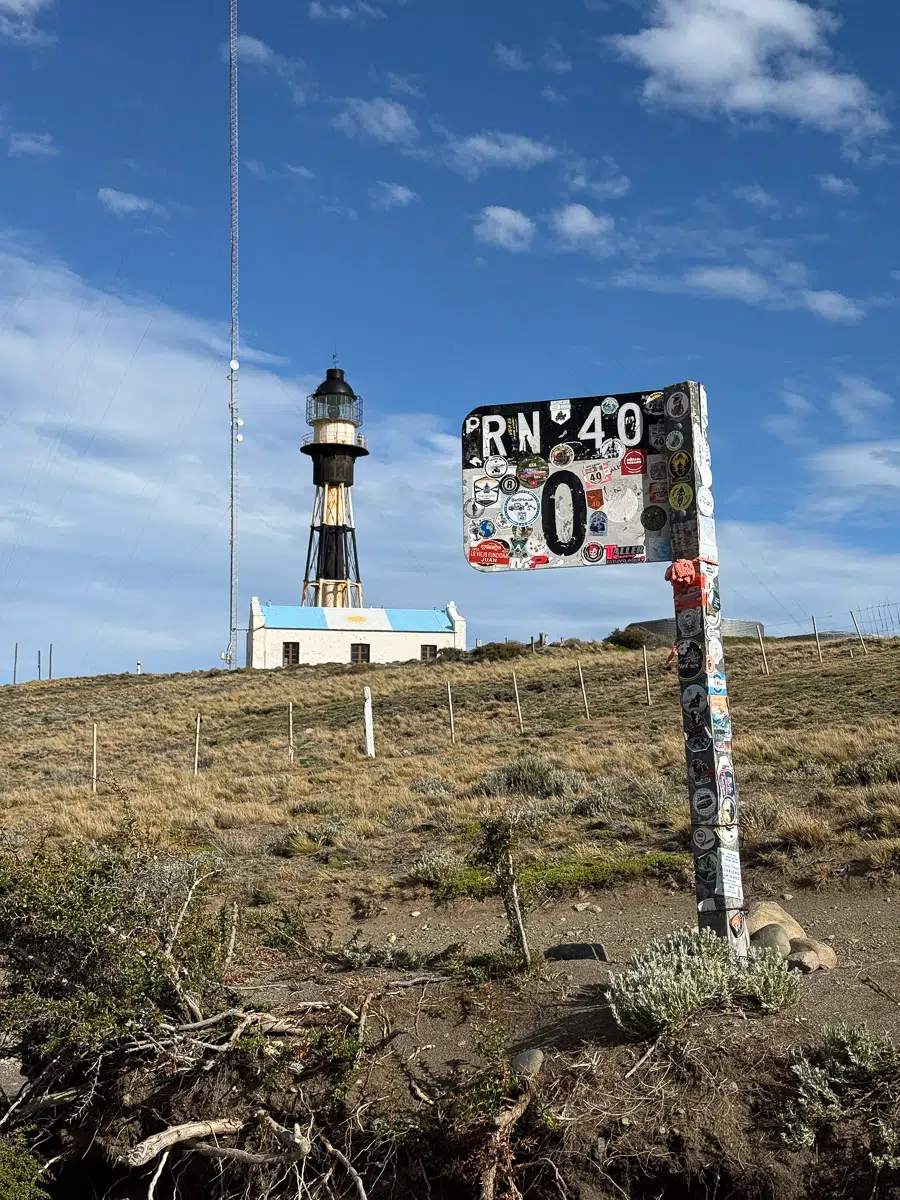
The lighthouse and history
The Cabo Vírgenes Lighthouse, inaugurated in 1904 and painted in black and white, dominates the landscape and watches over the Eastern Mouth of the Strait of Magellan, one of the most challenging areas for navigation. On clear days, Punta Dungeness and the northern coast of Tierra del Fuego can be distinguished.
The cape was named by the expedition of Ferdinand Magellan on October 21, 1520, the day of Saint Ursula and the Eleven Thousand Virgins. Nearby was the short-lived City of the Name of Jesus, one of the first Spanish settlements in the region.
In 2003, the lighthouse museum was inaugurated, exhibiting objects, panels, and photographs about the life of the lighthouse keepers, shipwrecks, and rescues, completing the historical experience.
Steppe, sea, and underwater forests
In front of these coasts, macroalgae forests (Macrocystis pyrifera) develop, true “forests under the sea” that:
- Provide refuge and breeding sites for fish and invertebrates.
- Cushion the force of the waves.
- Produce oxygen and store carbon.
These invisible ecosystems support much of the marine life that feeds the penguin colony.
Organizations like the Fundación Por el Mar, the Santa Cruz Agrarian Council, WCS Argentina, and the University of Patagonia research the penguins’ routes and key areas to ensure the health of the colony.
Conservation rules
The visitor plays a fundamental role in caring for the place. The reserve establishes clear rules:
- Do not enter with pets.
- Remove trash.
- Respect marked circuits.
- Do not touch nests or get too close to the animals.
- Avoid loud noises and follow staff instructions.
Cabo Vírgenes is not just the symbolic start of Route 40 nor just another postcard of Patagonia. It is a meeting point between history and nature, where the memory of foundational explorations, the daily life of thousands of penguins, and the richness of underwater ecosystems that sustain the biodiversity of the South Atlantic coexist.


