



The Lanín National Park, in the province of Neuquén, is moving forward with an innovative project of dry toilets in high mountains. The goal is to mitigate the environmental impact caused by the increasing number of visitors to the volcano.
After two seasons of operation, the toilets installed in the overnight areas at 2300 and 2600 meters above sea level allowed to obtain the first batch of organic compost to be incorporated into the soil.
The environmental challenge at Lanín
” Knowing that after two seasons we have our first batch of compost for the soil is satisfying,” said Bibiana Chávez to Río Negro Newspaper, from the National Park Conservation and Management Department.
 Dry toilets, a success in Lanín. (Photo: Argentine Mountain Guides Association).
The initiative emerged in response to the sustained increase in visitors to the area. Before the pandemic, the average influx was 3000 people per season, but as of 2021, the number exceeded 4000 visitors and in the last season reached 4600 entries.
They were located in high-altitude accommodation areas, such as the domes of the Mountain Guides Association and Alquimia en Altura, as well as the military shelter at 2300 meters and the Caja del Club Andino shelter at 2600 meters. In the area, the old pit latrines collapsed due to overload.
This forced to rethink a sustainable solution for an environment of great environmental fragility.
From pits to dry toilets: a sustainable change
The new system replaces traditional pits with dry toilets. The waste is moved to nearby composters instead of accumulating under the sanitary structure.
This is where the composting process begins, adding wood shavings to provide carbon, reduce odors, and accelerate the decomposition of fecal matter. Some details:
-
In the mountain guides area, each deposit is collected in a 20-liter bucket that is later emptied into a composter 20 meters from the toilet.
-
In the case of Alquimia en Altura, the waste was collected in 200 and 300-liter containers. Initially, they were treated with lime, but since the last season, they are directly incorporated into the composting process.
-
The Andean Club also implemented the system of a PVC pipe with compostable bags that are transported to the base.
Scientific monitoring in mountain soils
The project has the support of the Regional University Center of San Martín de los Andes. They conducted soil studies at 2300 meters above sea level before and after the operation of the latrines.
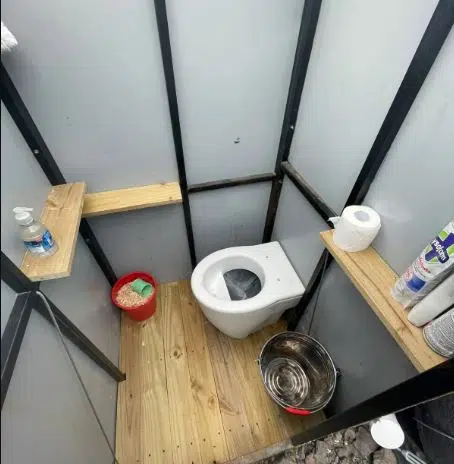 What the new toilets are like. (Photo: Río Negro Newspaper).
A young soil was detected, but with sufficient biological activity to support the installation of composters.
Another one was installed at the base of the volcano, in a wooded area with greater soil depth and abundant soil fauna, favoring the integration of the composted material.
In March, samples were taken in both sectors to analyze the presence of pathogens. The results, carried out by a laboratory from Mar del Plata with headquarters in Bariloche, will validate the incorporation of compost into the soil during the spring.
Sustainable tourism and environmental education
The project of dry toilets in Lanín National Park is supported by the joint work of park rangers, environmental education teams, tourist operators, and specialized technicians.
During the high season, monthly monitoring and educational campaigns are carried out to ensure the proper use of these toilets. ” The person must understand that a dry toilet works differently from conventional ones. Therefore, in addition to the infrastructure, the project includes a strong educational component,” Chávez concluded.
With this pioneering system, Lanín National Park positions itself as a benchmark in sustainable tourism in Patagonia, demonstrating that it is possible to reconcile tourist activity with environmental conservation in highly fragile ecosystems.


