



On the coast of Chubut, **Camarones** lies against the vastness of the ocean as if ignoring the vertigo of modernity. It does not seek to seduce with artifice or overwhelm with offers. It is a town that invites, but does not beg; that shows itself, but does not exhibit. There, tourism adopts a different rhythm: less frantic, **more natural**.
Founded in the late 19th century, this coastal town combines history, **biodiversity**, and a serenity that is hard to come by. Far from massive tourist spots, it offers experiences that unfold naturally.
Camarones proposes a sensitive openness to details: the constant sound of the sea, the flight of a **cormorant**, a corrugated iron house that holds within its structure the memory of the wind and the first inhabitants.
One of the voices that best interprets the soul of the place is that of Silvia Giménez, a textile artisan and local guide, originally from Punta Alta. She arrived in 1996 and built her life among yarns, walks, and stories.
With a deep knowledge of the environment and the culture of the town, Silvia offers a tour that **goes beyond conventional tourism**.
## Among penguins, steppes, and corrugated iron houses
The traditional tourist circuit includes the Perón Family Museum—a must-visit site for those wishing to understand the region’s political and social past—and the protected area **Cabo Dos Bahías**, located 28 kilometers from the urban center.
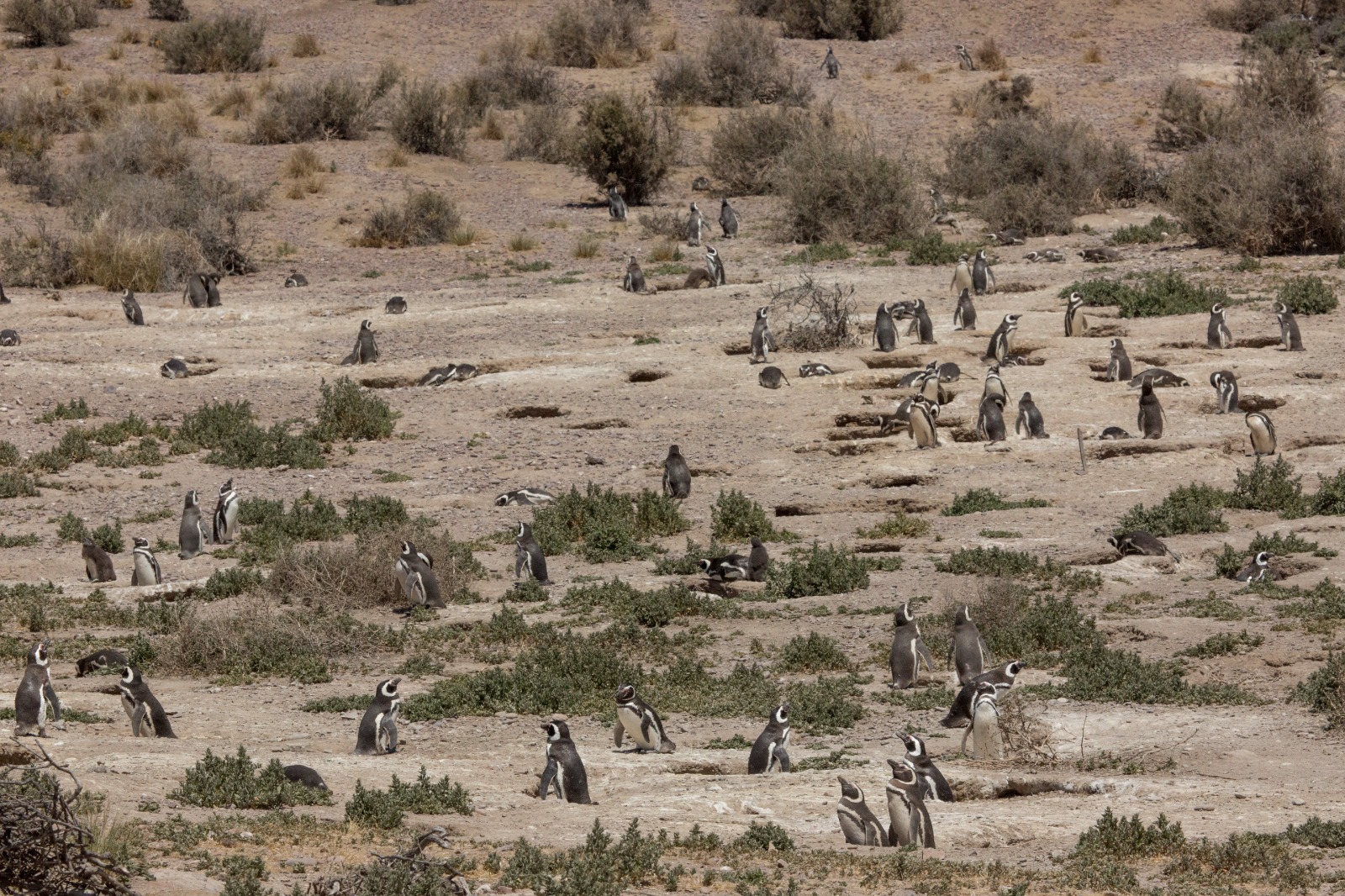
In this reserve, one of the most accessible colonies of **Magellanic penguins** in the province can be found, with a season that extends from mid-September to late April. “The **observation** is done through well-signposted paths, in an environment of low cliffs, low vegetation, and diverse fauna,” highlights Silvia.
Boat excursions are also offered for marine wildlife observation and navigation to Isla Leones, another icon of the **Blue Patagonia Provincial Park**, the great conservation corridor that unfolds to the south of Golfo San Jorge.
From the town, it is possible to access different park entrances: the Isla Leones Entrance, with access through Estancia El Sauce just 8 kilometers away, and the Bahía Bustamante Entrance, through Estancia La Ibérica, 80 kilometers further south.
## A landscape on the coast of Chubut made of sounds and silences
But beyond the points marked on the map, Camarones holds small secrets that define its true identity. One of them is “el arroyito,” a geographical feature located just one kilometer from the town, accessible through a **coastal trail**. There, a stream naturally drains from the high areas to the sea, forming a mosaic of ecosystems: rocky intertidal zones, marshes, and **Patagonian steppe**.
“There is a self-guided circuit with interpretive signage, ideal for those seeking a silent observation experience, without intermediaries,” emphasizes the local guide and points out: “El arroyito is like a miniature representation of **different ecosystems** and how beautifully nature has done things in this corner of the country.”
According to Silvia, living in Camarones is “a privilege that is constantly renewed.” She refers not only to the landscape but to the possibility of feeling part of a history that still breathes.
“I have the feeling of being immersed in the footprints left by the **first inhabitants**, and I feel a certain passion for rescuing those experiences that are not in history books,” she points out.
The everyday environment is composed of simple yet profoundly symbolic elements: the corrugated iron houses, true postcards from the past that are still inhabited; the singing of the birds, coexisting with the sound of the sea; in this **Chubut town**, peace is palpable, perceived as a tangible substance. Here, nature is not a show, but a way of being.
## Without hurry, without molds
Far from conventional tourism structures, in Camarones, it is recommended to pause, observe, listen. The coast of Chubut in its multiple forms—**open beaches, hidden bays, gentle cliffs**—offers places where simply sitting and watching becomes a fulfilling act.
The town, unpretentious, proposes another scale of values: less consumption, more contemplation; less schedule, more freedom.
Camarones represents an alternative that combines **pristine nature**, living history, and a community that values memory as much as the present.
It is not just about visiting a place, but about being part— even if only for a few days— of a different way of living, where each moment has its meaning, each corner its story, and each silence its depth.
Because in **Camarones**, everything seems to move at a different pace, at a different time. And that time, like the tide, has its rhythm and does not rush.
*Cover photo: Maike Friedrich*


