



The growing concern over waste from disposable diapers is driving changes in the global industry. Every minute, more than 300,000 units end up in landfills or incineration.
Consequently, the environmental challenge is becoming increasingly urgent. Moreover, the massive use increases the pressure on waste management systems.
A single child can use between 4,000 and 6,000 diapers in their early years. Therefore, the accumulation of waste represents a structural problem. In addition, there is the intensive use of resources such as oil in their manufacture.
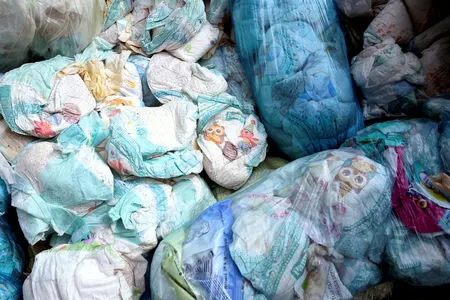
A global problem impacting ecosystems
The annual production of diapers demands millions of barrels of oil. This amplifies the carbon footprint from the product’s origin.
Moreover, their composition combines plastics, fibers, and materials difficult to recycle. As a result, a large portion of this waste persists for decades in the environment.
The impact is evident in regions like Indonesia and West Africa. In these territories, the lack of infrastructure aggravates pollution.
Additionally, there is a presence of microplastics in aquatic fauna. Consequently, the issue transcends the local and affects global ecosystems.
Recycling models in Europe
In Wales, the company Pura works with the local government on a recycling system. The project processes about 60 million diapers a year.
For this, household waste is collected and transported to the NappiCycle plant. There, a friction washing process separates the materials.
These can be reused in pavements or urban furniture. On the other hand, in Belgium, the firm Woosh develops diapers designed to be recycled.
The system integrates production, collection, and processing in a single chain. Currently, it collaborates with 1,400 nurseries and reaches thousands of daily users.

Biodegradable alternatives and the role of fungi
Some initiatives are moving towards biodegradable materials like bamboo fibers and organic cotton. These options aim to reduce the persistence of waste in the environment.
In Texas, the company Hiro Technologies is developing diapers with fungi. These organisms have the ability to accelerate the decomposition of the product.
The approach is based on research on species capable of degrading plastics. Among them, Pestalotiopsis microspora stands out.
This type of solution opens new possibilities in the management of complex waste. However, its implementation still faces technical and economic challenges.
The environmental benefits of these initiatives
The development of recyclable and biodegradable diapers significantly reduces the accumulation of waste. Additionally, it allows for the recovery of materials that were previously lost in landfills.
This contributes to a more efficient circular economy. On the other hand, it reduces pollution of soils, rivers, and oceans.
It also reduces the generation of microplastics that affect biodiversity. Moreover, these solutions promote the responsible use of natural resources.
In the long term, they can decrease the dependence on fossil fuels. Consequently, they strengthen the transition towards more sustainable consumption models.
Challenges for global expansion
Despite the advances, mass adoption still faces obstacles. In many countries, the lack of composting plants limits the impact of biodegradable alternatives.
Moreover, production costs remain high. This hinders their access compared to more economical traditional options.
Challenges also persist in consumer acceptance. Quality, comfort, and hygiene continue to be determining factors.
However, the growth of these initiatives reflects a paradigm shift. Thus, technological innovation and environmental awareness advance together to reduce one of the most persistent wastes of daily life.



