



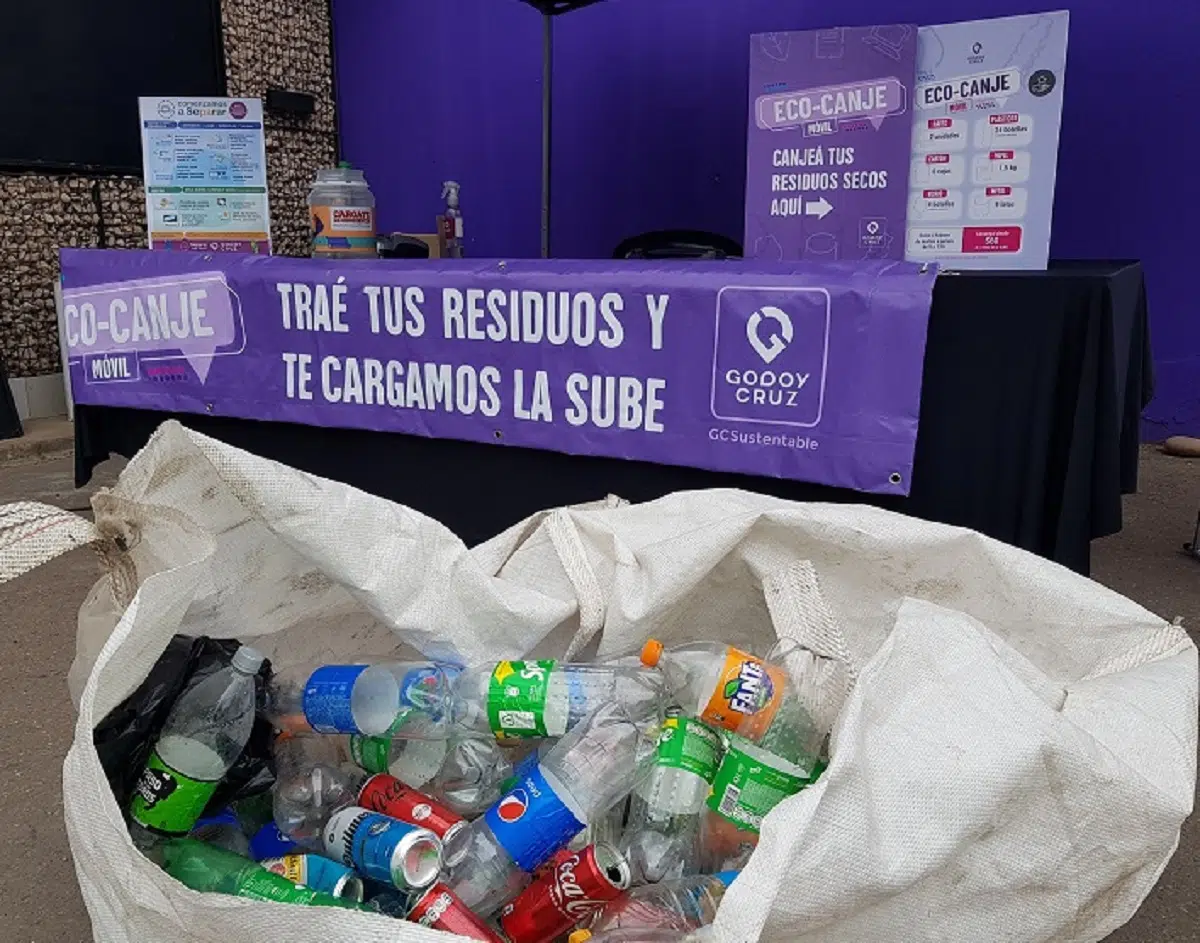
In the municipality of Godoy Cruz (Mendoza), an innovative method for paying bus fares has become popular: EcoCanje, a program that transforms recyclable waste into credit for the SUBE card. The proposal aims for the daily effort of separating waste to return to the neighbor as a concrete and direct benefit.
The system works through the exchange of dry and clean materials —bottles, cardboard, paper, glass, and cans— for public transport fares. The results already show its impact: more than 96,000 fares loaded and the recovery of 31 tons of dry waste that would otherwise have ended up in landfills.
Program rules and operation
Over time, EcoCanje adjusted its conditions to ensure continuity and order in the system:
- The benefit is exclusive to people residing in Godoy Cruz and requires digital validation.
- The accepted materials and minimum quantities are clearly defined.
- The limit is two loads per person per day.
The operation is managed through the Greenly Points app (Android), where each user registers with their personal data and links their SUBE card. The delivered waste is transformed into credits that are then exchanged for fares.
Equivalence table
- 40 plastic bottles of 500 ml or more.
- 3 kilos of cardboard or paper.
- 10 glass bottles.
- 20 aluminum or tin cans.
All materials must be dry and clean.
Exchange points
Residents can go to public spaces such as:
- Parque Mitre
- Poli Nicolino Locche
- Polo Ambiental
At each point, the resident presents the digital coupon along with the SUBE, and the staff performs the corresponding load.
Environmental benefits
Separating dry waste and recycling has multiple advantages:
- Less pollution: prevents harmful materials from mixing with other waste.
- Resource conservation: reduces the extraction of virgin raw materials.
- Energy savings: recycling an aluminum can saves enough energy to keep a television on for three hours.
- Reduction of greenhouse gases: contributes to mitigating climate change.
Economic and social benefits
- Lower costs for municipalities: extends the lifespan of landfills.
- Job creation: supports urban recyclers and the recycling industry.
- Circular economy: promotes the use of recycled materials as raw material in new production chains.
How to do it
- Classify: separate plastics, papers/cardboards, glass, and metals.
- Separate at source: organize waste at home or work before they mix.
- Take them to clean points: deliver them to green spaces or specialized collectors.
EcoCanje demonstrates that recycling makes sense when everyday action translates into a direct benefit. At the intersection of environment and mobility, Godoy Cruz maintains a public policy that changes habits without grandiloquent speeches, betting on the concrete participation of the community.



