



The Secretariat of Environment has made progress in a new strategy to strengthen the circular economy and sustainable waste management. Through a collaboration agreement with the private company Ecobat S.A.S, the Environmental Technologies Park (PTA), in San Juan, will be able to exchange recovered recyclable material for equipment that improves its infrastructure and optimizes its daily tasks.
The first exchange will take place next week. On this occasion, the Park will deliver around 100 tons of recycled materials and, in return, will receive a 48V 400Ah battery bank branded SOLUS. This device will be key to ensuring energy backup, ensuring that the PTA’s equipment operates even in cases of outages or supply failures.
The agreement reinforces the role of the PTA as a protagonist in the comprehensive waste management model of the province. The policy not only aims to reduce environmental impact but also to promote a sustainable economic dynamic, in which waste is transformed into useful resources for new productive processes.
The initiative is part of a public-private cooperation framework framed within provincial laws that promote the circular economy. It does not involve fund transfers but rather the commitment of both parties to an exchange system that adds environmental, social, and economic benefits.
 The Environmental Technologies Park in San Juan exchanges recovered recyclable material for new equipment. Photo: PTA.
Recovered recyclable material: from waste to resource
Recovered recyclable materials are all those solid waste that, after being separated and classified, can be reintegrated into the production cycle instead of being discarded as trash. In the case of the PTA, these include plastics, PET, nylon, drums, cookie containers, raffia bags, hoses, plastic household items, and other products that are collected, sorted, and baled daily.
Once baled, these wastes are stored until they reach a volume that allows for their commercialization or, as in this case, their exchange for equipment. The process not only reduces the disposal of waste in the landfill but also provides secondary raw materials to various industries that manufacture new products.
The agreement with Ecobat also includes the recycling of the battery itself once it reaches the end of its life. The plastic and metal material will be recovered and returned to the production chain, closing a loop that avoids hazardous waste and takes a concrete step towards a more sustainable system.
Thanks to these actions, the PTA consolidates itself as a key link in the transition to the circular economy. Its daily work transforms what used to be waste into valuable input and opens the door to new exchanges that strengthen the Park’s infrastructure.
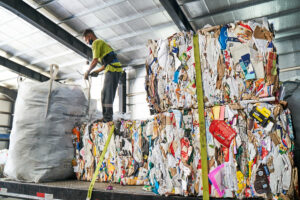 Recycled materials.
Advances in waste management
The agreement with Ecobat is not the only effort of the Secretariat of Environment. Last year, the PTA signed an agreement with the company Arcor to improve the treatment of tetra brik and cans packaging. Previously, they arrived in conditions that prevented their recovery, but by adapting machines to empty, wash, and dry these wastes, now 100% of the material is reused, preventing it from ending up in the landfill.
In addition, the Separar Suma plan, implemented with municipalities, promotes the separation at the source of household waste. This allows residents to contribute directly to the recovery process, improving the quality of the material reaching the Park and increasing the recycled volume.
These measures reflect a paradigm shift: the linear economy based on extraction, production, and disposal is gradually being replaced by a circular model. In this model, waste is treated as resources, final waste is reduced, and less raw materials are extracted from nature.
The first exchange of 100 tons of recyclables for the battery bank will be a concrete step on this path. Beyond the equipment, it symbolizes the construction of a system where what was once considered garbage is transformed into value, and where each exchange adds to the environmental protection and the strengthening of the circular economy in the province.



