



Focusing on an important environmental challenge, the authorities launched the program “The Forest at School,” from San Juan. It is already operating in 23 schools throughout the province, in addition to the institutions that requested talks and awareness activities.
This type of projects with native species are essential in a region with arid climates, where each tree has an incalculable value for environmental balance.
San Juan: environmental education and reforestation with native species
The Directorate of Native Forests of the Ministry of Environment launched just over a year ago The Forest at School. It started in 9 educational institutions and has already expanded to 23 schools throughout the province, in addition to numerous institutions that requested talks and awareness activities.
 How The Forest at School, from San Juan, works for environmental education. (Photo: San Juan municipality).
The program seeks to strengthen environmental education through practical experiences that directly involve students in the conservation of native forests.
In the first stage, playful and didactic training sessions were provided for elementary and high school students. Now, schools are advancing in soil preparation, seedling selection, and reforestation with specimens produced in the Biodiversity Park.
The children and their teachers choose suitable spaces, plant trees and put up identifying signs. Each species is recorded with its common and scientific name, promoting knowledge and respect for the natural environment.
Children as environmental multipliers
“When we started our management, we saw that the community was unaware of the existence of native forests. We decided to start with schools because children are the main disseminators of this knowledge,” explained Gustavo Mercado, Director of Native Forests.
The project proposes creating green spaces within schools for recreation, awareness, and the study of native flora.
Through games, talks, and songs, students learn to recognize the species, their benefits, and their relationship with local ecosystems.
Thus, students not only learn the names and characteristics of trees, but also their multiple uses: from beekeeping and livestock production to flour production or desertification prevention.
In the program’s second phase, progress is made with the planting of species such as carob, broom, chañar, jarilla, brea, cina cina, acacia, and mistletoe, among others, which give rise to small forests in each school.
Culture, education, and follow-up
Some institutions add symbolic value to their green spaces. The Miguel Cervantes School in Santa Lucía, for example, named the forested area Plaza de las Banderas, where flags used are stored in chests after being respectfully retired.
The Native Forest team carries out continuous monitoring to verify the growth of the trees and replace those that do not survive, ensuring the continuity of each school forest.
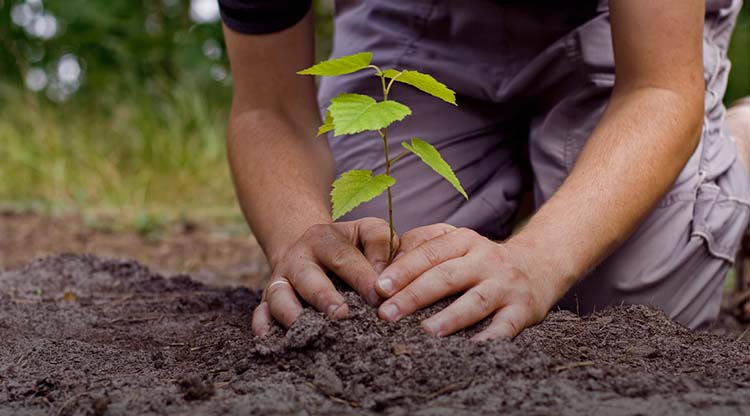 Environmental education and native species.
Outstanding Schools and Next Steps
Among the institutions, we highlight: Guido Spano and Profesor Mathus in Sarmiento; Villascusa and Miguel de Cervantes in Santa Lucía; Paso de Los Andes in Maliman (Iglesia); Julia León in Rivadavia; and Bernardo Housay in Angaco.
To close the year, the program includes three special events. The first will take place at the Villascusa School in Santa Lucía and at the Profesor Alejandro Mathus School in Sarmiento, selected as guiding schools for their enthusiastic support of the project.
The closing will be on September 5th in La Granja, Santa Lucía. A new area will be reforested, participatory games will be held, and a soccer tournament focused on forest conservation will take place.
How to participate in the program
Primary and secondary schools interested in joining “The Forest at School” can register through the website of the Anchipurac Environmental Center. They must submit a project related to the protection of native forests.
It is worth noting that the initiative is framed within the National Law of Native Forests No. 26.331. It aims to enrich, restore, and preserve forest ecosystems, while promoting knowledge about native flora and fauna.



