



Researchers from the Swiss Federal Institute of Technology (ETH) Zurich in Chile created an innovative material in sustainable construction.
It is an element that is not only alive but actively captures carbon through photosynthetic cells.
This advancement combines cyanobacteria, 3D printable hydrogel, and biomineralization to create structures capable of absorbing carbon dioxide (CO2) from the air, similar to a tree.
Sustainable construction and living material: how this innovation works
The secret lies in a cross-linked polymer hydrogel that serves as a support for the cyanobacteria. This gel allows the passage of light, water, nutrients, and CO2, creating a self-sufficient environment where the bacteria perform photosynthesis and generate biomass.
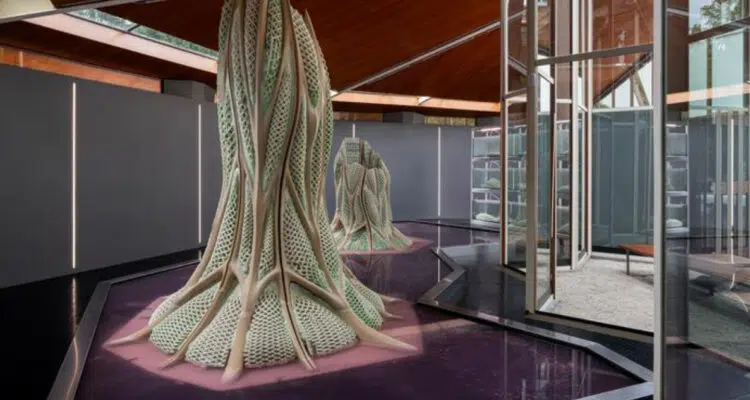
The team was led by Professor Mark Tibbitt. Additionally, they transform part of the CO2 into mineral carbonates, reinforcing the material with stone-like structures.
Ecological benefits and performance
In addition to ensuring a key sustainable construction type for the future, there are various benefits of this material:
-
Prolonged carbon capture: in laboratory tests, the material retained CO₂ for over 400 days, with a rate of 26 mg of CO2 per gram — a figure comparable to the mineralization of recycled concrete.
-
Stable mineral storage: biomineralization allows fixing carbon in a solid form, preventing its re-emission.
-
Structural self-reinforcement: as the carbonates grow, the structure gains rigidity, transforming soft pieces into sturdy blocks.
From the lab to urban architecture
The first applications were showcased at the Canada Pavilion during the Venice Biennale, featuring living blocks up to three meters. They are capable of absorbing up to 18 kg of CO2 per year, similar to an adult pine tree.
This technology opens the door to facade coverings that act as authentic carbon filters integrated into buildings. They do not require complex energy systems.
Key aspects of this development and future steps
Among the highlights of this innovation are:
-
Sustainable construction: reduces the carbon footprint compared to conventional materials.
-
Living architecture: promotes the integration of biological systems that regenerate the urban environment.
-
Easy scalability: thanks to 3D printing and modular design, the pieces can adapt to different shapes and sizes.
Although promising, the material is in the experimental phase. The next goal is mainly to adapt it to real climates, evaluate resistance to extreme conditions.
Furthermore, scaling up production, optimizing costs and industrial processes; as well as integrating it into regulations, that is, ensuring its safe use in real buildings, are essential steps.


