



On August 28th, at the Buenos Aires Grain Exchange, the company **Gensus SA** held the official presentation of “**The new path of cotton**,” an event that brought together leaders from the [agricultural, scientific, business, and governmental sectors](https://noticiasambientales.com/innovacion/globotent-amplia-la-instalacion-expres-de-carpas-agricolas-en-toda-espana/) to announce a historic breakthrough: the commercial approval of the first **biotechnological event applied to cotton** entirely developed in Argentina.
Technology, genetics, and public-private partnership
During the event, they shared the innovations that will transform **cotton production** in the coming years, integrating **advanced genetics**, **biotechnology**, [**sustainable management**](https://noticiasambientales.com/compromiso-ambiental/innovacion-sustentable-estudiantes-de-guaymallen-transforman-residuos-en-un-potente-fertilizante-organico-en-mendoza/), and **strategic partnerships** with the national and international scientific-technological system.
“The new path of cotton is the result of the **synergy between investment in R&D&I and public-private partnership**,” said **Pablo Vaquero**, president of Gensus. “The incorporation of new technologies will **improve fiber quality**, **increase yields**, and **boost exports**. This virtuous process, supported by programs like **Sembrá Evolución**, will strengthen the **competitiveness of the entire Argentine cotton chain**.”
Projections for 2030: doubling production and tripling exports
Vaquero anticipated that by 2030, Argentina is expected to **double its production**, **triple its exports**, and increase the **revenue of the chain to over USD 1.7 billion**, thanks to a 60% growth in yields and a 30% increase in cultivated area.
The event was attended by **Chaco Governor Leandro Zdero**, who highlighted the project’s impact on the **local economy**: “Gensus is betting big on our province, which has great opportunities. This technological advancement will **provide tranquility and value to the entire regional economic chain**.”
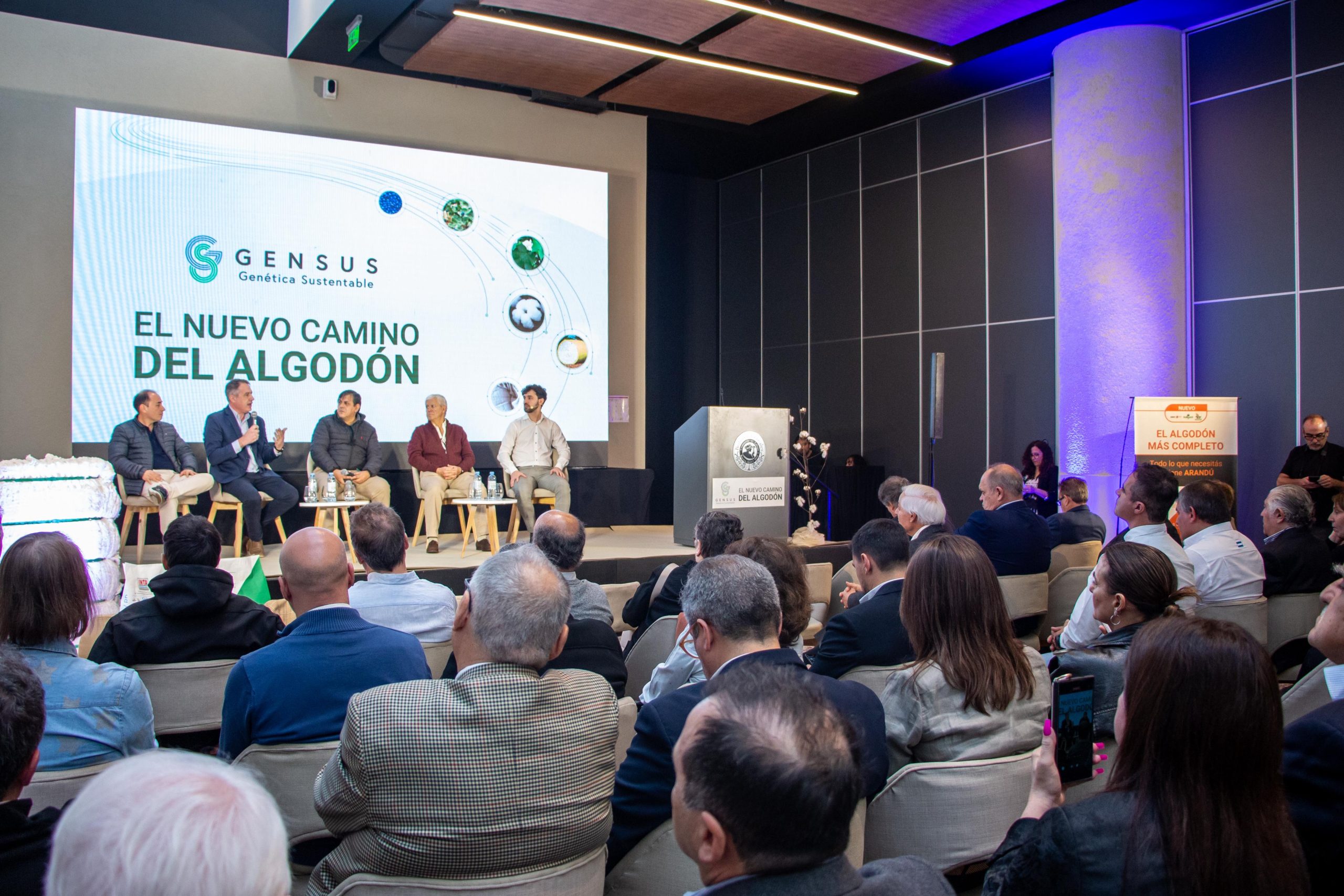
Also present were **Nicolás Bronzovich**, president of [**INTA**](https://intainforma.inta.gob.ar/), and **Manuel Chiappe**, Undersecretary of Agricultural and Forestry Production. Bronzovich emphasized the evolution of the **technological collaboration agreement** initiated in 2018, which now translates into **exclusive genetics and accelerated improvement platforms**. “They are **public assets of the future**,” he stated.
Chiappe, on his part, celebrated the historic moment in Argentine agriculture: “We are working with a **long-term national vision**, with **producers within the State** to ensure smooth processes. Let’s continue sowing because **the country will be much better**.”
Technological transfer and international competitiveness
Representatives of the cotton chain agreed that this advancement will allow **accelerating technological transfer**, **improving competitiveness**, and **projecting Argentine cotton towards international markets**.
From **Louis Dreyfus Company (LDC)**, **Pablo Yezdrich** stated: “Boosting technological development behind each seed is key for Argentine cotton to **realize its potential**. At LDC, we work to **connect production with global demand**.”
Traceability, quality, and intellectual property
**Matías Goodman** from **FUNDAR** highlighted three strategic axes: **intellectual property and seed oversight**, **production traceability**, and **fiber quality classification**.
“There is a great opportunity, both due to the **growth in global consumption** and the **export margin** that can still expand,” he noted.
**Claudio Mazás** from **Mayton** emphasized: “Everything is in place for growth. Cotton **complements the agricultural business** and, with higher productivity, can compete on par with other crops.”
From **INTA EEA Sáenz Peña**, **Mauricio Tcach** celebrated the results of the partnership with Gensus: “We took seeds to the U.S. and confirmed that our **germplasm is competitive**. Today, we generate events and have **international partnerships**.”
A crop with identity, traceability, and future
**The new path of cotton symbolizes a strategic commitment to innovation and biotechnological regional development**.
More than a technological advancement, this launch represents a **vision of the future**: a **competitive, traceable, sustainable, and internationally high-quality crop**. It boosts regional economies, creates jobs, and positions Argentina as a global reference in **cotton production**.



