



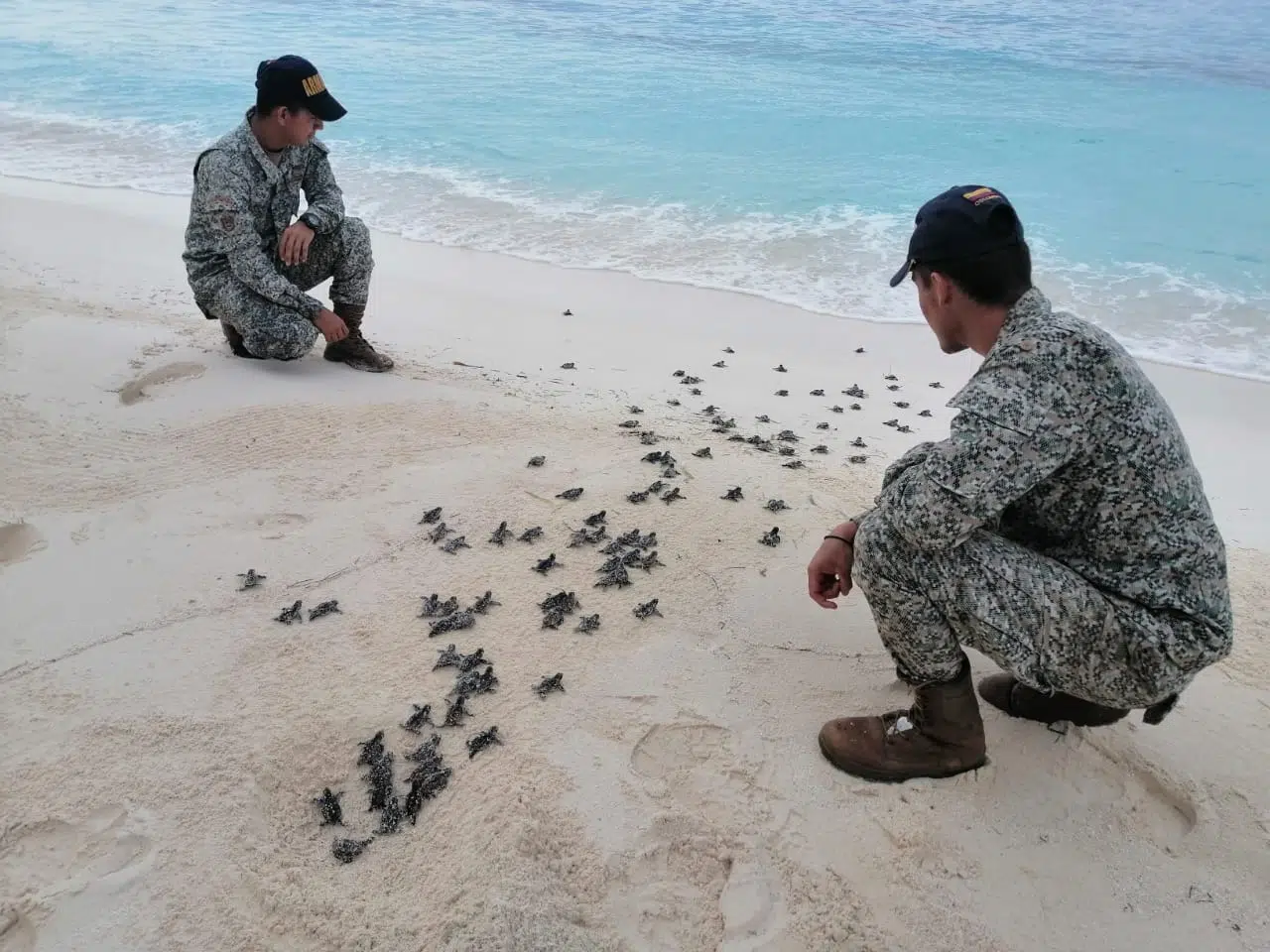
The Colombian Navy recently accompanied the journey of more than 19,000 newborn sea turtles to the sea in the archipelago of San Andrés, Providencia, and Santa Catalina, marking a milestone in the protection of endangered species.
The initiative is part of the project “Blue Sanctuary of Sea Turtles”, which aims to consolidate the department’s cays as a natural refuge for turtles and migratory birds.
Supervision and accompaniment during hatching
The Marine Infantry Battalion No. 11, under the Specific Command of San Andrés and Providencia, supervised the hatching of 155 nests, ensuring that thousands of newborns could begin their life in the ocean.
Cayo Serrana stood out as the main concentration point for nests of three species present in the archipelago:
- Hawksbill turtle (Eretmochelys imbricata), critically endangered.
- Loggerhead turtle (Caretta caretta), classified as vulnerable.
- Green turtle (Chelonia mydas), also threatened.
Science and conservation: monitoring and tagging of sea turtles
The collaboration between the Colombian Navy and the Sea Turtle Foundation, through the Fi Wii Riif Project, allowed advances in monitoring, tagging, and counting of nests.
In 2025, the donation of specialized equipment facilitated the recording of arrivals and the identification of specimens, strengthening the database for conservation.
Environmental training and SeaFlower Biosphere Reserve
The Marines receive continuous training in:
- Nest protection.
- Specimen tagging.
- Species recognition.
Their work is carried out within the SeaFlower Biosphere Reserve, recognized for its biodiversity. Additionally, more than seven educational institutions participated in awareness sessions on the ecological importance of turtles, considered “gardeners of the corals” for their role in controlling algae on reefs.
Education and community awareness
During the nesting season (May to December), the Navy visited more than 14 schools in the archipelago, promoting the protection of hawksbill, loggerhead, and green turtles.
The hunting and commercialization of the hawksbill turtle has been prohibited in Colombia since 1977, and environmental education emphasizes the illegality and negative impact of its consumption.
Survival challenges and “escort” strategy
Lieutenant Colonel Moisés Palerm, commander of the Marine Infantry Battalion No. 11, explained that the mortality of newborns is extremely high:
- Only 10 out of every 100 turtles manage to reach the sea.
- Of those, just 1 out of every 100 reaches adulthood.
To counter this situation, the Navy implemented the “escort” strategy, which consists of accompanying the newborns during their journey to the sea. This increases their chances of survival by up to 10%.
A flagship project of the Military Forces
“The Blue Sanctuary of Sea Turtles is the most important environmental project of the Colombian Military Forces,” highlighted Lieutenant Colonel Palerm.
The officer emphasized that only on Bolívar Island were 70 hawksbill turtle nests recorded, a number much higher than found in other areas of the Caribbean or the Colombian Pacific. In total, the archipelago exceeds 200 nests, establishing itself as a nesting epicenter in the region.
Conclusion: protecting the blue of the flag
The joint work between the Navy, foundations, and educational communities demonstrates that the conservation of endangered species requires both military and scientific actions as well as citizen education.
“The slogan of the National Navy is to protect the blue of the flag, and what we want is to contribute so that this blue always remains alive,” concluded Palerm.
The Blue Sanctuary of Sea Turtles thus consolidates itself as a model of comprehensive conservation, where the protection of biodiversity becomes a national and community commitment.


