



With an area of almost 9,000 km², Yellowstone National Park is not only one of the most stunning natural landscapes on the planet but also the world’s first National Park, created in 1872 by the United States Congress and signed into law by President Ulysses S. Grant.
Its establishment marked a turning point in history, as it was the first time a territory of immense natural value was protected for present and future generations.
A pioneering model of conservation
Before Yellowstone, lands with natural resources were usually destined for private exploitation. The decision to protect this space introduced a revolutionary concept: nature as public heritage. Since then, the model has inspired the creation of thousands of national parks and protected areas worldwide, helping to preserve fragile ecosystems, endangered species, and landscapes of great cultural and scientific value.
America today is home to more than 300 National Parks, many of them with unique stories that go unnoticed. Yellowstone, however, became the starting point of the modern environmental conservation movement, an example that transcended borders and continues to be a global reference.
Location and ecosystems
Yellowstone National Park is mostly located in the state of Wyoming, although its territory extends into southern Montana and northern Idaho, in the western United States. Its strategic location encompasses:
- Mountains and forests.
- Rivers and volcanic plains.
- A supervolcano caldera, which gives it unique characteristics.
This mosaic forms one of the most diverse ecosystems on the continent, where landscapes of great beauty coexist with active geological processes that make it a natural laboratory.
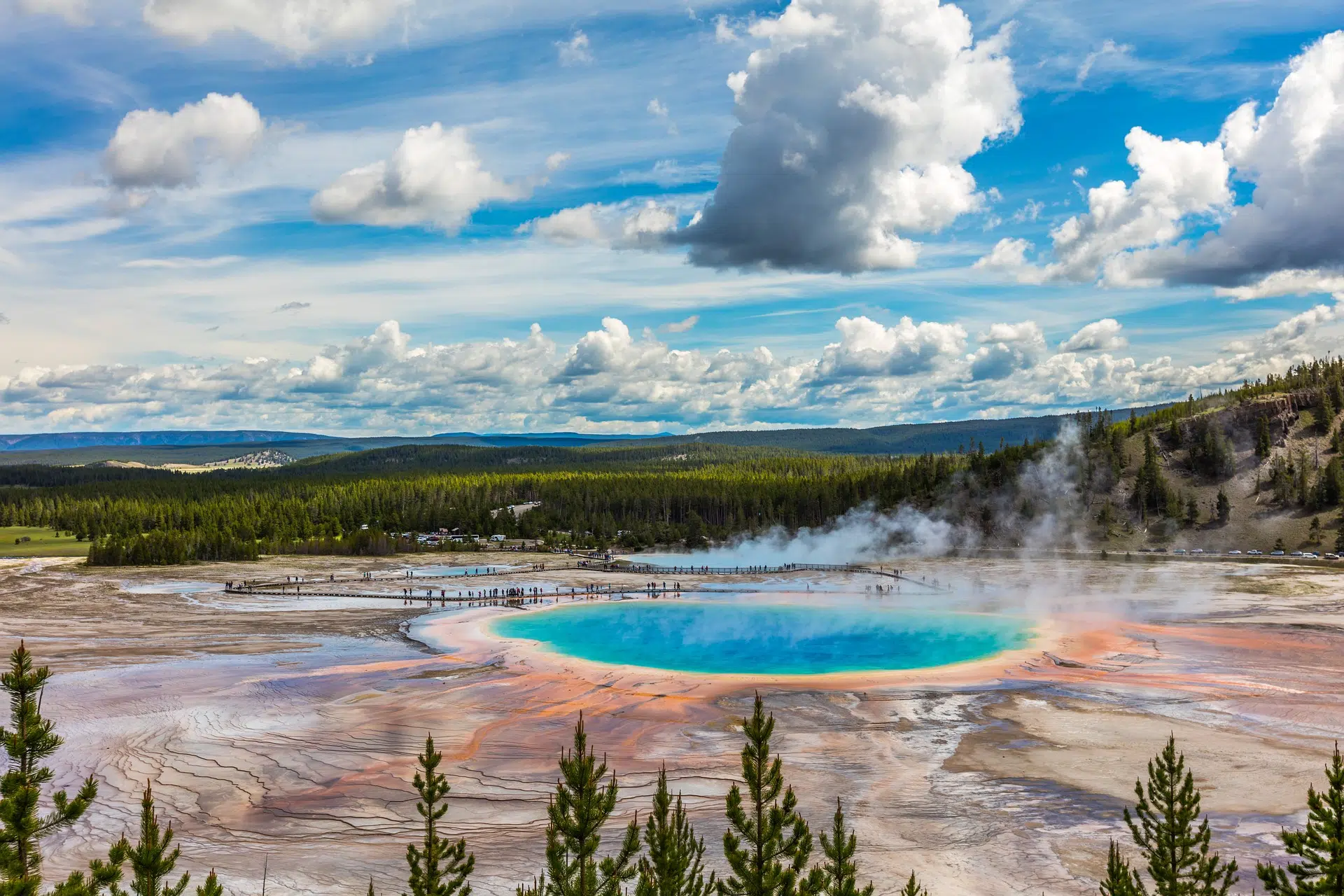
Geothermal activity and natural wonders
Yellowstone is famous for its geothermal activity: it contains nearly half of the world’s geysers, including the iconic Old Faithful, which erupts regularly every few hours.
These natural phenomena make it a unique setting for scientific research and environmental education, as well as being one of the park’s main tourist attractions.
Iconic wildlife
The park is home to an impressive diversity of wildlife:
- Large herds of American bison, unique in the contiguous 48 states that have roamed continuously since prehistoric times.
- Grizzly and black bears.
- Wolves, elk, deer, and eagles.
- A vast variety of birds and mammals.
This combination makes it a key setting for the conservation and study of biodiversity, as well as a place where visitors can observe iconic species in their natural habitat.
Highlights
- Area: more than 9,000 km², larger than some small countries.
- Creation: March 1, 1872, by law of the United States Congress.
- Recognition: considered the starting point of the modern environmental conservation movement.
- Uniqueness: it is located on a supervolcano caldera, which explains its intense geothermal activity.
Yellowstone is not just a park: it is a global symbol of conservation. Its creation laid the foundation for humanity to understand that protecting nature is protecting the future. Among geysers, bison, and volcanic landscapes, it continues to remind us that biodiversity and ecosystems are a common heritage that deserves to be preserved.
With more than 150 years of history, Yellowstone continues to be a world reference in environmental defense, demonstrating that political decisions can change the course of the relationship between society and nature.

