



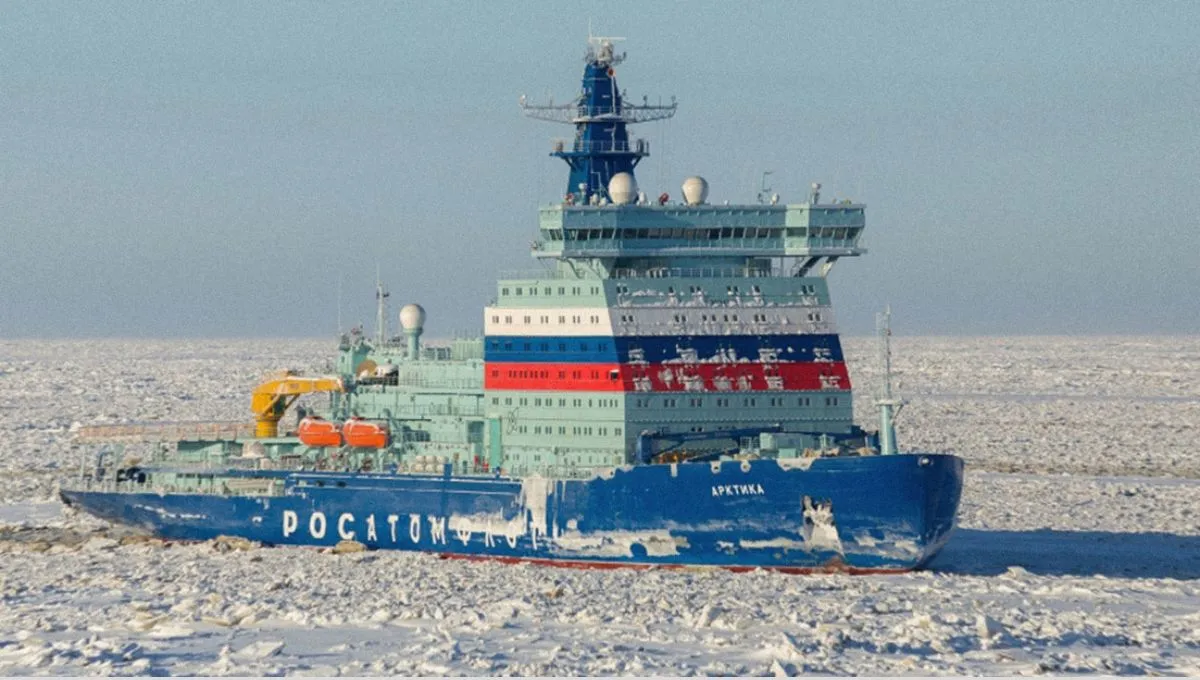
In the Arctic, where extreme weather imposes nearly insurmountable limits, the Arktika stands as the most powerful and resilient icebreaker ever built.
This ship does not dodge the ice: it breaks it, pushes it, and opens routes where none existed before. It is the ultimate expression of naval engineering applied to survival in one of the planet’s most hostile environments.
Project 22220: the new generation of nuclear icebreakers
The Arktika belongs to Project 22220, the most modern class of nuclear icebreakers in the world. It was built at the Baltiysky Zavod shipyards in St. Petersburg and entered service in 2020. Its main mission is to keep the Northern Sea Route open, crucial for trade and logistics in polar waters.
Unlike other reinforced ships, the Arktika uses nuclear energy, allowing it to operate for years without the need for refueling. This extreme autonomy makes it a self-sufficient floating base, capable of ensuring the safety of entire convoys in conditions where other ships would become trapped.
Technical capabilities
- Icebreaking: continuously traverses layers up to 2.8–3 meters thick.
- Reinforced hull: built with high-strength steel to withstand impacts against compact ice.
- Nuclear propulsion: equipped with two RITM-200 reactors, generating more than 55–60 MW of power.
- Double-draft design: suitable for the Arctic’s deep waters and frozen rivers.
- Dimensions: 173.3 meters in length, 33,530 tons displacement.
- Maximum speed: 22 knots.
- Extreme autonomy: functions as a self-sufficient floating base for long periods.
More than an icebreaker
The Arktika not only escorts ships through dangerous routes, it also serves as a scientific platform. Its state-of-the-art laboratories enable multidisciplinary studies:
- Climate: monitoring ice thickness, ocean currents, and temperatures.
- Marine biology: analysis of Arctic ecosystems as indicators of environmental health.
- Geology: mapping the seabed and exploring resources beneath the ice.
Additionally, it incorporates advanced systems such as integrated digital control and sonar detection, setting a new benchmark for polar exploration.
Innovation and national pride
The design of the Arktika reflects Russia’s commitment to Arctic sovereignty and the protection of its economic and geopolitical interests. The Arctic region holds vast natural resources and strategic maritime routes, making this icebreaker a symbol of national pride and international presence.
Its ability to operate in extreme conditions makes it a key tool for maintaining Russian competitiveness in the Arctic, a scenario where more and more nations are seeking to secure their influence.
The Arktika symbolizes human ingenuity and technical resilience. It is an icebreaker that not only ensures maritime safety in icy waters but also promotes scientific research and reinforces strategic presence in the Arctic. With its power and versatility, it marks a new era in polar exploration and development.



