



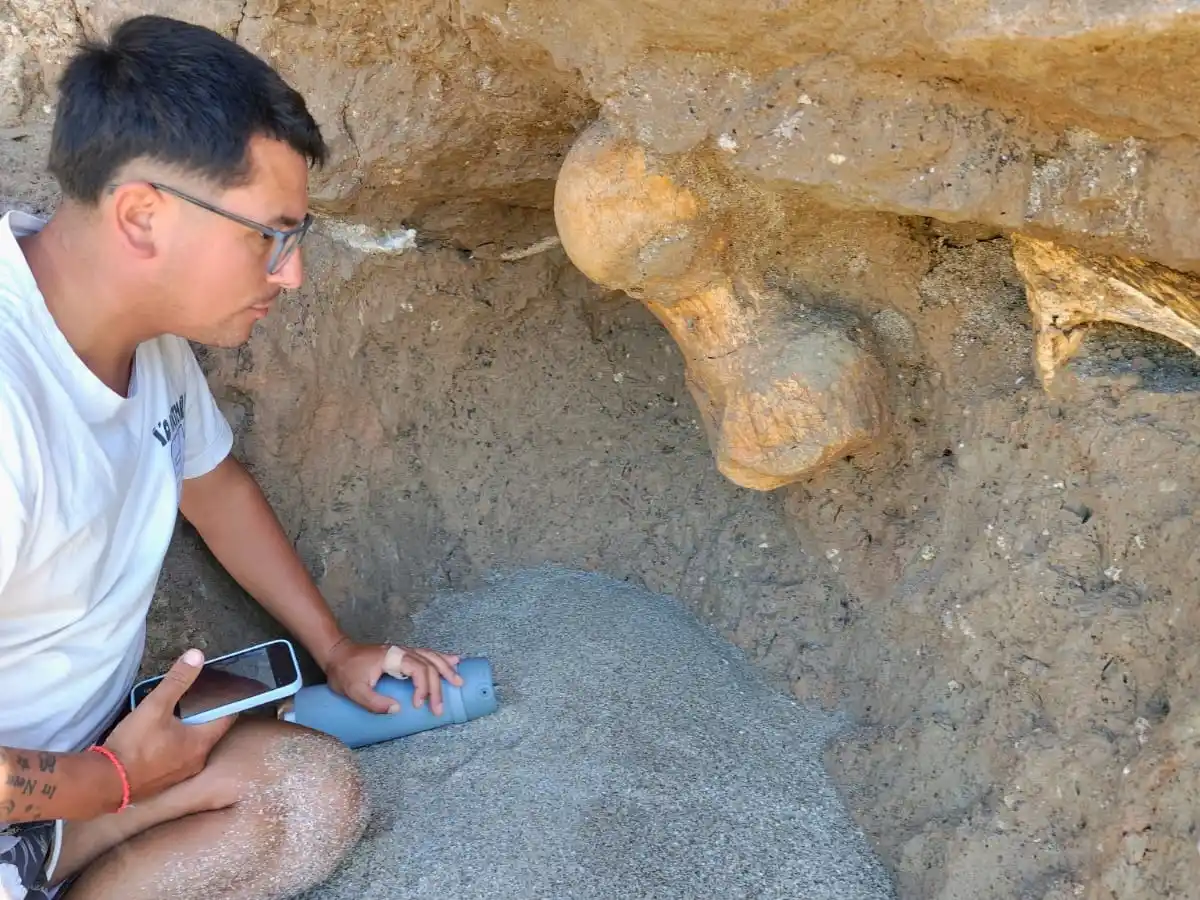
Two tourists, Mario Cianciola and Lumar Ávila González, accidentally found an exceptional fossil on the cliffs of southern Santa Clara del Mar, Buenos Aires province. It is the right femur of an American megatherium, a giant sloth that inhabited the region about 400,000 years ago and became extinct less than 12,000 years ago.
The bone, measuring 80 centimeters long by 50 wide, is considered one of the best-preserved fossils of this species in the region. After being recovered, it was transferred to the Museo Municipal de Ciencias Naturales “Lorenzo Scaglia” in Mar del Plata and will later be transferred to the Museo Pachamama in Santa Clara del Mar.
Scientific Importance
Paleontologist Matías Taglioretti highlighted that this femur is one of the most complete found on the Buenos Aires coast. Its excellent condition will allow specialist Néstor Toledo (Conicet and UNLP) to advance in the detailed reconstruction of the musculature and body structure of the megatherium.
In addition to the femur, well-preserved pelvis remains were identified, although their extraction requires heavy machinery due to the risk of collapse.
The fossil presents an orange color, typical of sediments rich in iron oxides, which favored its preservation and allowed the distinction of muscle insertion striations.
Background in the Region
The area of Mar Chiquita and surroundings has been the scene of multiple discoveries:
- 2023: megatherium remains in Camet Norte, including vertebrae and dental pieces.
- 2022: a 12-year-old girl found a vertebra in Mar del Plata.
- 2022: an 8-year-old boy found a 700,000-year-old skull attributed to a South American camelid.
- 2021: an interdisciplinary team discovered a megatherium skull over 3.5 million years old in San Eduardo del Mar.
These precedents confirm that the Pampas region is a key reservoir of megafauna fossils.
The Megatherium: A Giant of the Ice Age
The Megatherium americanum was an herbivorous mammal up to 6 meters long and about 3 tons in weight, comparable to a small truck.
- It had long, curved claws for tearing branches and defending itself.
- It lacked front incisors; its side teeth were adapted to process leaves and shoots.
- It fed on arboreal vegetation, standing on its hind legs and supported by a robust tail.
- It inhabited South America and expanded into North America during the Pleistocene.
Its disappearance about 11,700 years ago is attributed to climatic changes after the retreat of glaciers and possibly to the pressure of human hunter-gatherers.
The discovery in Santa Clara del Mar not only enriches the Argentine paleontological heritage but also opens new research possibilities on the anatomy and ecology of the giant sloth.
This fossil, one of the best preserved to date, reinforces the importance of protecting the Buenos Aires cliffs as sites of scientific and cultural value.


