



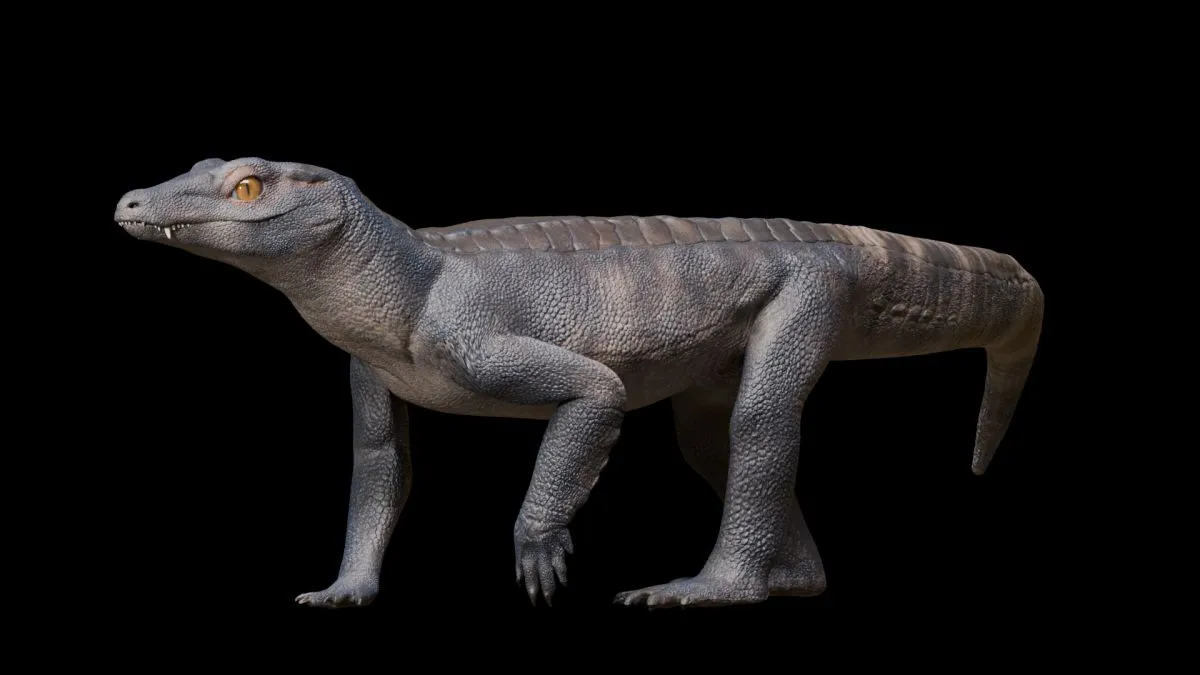
A team of researchers from the CONICET found fossil remains of a terrestrial crocodile that inhabited northern Patagonia 85 million years ago, during the Cretaceous era.
The discovery took place in the Protected Natural Area Paso Córdoba, near General Roca, Río Negro, within the Bajo de la Carpa Formation, a site that is becoming a privileged window to the past.
The discovery began when Facundo Riguetti, a postdoctoral fellow at CONICET, identified a skull fragment among the sediments. The excavation, led by Dr. Agustina Lecuona from the Institute of Paleobiology and Geology (CONICET-UNRN), also revealed vertebrae and limb bones, which will allow for a more precise reconstruction of the animal’s morphology.
A crocodile adapted to land
Unlike current crocodiles, associated with tropical climates and permanent bodies of water, this reptile lived in an environment of ephemeral rivers and arid landscapes, similar to modern deserts.
These conditions suggest that it developed specific adaptations to survive in water-scarce environments, making it a unique case within the evolution of crocodiles.
Scientific importance
The finding provides key information on the dispersion and evolution of reptiles in Patagonia during the Cretaceous. The quality of the recovered material, which includes parts of the post-cranium, offers a more complete sample than usual and will allow for comparative studies on its locomotion and lifestyle.
The fieldwork involved specialists like Mattia Baiano and students from the National University of Río Negro, reaffirming the importance of preserving protected natural areas like Paso Córdoba to safeguard scientific heritage.
Patagonia, paleontological epicenter
In recent years, Patagonia has become a true natural laboratory for paleontology. Between 2025 and 2026, significant discoveries were recorded:
- Bicharracosaurus dionidei (Chubut): herbivorous titanosaur 15-20 meters long.
- Alnashetri cerropoliciensis (Río Negro): small carnivorous alvarezsaur the size of a chicken.
- Joaquinraptor casali (Chubut): new carnivorous dinosaur from the megaraptorid group.
- Yeneen houssayi (Neuquén): titanosaur described in the Confluencia area.
- Paleoteius lakui (Río Negro): terrestrial lizard from 70 million years ago, one of the most complete from the Late Cretaceous in South America.
These discoveries, driven by scientists from CONICET and local museums, consolidate the region as one of the richest fossil deposits in the world.
The discovery of the terrestrial crocodile in Paso Córdoba not only expands the fossil catalog of Río Negro but also opens new lines of research on how reptiles adapted to extreme environments millions of years ago.
Patagonia reaffirms its role as a key territory for understanding the evolutionary history of the planet and as a scientific heritage of international value.


