



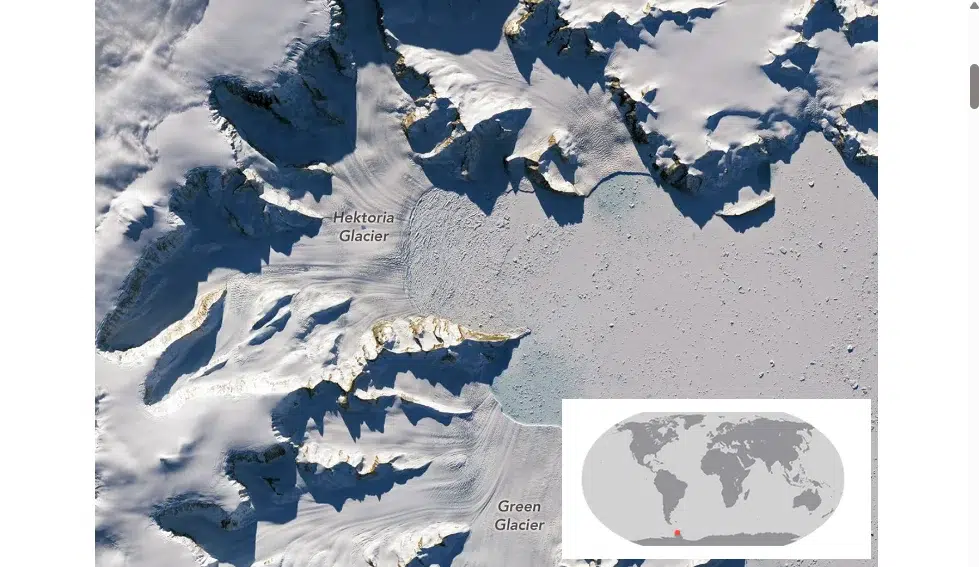
The Hektoria Glacier, located in the eastern Antarctic Peninsula, experienced one of the most extreme retreats ever recorded in modern history. Between January 2022 and March 2023, it lost nearly 25 kilometers in length, in a phenomenon that raised new alarms about the fragility of polar ecosystems.
Additionally, in just two months, the glacier front retreated more than 8 kilometers. Specialists consider this the highest rate of terrestrial ice loss documented so far through satellite observations.
The analysis was conducted by international researchers using remote sensing data and laser altimetry measurements. According to their explanation, the glacier’s particular shape and the loss of marine support accelerated the collapse process.
A rapidly changing polar ecosystem
Hektoria belongs to the group of glaciers that originate on land and flow into the ocean through a floating ice tongue. For decades, this structure remained stabilized thanks to the Larsen B ice shelf, a huge ice barrier that protected several neighboring glaciers.
However, the situation changed drastically in 2002 when the Larsen B ice shelf fragmented and disappeared. Since then, numerous glaciers began to thin and slowly retreat in various areas of Antarctica.
In the case of Hektoria, the deterioration accelerated when the fixed sea ice of Larsen B Bay broke in early 2022. The ocean swells and rising temperatures likely contributed to destabilizing the area and triggering a rapid disintegration of the ice tongue.
During that same austral summer, the glacier lost around 16 kilometers of extension. Subsequently, another phase of calving caused an additional retreat of 8 kilometers in just weeks.
What is the Hektoria Glacier and why does it concern scientists?
The Hektoria Glacier is considered a tidewater glacier, a type of ice mass that interacts directly with the ocean. These systems are particularly sensitive to global warming because seawater can infiltrate beneath the ice and accelerate its calving.
Researchers found that much of the glacier rested on a relatively flat seabed plain. This configuration allowed tides to lift entire sections of weakened ice, leading to massive fractures.
Additionally, seismic studies revealed movements beneath the glacier shortly before the most significant collapses. This phenomenon, known as buoyancy-driven calving, occurs when the ice loses stability and begins to separate from the seabed.
Although Hektoria is small compared to other Antarctic giants, specialists warn that a similar behavior in larger glaciers could significantly accelerate the global rise in sea levels.

New technologies aim to anticipate future glacier collapses
The retreat of Hektoria also prompted the use of more advanced satellite tools to monitor the cryosphere. The NISAR and SWOT missions, developed by NASA alongside international partners, will allow for more precise measurement of structural changes in the ice.
Thanks to these systems, scientists will be able to detect minimal deformations and track the evolution of vulnerable glaciers in Antarctica, Greenland, and Alaska. The goal is to anticipate destabilization episodes before irreversible losses occur.
Meanwhile, experts believe that Hektoria has entered a new phase. After losing much of its mass and height, the glacier could experience a slower retreat and gradually transform into a fjord dominated by seawater and sediments.


