



The Canadian Evan Budz, a high school student from Burlington (Ontario), created a bionic underwater robotic turtle inspired by a snapping turtle he observed during a camping trip. His goal: to design an autonomous device capable of monitoring marine ecosystems without disturbing them.
“I want to protect the places I am passionate about without harming them,” says Budz, who named his invention BURT (Bionic Underwater Robotic Turtle).
Design and Functionality
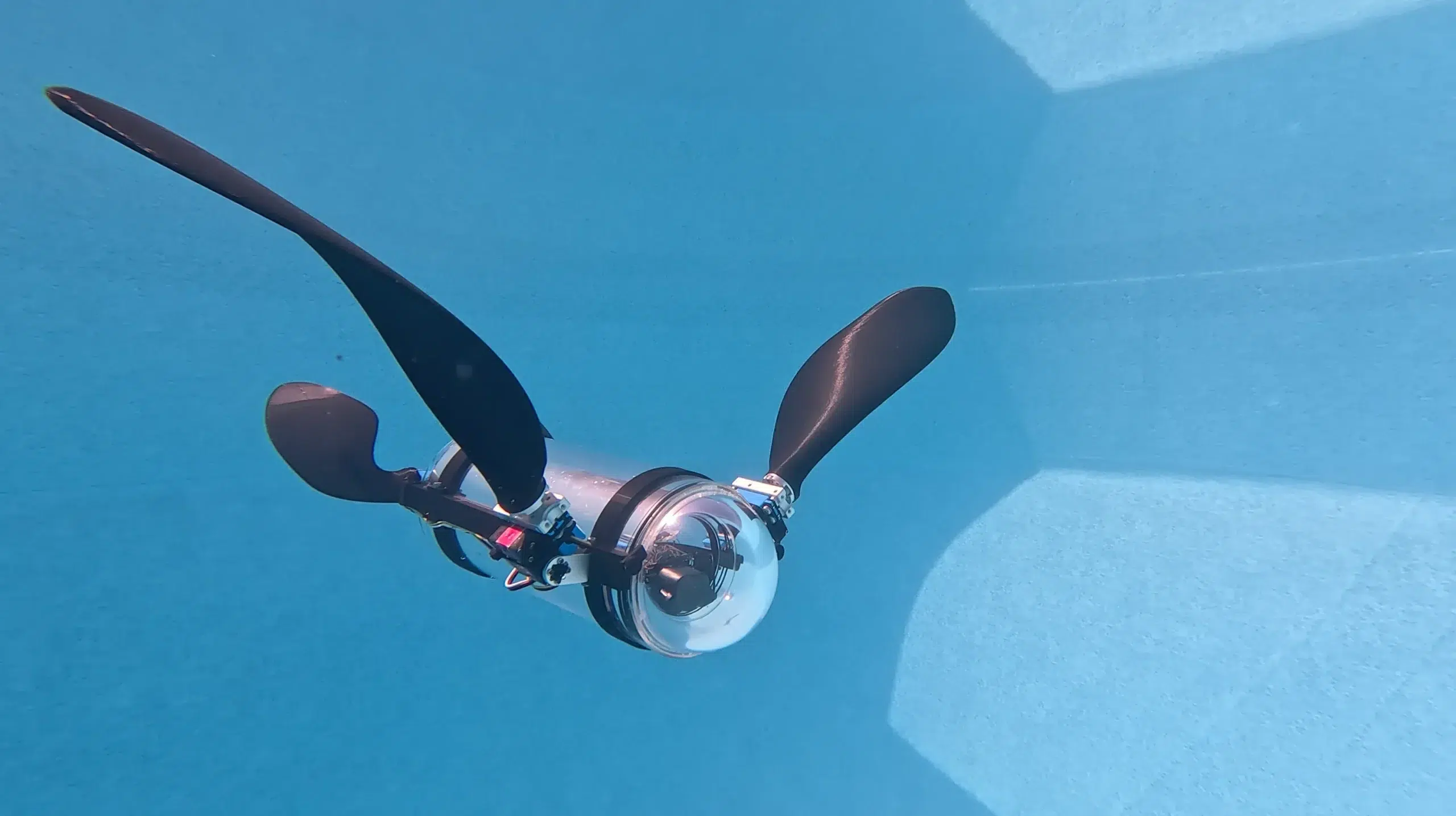
BURT mimics the kinematics of a green sea turtle:
- Four flippers: the front ones propel, the rear ones stabilize and steer.
- Acrylic body: houses electronic components and a Raspberry Pi microcomputer.
- Sensors and front camera: detect microplastics, invasive species, and coral bleaching.
- GPS and grid pattern: allows for cable-free navigation, unlike traditional underwater drones.
- Neutral buoyancy: achieved with additional weight to reach greater depths.
- Autonomy: up to 8 hours with a lithium battery, extendable thanks to a solar panel.
Technological Innovation
Budz used SolidWorks to design the 3D parts and studied the locomotion of sea turtles in local aquariums. BURT swims at an average speed of 0.8 km/h, faithfully replicating natural movement.
Additionally, the young inventor incorporated:
- Front lights for murky waters.
- Ultrasonic transducer to detect obstacles.
- Holographic imaging system that, along with a neural network, classifies tiny particles like microplastics.
Testing and Results
The first tests were conducted in his grandparents’ pool, where Budz simulated coral reefs with 3D models. BURT managed to detect coral bleaching with 96% accuracy.
The next step will be to deploy the robot in real environments to test its performance at different depths and marine conditions.
Awards
The invention has already received notable awards:
- First place in the European Union Contest for Young Scientists (2025) in Latvia.
- Award at the Canada-Wide Science Fair, where more than 25,000 students compete.
Future Vision
Budz dreams of deploying a fleet of robotic turtles to monitor the oceans:
- Coral bleaching.
- Invasive species.
- Microplastics and marine pollution.
His project demonstrates how biomimicry and artificial intelligence can be combined to create sustainable solutions that protect ecosystems without harming them.
BURT is more than a robot: it is an example of how youthful creativity can provide innovative tools to tackle the ecological threats of the 21st century. Inspired by nature and supported by technology, this invention opens the door to a future where marine conservation is carried out with respect and precision.


