



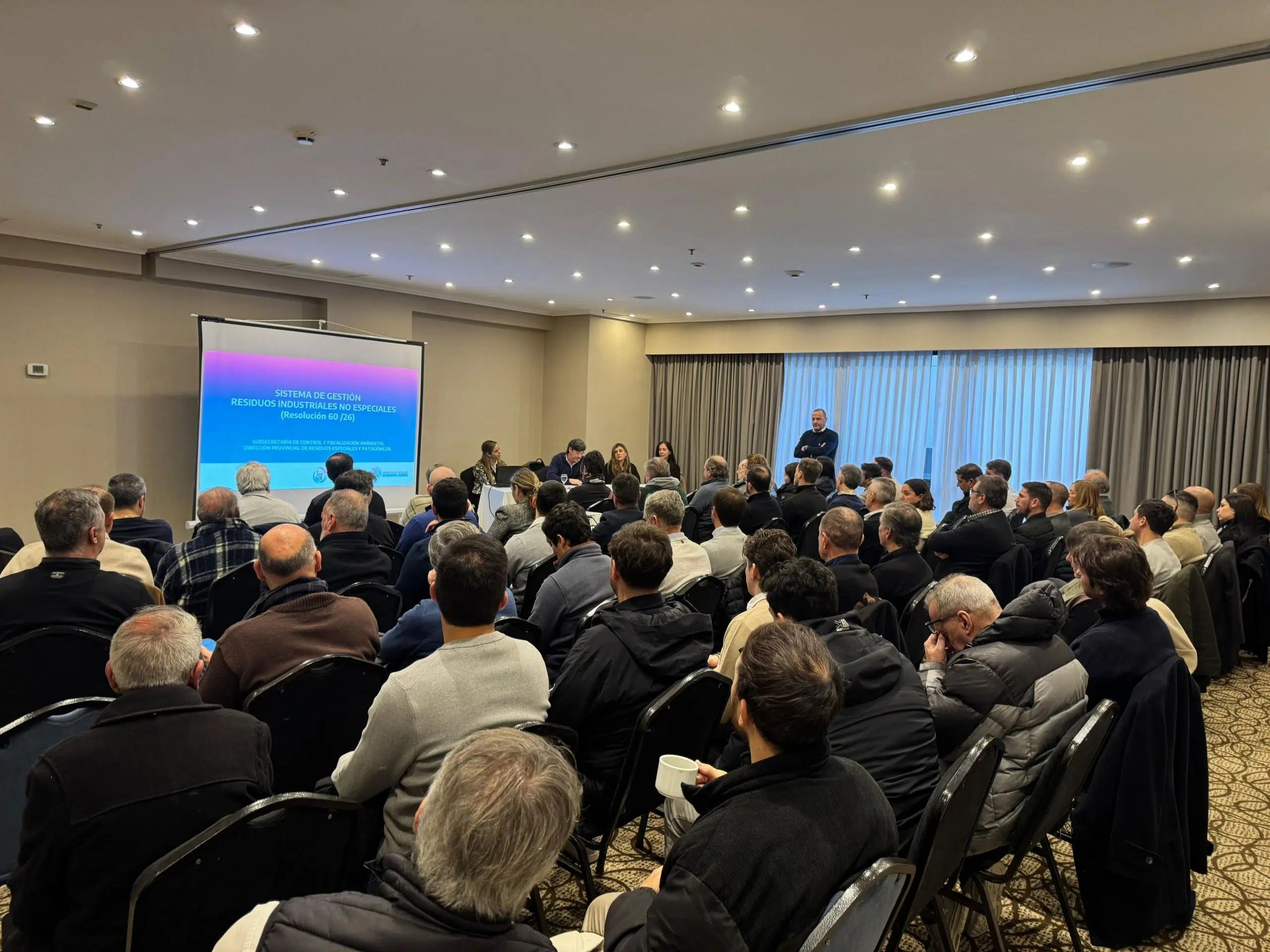
The Ministry of Environment of the Province of Buenos Aires, led by Daniela Vilar, presented Resolution 60/2026, which establishes a management system for Non-Special Industrial Waste (RINE).
The measure will come into effect on July 15, 2026 and will apply to all industries generating this type of waste in the province.
Until now, RINE was in a “gray area” without specific regulation. This regulation aims to organize its management, strengthen traceability, and ensure clear rules for producers, transporters, and operators.
Mandatory registration and traceability
One of the pillars of the new regime is the creation of a mandatory registry for generating industries. From the effective date, companies must:
- Register in the provincial system.
- Provide documentation to support the destination of the waste.
- Report if the waste is valued, recycled, reused, or disposed of finally.
This mechanism will allow for reliable information, generate statistics, and improve public planning in waste management.
Circular economy and valorization
The regulation promotes the circular economy, encouraging certain waste to become inputs for other production processes.
- Example: plastic scrap can be reused as raw material to manufacture new products.
- In these cases, companies must submit a joint sworn statement within the system provided by the Province.
Meeting with business chambers
The launch of the regime was attended by sector chambers:
- Caitpa (Argentine Chamber of Treatment Industries for Environmental Protection).
- Catries (Argentine Chamber of Industrial and Special Waste Handlers and Transporters).
During the meeting, operational aspects were addressed, and contributions from key players were gathered.
- Gustavo Solari, president of Caitpa, celebrated the initiative as a tool that provides predictability and clear rules.
- Claudia Kalinec, president of Catries, highlighted the importance of joint work between the public and private sectors to achieve efficient and sustainable implementation.
Benefits of the new regime
- Regulatory order: covers a legal gap around RINE.
- Administrative transparency: strengthens controls and traceability.
- Modernization of management: digitization of records and procedures.
- Investment boost: creates conditions for companies to invest in valorization and treatment technologies.
Information and access
All information related to the new registry, instructions, and registration procedures will be available on the Ministry of Environment’s website days before the regulation comes into effect.
The new Non-Special Industrial Waste regime represents a key step towards the modernization of environmental management in Buenos Aires, consolidating a policy oriented towards transparency, circular economy, and public-private collaboration.
With clear rules and traceability, the province seeks to transform a universe of unregulated waste into an orderly and sustainable system.



