



The International Research Institute for Climate and Society (IRI), part of Columbia University, published its latest update on the ENSO phenomenon (El Niño-Southern Oscillation) on July 20.
The forecast plume gathers predictions from 24 climate models initiated in July, following record temperatures in the equatorial Pacific.
The results reinforce the hypothesis of a historic Super El Niño, with warming exceeding 3 °C, placing it among the most intense episodes ever observed.
Current Pacific Data
According to the NOAA Climate Prediction Center (CPC):
- The Niño 3.4 region recorded an absolute anomaly of +2.1 °C in the week of July 15.
- It is the second consecutive week with anomalies equal to or greater than 2 °C, a typical level of “very intense” episodes.
- Relative anomalies reached 1.4 °C, approaching the “strong” event threshold (1.5 °C).
- Subsurface waters show a warm bubble with anomalies exceeding 6 °C near the surface.
Additionally, records from the Climate Reanalyzer confirm that 2026 is breaking sea surface temperature records, surpassing values from emblematic years like 1982, 1997, and 2015.
Projected Intensification
The IRI model integrates predictions from various meteorological centers.
- The July update shows a maximum value of 3.1 °C, higher than the 2.6 °C projected in June.
- The ECMWF (European Centre for Medium-Range Weather Forecasts), through the Copernicus Climate Change Service (C3S), projects anomalies of 3.5 °C in December.
- The coherence between dynamic and statistical models increases confidence that the event will be exceptional.
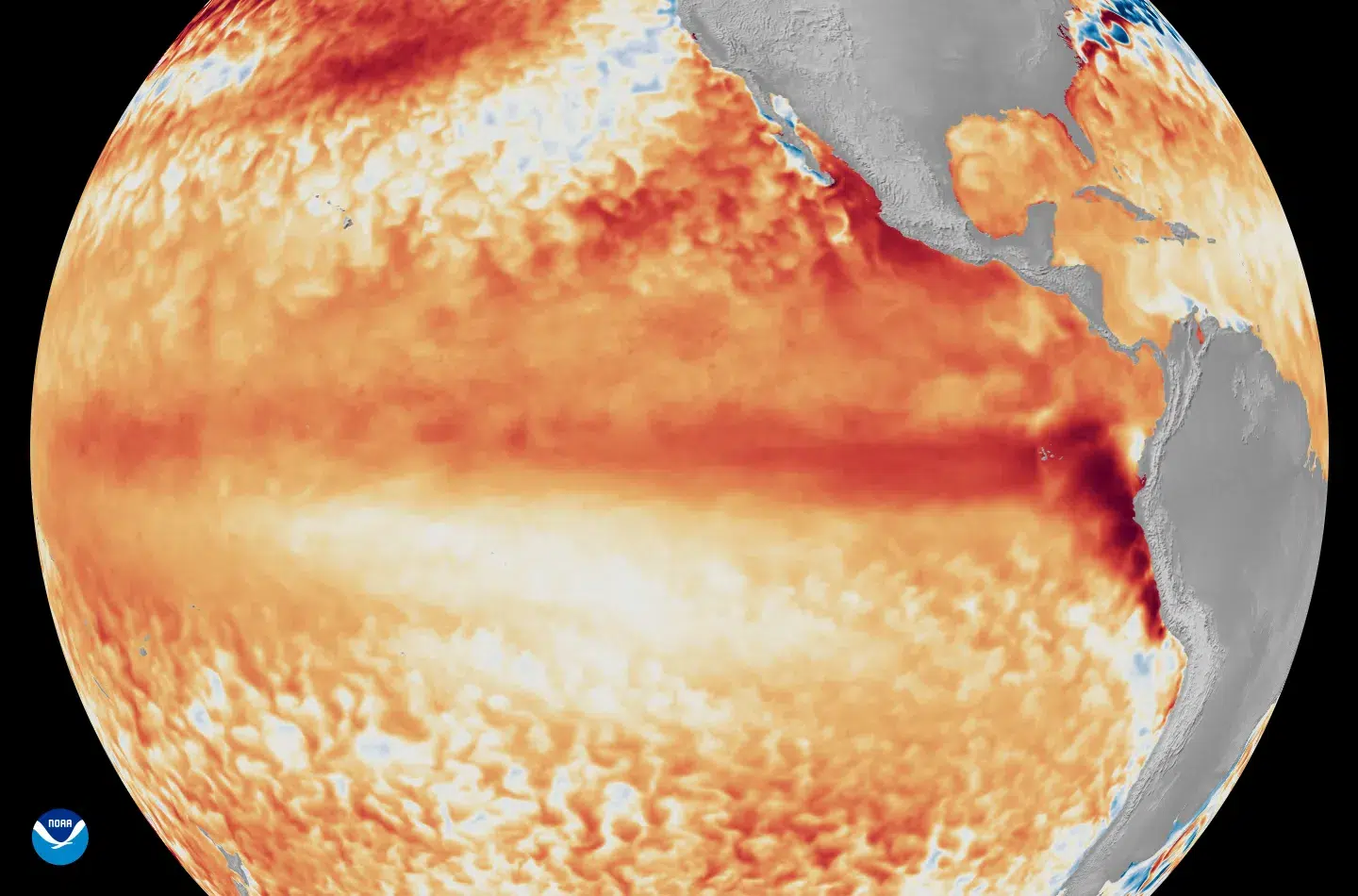
Comparison with Historical El Niño
El Niño 2026/2027 could compete with the strongest recorded episodes:
- 1982/1983: considered one of the most devastating.
- 1997/1998: caused global impacts on agriculture and health.
- 2015/2016: generated extreme droughts and torrential rains in different regions.
Current and projected temperatures already exceed the initial values of those events, reinforcing the hypothesis of a record El Niño.
Global Implications
An event of this magnitude would have consequences in multiple areas:
- Agriculture: risk of droughts in South America and extreme rains in other regions.
- Public health: proliferation of vector-borne diseases in warm and humid climates.
- Energy: disruptions in hydroelectric generation and energy demand.
- Marine ecosystems: impact on fisheries due to surface water warming.
The IRI update and the agreement among major international climate models reinforce confidence that the El Niño 2026/2027 phenomenon will be one of the most intense in history.
The scientific community warns that, although monitoring is increasingly accurate, the magnitude of the event requires global preparation to address its impacts on agriculture, health, energy, and ecosystems.



