



Every spring, the songs of the Swainson’s thrushes and warblers bring parks and gardens in eastern North America to life. However, their journey begins much further south, in the tropical forests of Central America, where they spend much of the year.
A new study by the Wildlife Conservation Society (WCS) and the Cornell Lab of Ornithology, published in Biological Conservation, confirms that the Five Great Forests of Central America —from southern Mexico to northern Colombia— are vital corridors for dozens of migratory bird species that connect the Americas.
A living bridge for migratory birds
Using millions of observations from the eBird platform, scientists discovered that these five forests support between one-tenth and nearly half of the global populations of 40 migratory species. Additionally, they include some of North America’s most rapidly declining birds.
“These forests are not just pristine tropical sites; they are the heart of migration,” explained Anna Lello-Smith, the study’s lead author.
Among the most notable findings:
- More than a third of Kentucky warblers and nearly a quarter of wood and golden-winged warblers spend the winter in these forests.
- More than 40% of the global population of the cerulean warbler, a species that has declined by more than 70% since 1970, depends on these forests during spring migration.
- The Maya Forest (Mexico, Belize, and Guatemala) and the Mosquitia (Honduras and Nicaragua) are the most important, but also the most threatened: they have lost a quarter of their area in just 15 years, mainly due to illegal cattle ranching.
A shared ecosystem
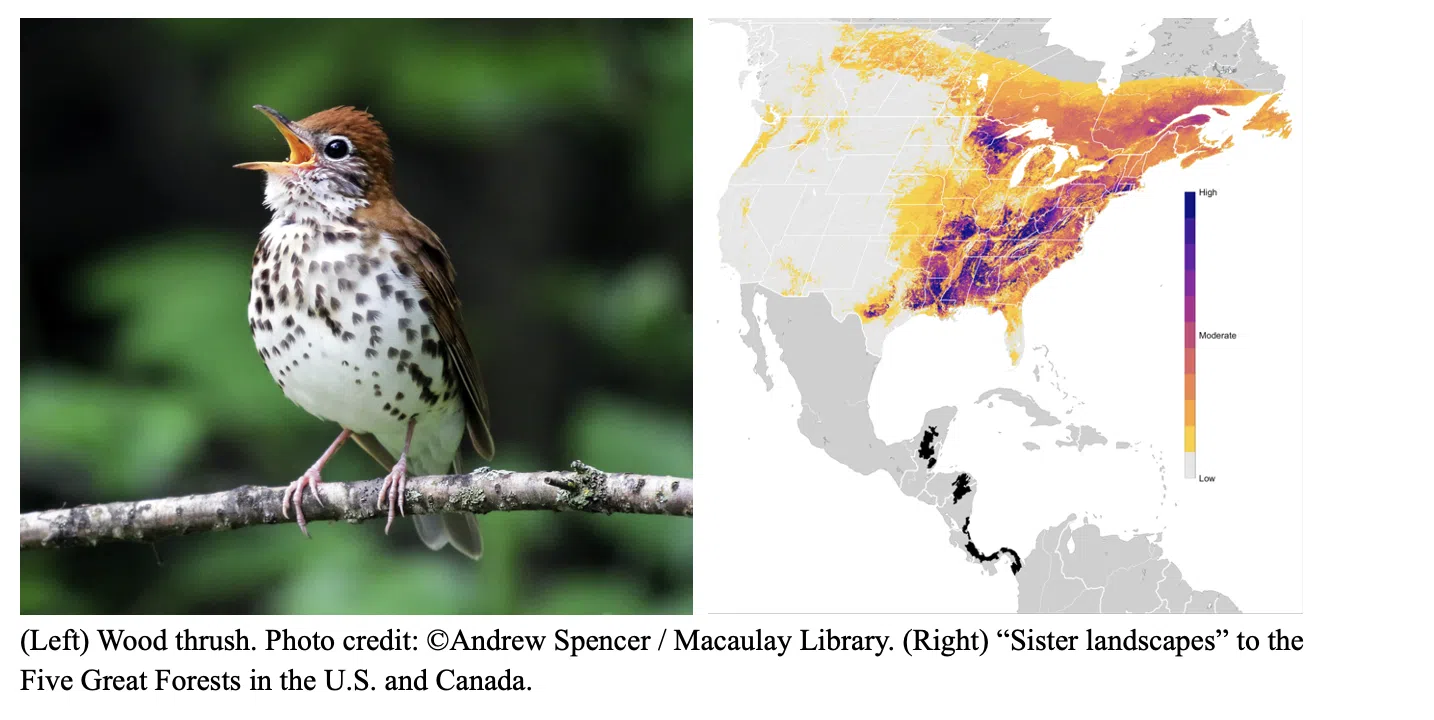
The Five Great Forests —Maya Forest, Mosquitia, Indio Maíz-Tortuguero, La Amistad, and Darién— form a living bridge the size of Virginia. They are home not only to migratory birds but also to jaguars, scarlet macaws, and tapirs.
“Every fall, billions of birds migrate south through the narrow land bridge of Central America,” noted Viviana Ruiz Gutiérrez from the Cornell Lab.
The density of birds concentrated in these jungles is so high that each protected hectare safeguards a disproportionate number of species.
Threats and conservation efforts
Deforestation is advancing rapidly: in the Mosquitia, nearly a third of the forest has been cut down in just two decades.
“If we lose the last great forests of Central America, we will lose the birds that define our eastern forests in North America,” warned Jeremy Radachowsky, WCS regional director.
In the face of this threat, indigenous and local communities are leading efforts to:
- Restore degraded lands.
- Combat forest fires.
- Promote sustainable livelihoods such as cacao and allspice production.
These forest guardians risk their lives to protect vital habitats but need international support.
Hemispheric connections
The study applied a framework from Partners in Flight and the Cornell Lab to track “management connections.” These are regions in North America where species that depend on the Five Great Forests for breeding are concentrated.
Researchers identified links with the Appalachians, the Mississippi Delta, the Great Lakes, New England, and New York, forming “sister landscapes” connected by the same birds at different times of the year.
In essence, the Five Great Forests are the tropical reflection of the eastern forests of North America, hosting the same community of migratory birds during the winter months.
Protecting to ensure the return of the songs
Each protected hectare in Central America has positive repercussions for birds and people throughout the hemisphere. The forests that support thrushes and warblers also sustain human communities.
“If you love watching your birds every spring, we invite you to discover the tropical forests they call home for most of the year and help us protect them,” concluded Lello-Smith.



