



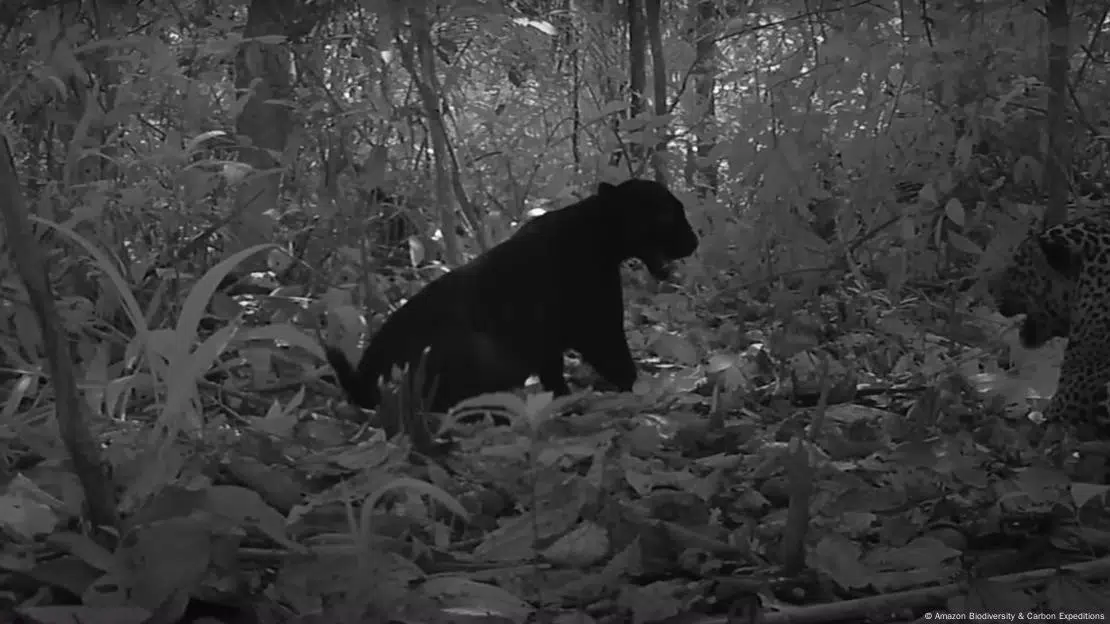
A group of scientists achieved a historic milestone by recording for the first time in its natural habitat the mating of a wild black jaguar or melanistic jaguar. Popularly known as black panther, the animal was in the heart of the Brazilian Amazon.
This event, documented in the journal Ecology and Evolution, is the first of its kind recorded in wild jaguars.
The footage was recorded in September 2023 in the Serra do Pardo National Park, during the Amazon Biodiversity and Carbon (ABC) expedition. The video captured a female black panther and a male jaguar with spotted fur, a courtship moment that had only been observed in captivity until now.
Jaguars in nature: a challenge for science
The jaguar (Panthera onca) is a solitary and elusive feline. Its evasive nature and the vastness of its territories make its reproductive behavior nearly impossible to study.
“We hit the jackpot and captured the first video of a black panther mating with a spotted male in the wild,” stated Carlos Peres, co-author of the study and expert from the University of East Anglia (UEA).
A “camouflage” behavior to protect the cubs
An intriguing detail of the discovery was the possible “false” receptivity of the female. Researchers observed that the black panther showed signs of lactation, suggesting that it could have been employing a “pseudestrus” strategy.
This behavior of “concealment and flirtation” helps protect the cubs by confusing males.
“It’s a possibility that we can’t rule out,” commented Dr. Thomas Luypaert from the Norwegian University of Life Sciences (NMBU).
Melanism and conservation: valuable clues
Melanism, the genetic mutation that produces black fur, is more common in humid environments like the Amazon. Although its exact role in reproductive success is still uncertain, this finding provides key data.
In addition to its scientific value, the recordings offer valuable information for conservation programs. “Understanding how jaguars behave in their natural environment is essential to improve breeding programs worldwide,” emphasized Luypaert.
This milestone underscores the importance of camera traps in researching elusive species, demonstrating that they are a revolutionary tool for the study of wildlife. This video not only expands our knowledge about jaguars but also highlights how much there is still to discover about wildlife in the Amazon.



