



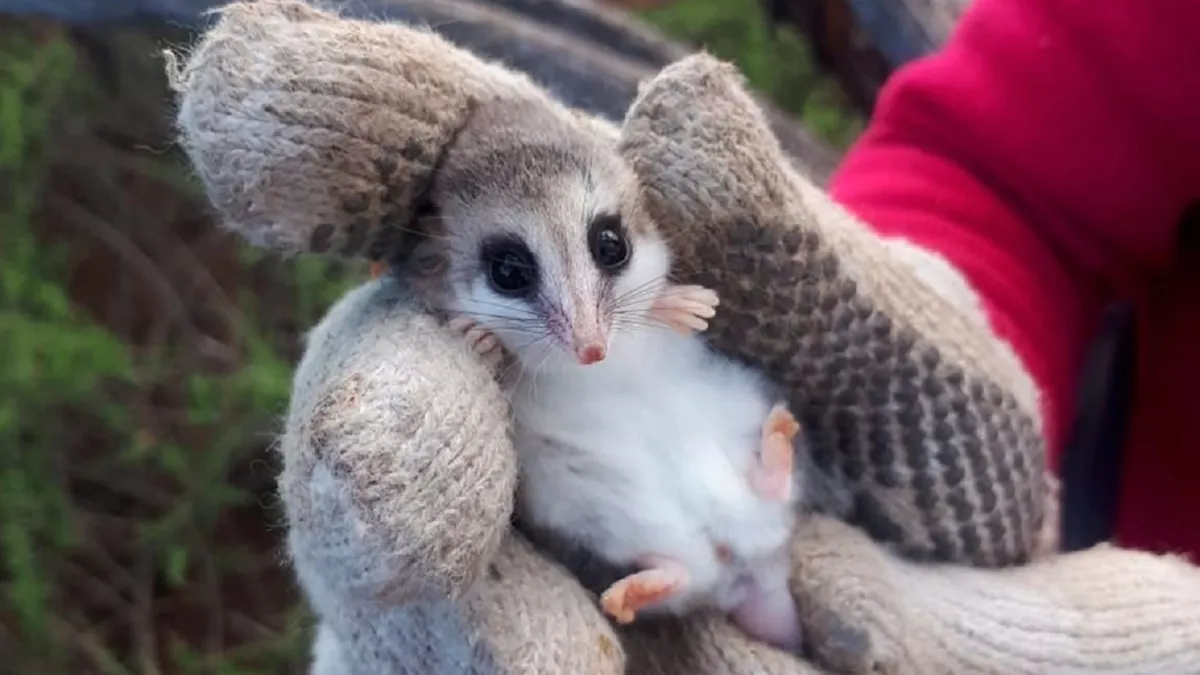
Las marmosas are small marsupials that inhabit different regions of South America, including Argentina, where they are mainly distributed in arid and semi-arid environments.
In the country, six species are recognized, two of which are found in Mendoza: Thylamys pallidior and Thylamys bruchi. These animals can live both on the ground and in trees, adapting to different landscape conditions.
Distinctive Features
Marmosas have particular characteristics:
- Soft, tricolored fur.
- Large ears and small feet with an opposable thumb.
- Prehensile tail, which facilitates movement in trees.
Among the species, differences are observed in coloration pattern, size, skull morphology, and genetic sequence. Unlike other marsupials like the common opossum, marmosas do not have a pouch, so the young do not have the typical pouch of this group.
Research in Mendoza
The Integrative Ecology of Wildlife Group at IADIZA (CONICET-UNCUYO-Gob. Mza.), led by researchers Paola Sassi and Soledad Albanese, studies the biology of marmosas. Doctoral fellow Rosarito Sánchez Dómina emphasizes that the available information is often scarce and focused on taxonomic aspects, making it crucial to delve into their ecology and physiology.
A significant finding is that species like Thylamys bruchi exhibit an uncommon reproductive strategy: they reproduce only once in their lifetime and then die. Survival depends on birth and weaning coinciding with the period of greatest food abundance, allowing them to accumulate reserves to face the winter.
Life Cycle and Diet
Marmosas are omnivorous-insectivorous: they mainly consume arthropods and, to a lesser extent, plants and fruits.
- The gestation is brief and development continues outside the womb.
- The lactation is extensive: the young remain attached to the mother’s nipple in their early stages.
- Upon independence, adults accumulate fat at the base of the tail, allowing them to survive during times of scarcity.
- In spring and summer, the last stage of their life cycle begins: reproduction.
Vulnerability to Climate Change
Current environmental changes, especially the intensification of droughts, can disrupt the synchrony between reproduction and food availability.
Unlike other small mammals like rodents, marmosas have little reproductive flexibility, making them more vulnerable to climate variability.
Ecological Role
Marmosas play key roles in ecosystems:
- Natural controllers of insects and arachnids, thanks to their insectivorous habits.
- Prey for other animals such as foxes, wild cats, snakes, and birds of prey.
This dual role makes them fundamental pieces for maintaining ecological balance.
The study of marmosas in Argentina, and particularly in Mendoza, is essential to understand the dynamics of arid and semi-arid ecosystems.
Their unique biology, vulnerability to climate change, and role as insect controllers and prey for predators underscore the need to promote their conservation and that of the environments they inhabit.

